
Professional Development Factors Test
How the Scales are Structured
Who Usually Takes This Test?
See How You Compare
Below is a preview of how scores are typically distributed across each scale.
Example Questions From the Test
- Disagree
- Rather disagree
- Rather agree
- Agree
- Disagree
- Rather disagree
- Rather agree
- Agree
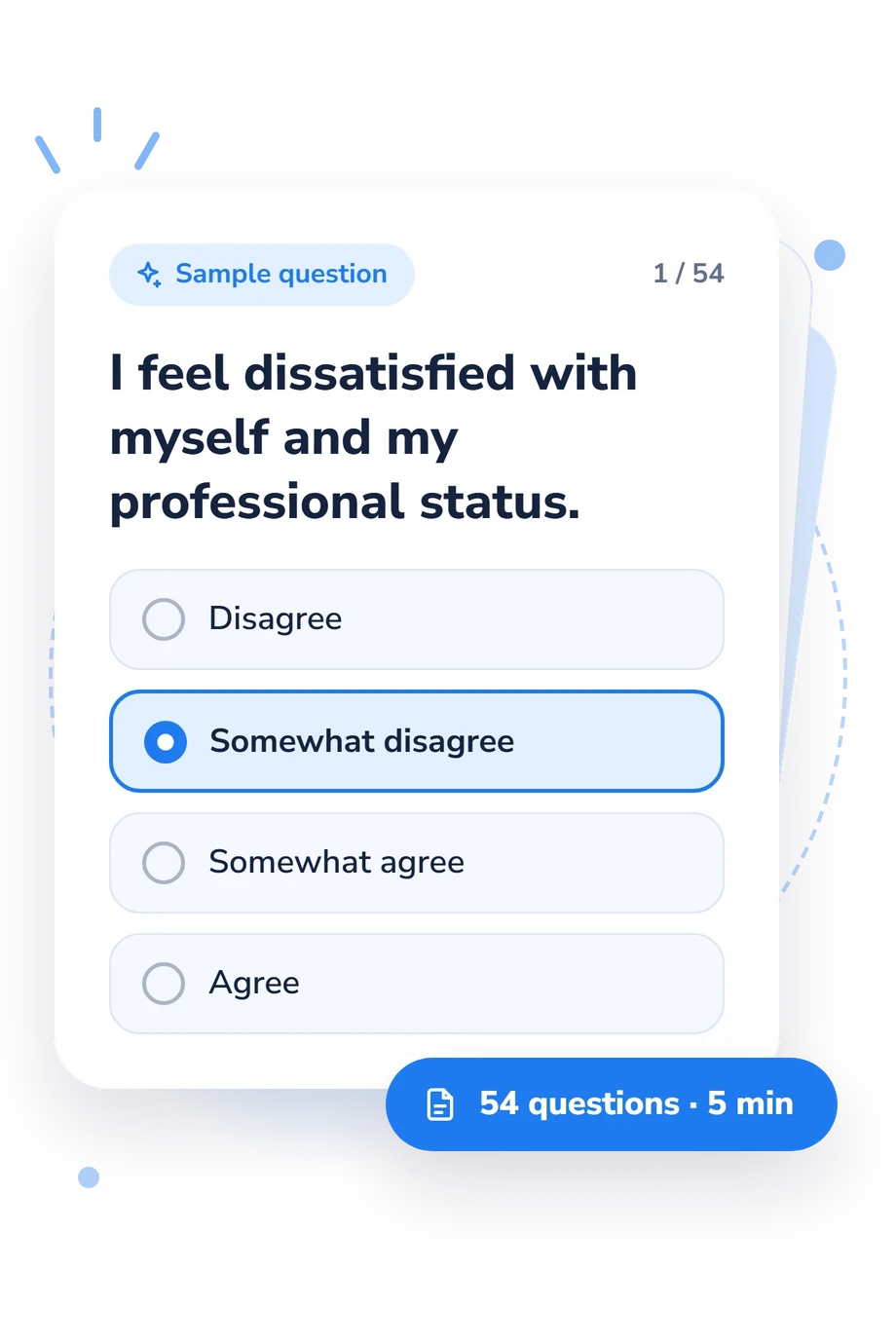
- Disagree
- Somewhat disagree
- Somewhat agree
- Agree
Professional Development Factors Test - Description and methodology of the test
People seeking a clearer view of their working life can use the Professional Development Factors Test to examine motivation, satisfaction, self-regulation, and resilience alongside one another. This professional development assessment suits readers considering their current direction, workplace experience, or next career step. Its profile points to established resources and areas that may benefit from deliberate attention.
What This Assessment Explores
It assesses direction, self-regulation, and energy. Items cover goals, meaning, colleagues, conflict, health, rest, and learning. These career development factors describe a pattern.
The profile presents six displayed results: five component scales and one overall index:
- Professional Self-Realization (8-32) reflects meaning, goals, satisfaction, sharing; Low 8-20, Moderate 21-27, High 28-32.
- Behavioral Self-Control (4-16) reflects regulation, conflict handling; Low self-control 4-10, Moderate self-control 11-14, High self-control 15-16.
- Job Satisfaction (7-28) reflects expectation-reality fit; Low satisfaction 7-18, Moderate satisfaction 19-24, High satisfaction 25-28.
- Psychophysiological Capacity (9-36) reflects recovery, resilience; Low 9-22, Moderate 23-28, High 29-36.
- Goal Orientation (7-28) reflects career aims and growth; Low 7-18, Moderate 19-24, High 25-28.
- Overall Professional Development Factors (27-108) integrates growth, adaptation; Needs support 27-76, Developing 77-93, Strong 94-108.
Methodology and Scientific Basis
Each statement uses a four-point agreement scale, from Disagree through two intermediate choices to Agree. Items cover constructive and difficult situations, including planning, self-improvement, conflict, exhaustion, health concerns, and doubts about achievement. Responses are combined into the displayed dimensions and overall index; ranges do not show how many points each answer contributes.
Petrash’s 2011 study provides a conceptual source for these domains. Petrash (2016) relates professional-development factors to psychological well-being. Super’s (1980) life-span, life-space approach offers a framework in which career development changes across roles and experiences. This online questionnaire is conceptually consistent with these works, while its scoring is specific to this version.
The profile functions as a professional growth test, showing where motivation, satisfaction, regulation, or stamina deserve attention. Its displayed bands are specific to this questionnaire, while the overall index integrates the component areas; because no normative sample or reliability coefficients are specified for this version, self-report results may shift with mood, workload, health, recent events, and self-awareness.
- Petrash, M. D. (2011). Psychological Content and Factors of Incipient Professional-Development Crises at the Early Stages of Professional Activity. Experimental Psychology (Russia), 4(4), 88-100.
- Petrash, M. D. (2016). Factors of Professional Development in Adults with Different Levels of Psychological Well-Being. International Research Journal, 1(43). 10.18454/IRJ.2016.43.010
- Super, D. E. (1980). A Life-Span, Life-Space Approach to Career Development. Journal of Vocational Behavior, 16(3), 282-298. 10.1016/0001-8791(80)90056-1
Updated: