
Self-Determination Scale (SDS) Test
How the Scales are Structured
Who Usually Takes This Test?
See How You Compare
Below is a preview of how scores are typically distributed across each scale.
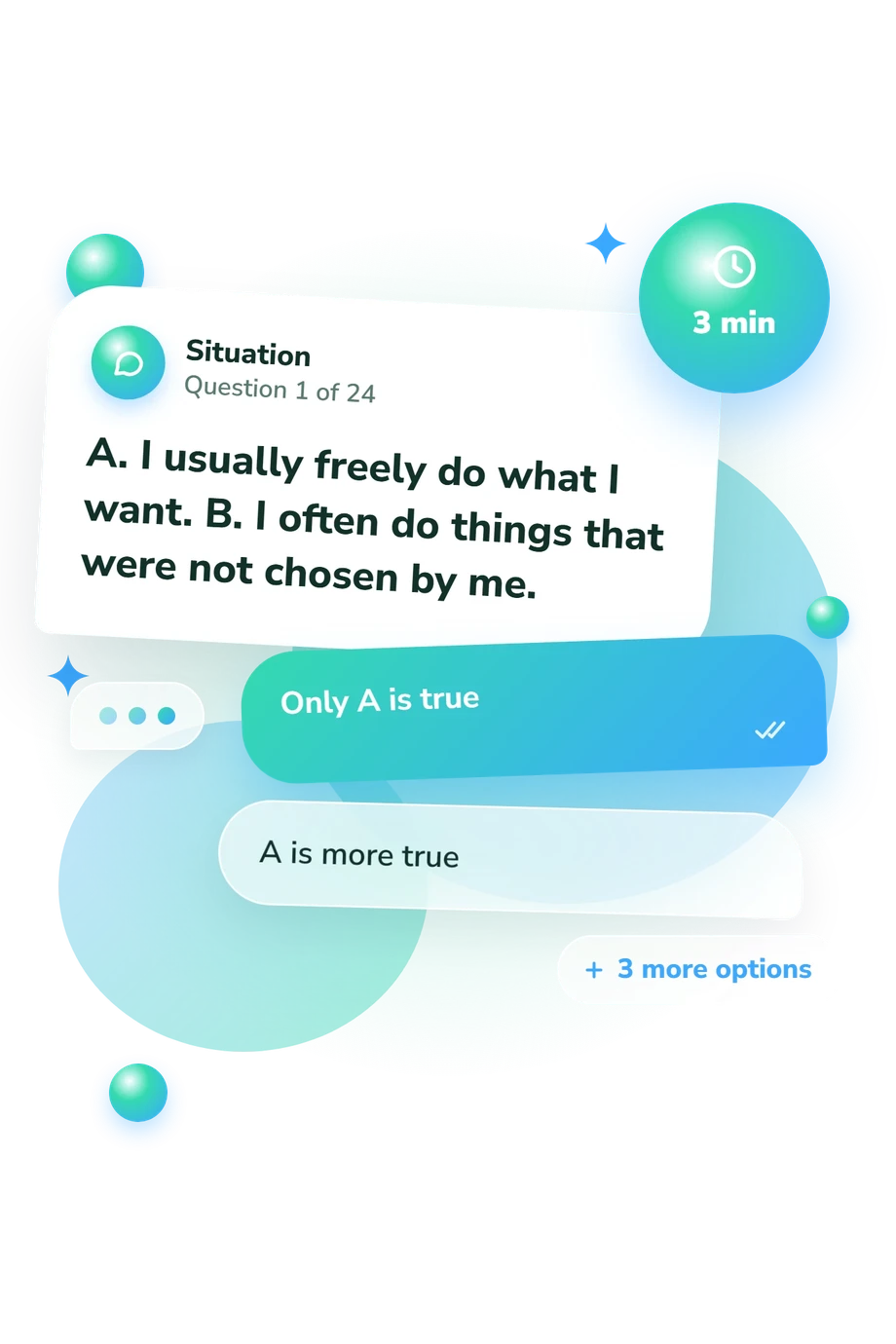
Example Questions From the Test
- Only statement A is true
- Statement A is more true
- Both statements are partly true
- Statement B is more true
- Only statement B is true
- Only statement A is true
- Statement A is more true
- Both statements are partly true
- Statement B is more true
- Only statement B is true
- Only statement A is true
- Statement A is mostly true
- Both statements are partly true
- Statement B is mostly true
- Only statement B is true
Self-Determination Scale (SDS) Test - Description and methodology of the test
For readers examining whether daily choices feel genuinely their own, the Self-Determination Scale (SDS) Test offers a structured way to reflect on everyday decisions. This autonomy assessment helps identify where actions feel self-directed, expressive, or disconnected from inner values. The profile can help readers examine how everyday experiences of choice shape their actions.
What This Assessment Explores
Paired statements examine chosen, meaningful, expressive actions and alignment with inner values. The test suits anyone reflecting on agency in everyday decisions. Its autonomy profile shows whether contributions feel significant and abilities realized, rather than assigning a fixed personality label.
The four result dimensions are:
- Self-Expression (1-5) measures meaningful contribution and realized ability: Low self-expression (1-2.4), Moderate self-expression (2.5-3.4), High self-expression (3.5-5).
- Perceived Choice (1-5) measures freedom to make independent decisions: Low perceived choice (1-2.4), Moderate perceived choice (2.5-3.6), High perceived choice (3.7-5).
- Authenticity (1-5) measures alignment between inner ideals and behavior: Low authenticity (1-2.4), Moderate authenticity (2.5-3.6), High authenticity (3.7-5).
- Self-Determination Index (1-5) measures autonomy and intrinsic motivation in defining goals and actions: Low autonomy (1-2.4), Moderate autonomy (2.5-3.6), High autonomy (3.7-5).
Methodology and Scientific Basis
Each item presents two contrasting statements, such as acting from personal choice versus doing what others require. The respondent selects one of five positions: one statement only, both partly, or a stronger fit for one side. This comparative format captures direction and degree without a simple yes-or-no answer.
The self-determination questionnaire displays four 1-5 scales; the documented response format does not specify how individual answers are combined into those scores, and it reports four dimensions rather than a single clinical judgment. The 12-item online questionnaire is conceptually consistent with Sheldon's Self-Determination Scale and Ryan and Deci's self-determination theory; this does not establish it as an adaptation, validated version, or standardized version of either source. Its result can reflect autonomy and intrinsic motivation as experienced-whether motivation feels internally endorsed or imposed by circumstances-without extending the displayed dimensions to competence or well-being.
No population norms or clinical cutoffs are supplied, so the bands are descriptive. Self-report means current context, self-awareness, memory, and impression management may influence the profile; use it as one perspective on lived experience rather than a diagnosis.
- Sheldon, K. M. (1995). Creativity and Self-Determination in Personality. Creativity Research Journal, 8(1), 25-36. 10.1207/s15326934crj0801_3
- Sheldon, K. M., Ryan, R. M., & Reis, H. T. (1996). What Makes for a Good Day? Competence and Autonomy in the Day and in the Person. Personality and Social Psychology Bulletin, 22(12), 1270-1279. 10.1177/01461672962212007
- Ryan, R. M., & Deci, E. L. (2000). Self-Determination Theory and the Facilitation of Intrinsic Motivation, Social Development, and Well-Being. American Psychologist, 55(1), 68-78. 10.1037/0003-066X.55.1.68
Updated: