
Self and Interpersonal Functioning Scale (SIFS) Test
How the Scales are Structured
Who Usually Takes This Test?
See How You Compare
Below is a preview of how scores are typically distributed across each scale.
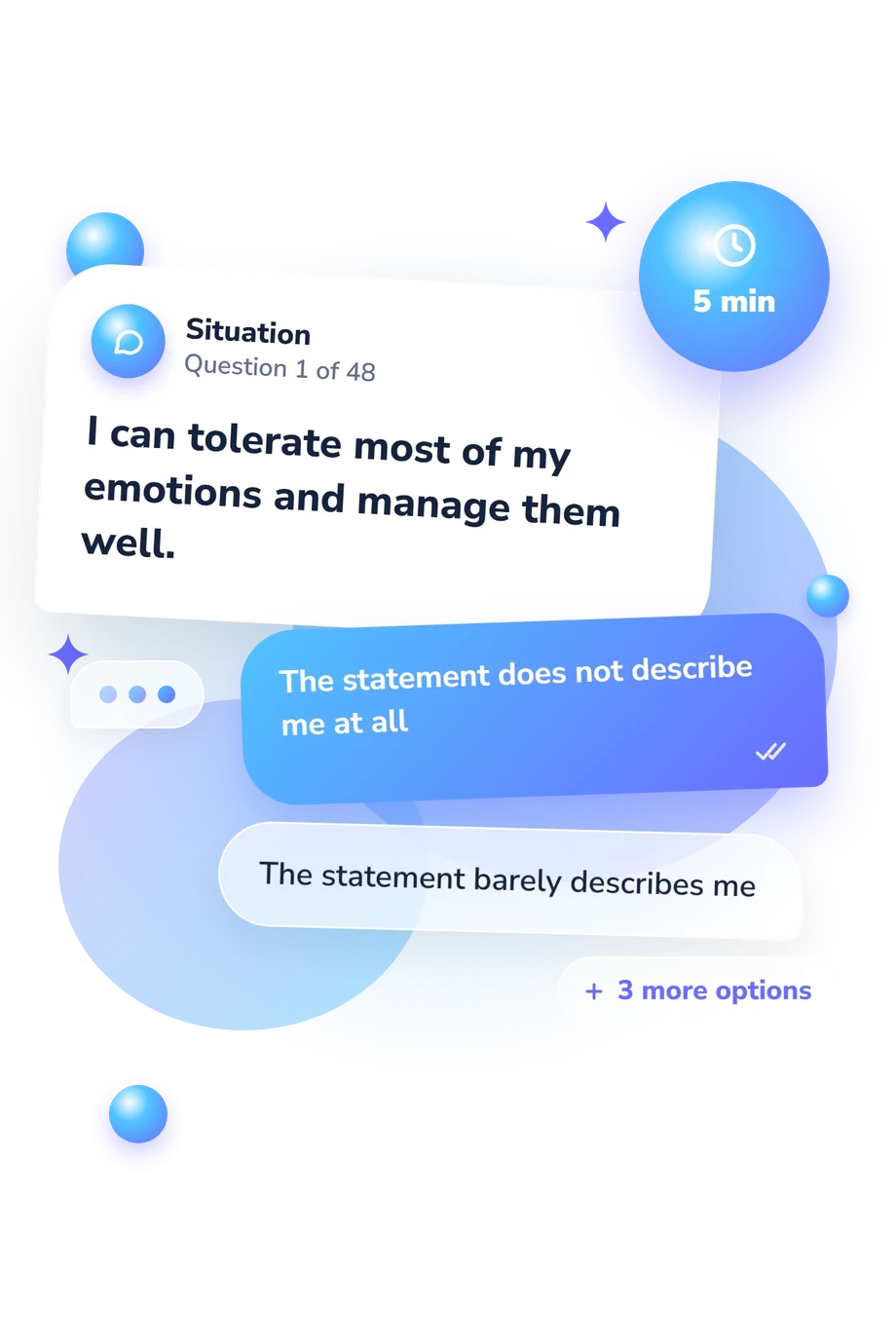
Example Questions From the Test
- The statement does not describe me at all
- The statement barely describes me
- The statement moderately describes me
- The statement largely describes me
- The statement completely describes me
- The statement does not describe me at all
- The statement barely describes me
- The statement moderately describes me
- The statement largely describes me
- The statement completely describes me
- The statement does not describe me at all
- The statement barely describes me
- The statement moderately describes me
- The statement largely describes me
- The statement completely describes me
Self and Interpersonal Functioning Scale (SIFS) Test - Description and methodology of the test
People who want a structured view of how they experience themselves and relate to others may use the Self and Interpersonal Functioning Scale (SIFS) Test to examine patterns in identity, emotions, goals, and relationships. It focuses on personality functioning in emotional, goal-directed, and relational experiences. A self and interpersonal functioning questionnaire can help readers notice areas that feel secure, inconsistent, or difficult, while keeping the result descriptive rather than diagnostic.
What This Assessment Explores
A personality functioning test covers identity, emotions, goals, empathy, trust, and closeness. The dimensions are:
- Need for Trusting Relationships (0-4) measures depth, stability, intimacy, mutual respect; Low need for trust 0-1.3; Moderate need for trust 1.4-2.5; High need for trust 2.6-4.
- Empathy (0-4) assesses understanding and respect for others’ feelings, motivations, and one’s impact; Low 0-1.3; Moderate 1.3-2.5; High 2.5-4.
- Self-Direction (0-4) measures goals, standards, and reflection; Low self-direction 0-1.9; Moderate self-direction 1.9-2.5; High self-direction 2.5-4.
- Self-Awareness (0-4) measures individuality, self-esteem, and regulation; Low 0-1.9; Moderate 1.9-2.5; High 2.5-4.
- Severity Index (0-4) reflects dysfunction severity; higher indicates greater impairment; lower, less; Mild 0-1.9; Moderate 1.9-2.5; High 2.5-4.
Methodology and Evidence Base
Each item is a first-person statement rated from 1 (does not describe me at all) to 5 (completely describes me). The content covers patterns in emotions, identity, values, goals, empathy, disagreement, closeness, trust, and relationship stability.
The questionnaire reports scores through bands. It does not specify item-by-item point contributions, a reverse-scoring procedure, or the conversion from 1-5 responses to 0-4 scores, so readers should interpret the profile as a pattern of tendencies rather than reconstructing a scoring formula.
Its conceptual anchor is SIFS (Gamache et al., 2019), a self-report measure developed for DSM-5 personality functioning. Gamache et al. (2021) examined links between SIFS scores and ICD-11 severity degrees, while Macina et al. (2024) evaluated a German version’s psychometric properties. This online version is conceptually consistent with that work, not presented as a direct adaptation or normed replication.
As an interpersonal functioning assessment, it supports self-reflection, while responses can shift with context, self-awareness, and response bias. The result is a snapshot: the bands describe the displayed level of each dimension, but they cannot establish its cause, duration, or impact across every setting.
- Gamache, D., Savard, C., Leclerc, P., & Côté, A. (2019). Introducing a short self-report for the assessment of DSM-5 level of personality functioning for personality disorders: The Self and Interpersonal Functioning Scale. Personality Disorders: Theory, Research, and Treatment, 10(5), 438-447. 10.1037/per0000335
- Gamache, D., Savard, C., Leclerc, P., Payant, M., Berthelot, N., Côté, A., Faucher, J., Lampron, M., Lemieux, R., Mayrand, K., Nolin, M.-C., & Tremblay, M. (2021). A Proposed Classification of ICD-11 Severity Degrees of Personality Pathology Using the Self and Interpersonal Functioning Scale. Frontiers in Psychiatry, 12, 628057. 10.3389/fpsyt.2021.628057
- Macina, C., Kerber, A., Zimmermann, J., Ohse, L., Kampe, L., Mohr, J., Walter, M., Hörz-Sagstetter, S., & Wrege, J. S. (2024). Evaluating the Psychometric Properties of the German Self and Interpersonal Functioning Scale (SIFS). Journal of Personality Assessment, 106(6), 711-723. 10.1080/00223891.2023.2268199
Updated: