
Morisky-Green Medication Adherence Scale Test
How the Scales are Structured
Who Usually Takes This Test?
See How You Compare
Below is a preview of how scores are typically distributed across each scale.
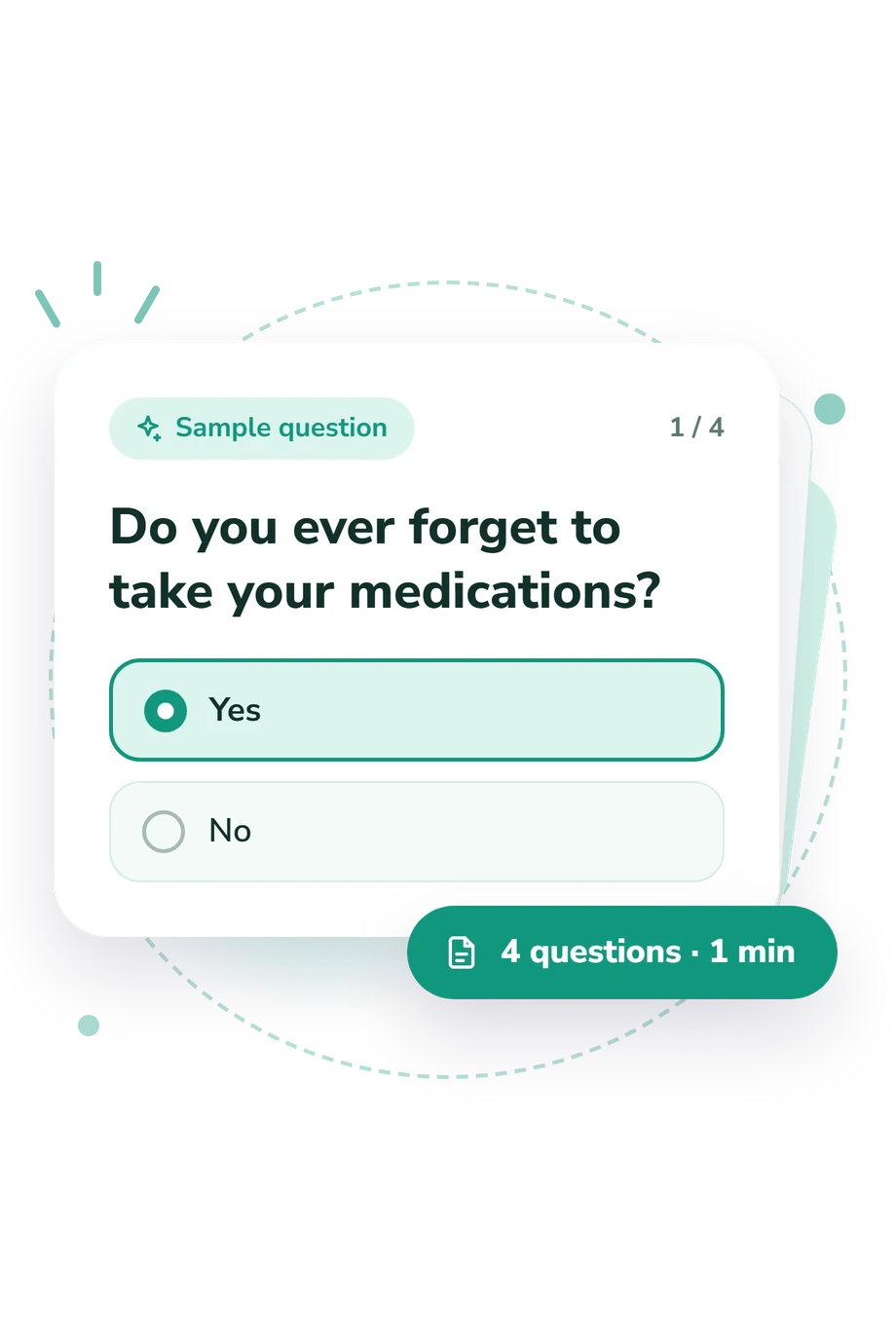
Example Questions From the Test
- Yes
- No
- Yes
- No
- Yes
- No
Morisky-Green Medication Adherence Scale Test - Description and methodology of the test
For people who want to examine how reliably they follow a prescribed treatment plan, the Morisky-Green Medication Adherence Scale Test offers a focused self-report snapshot. It is suitable for people reviewing everyday medication habits, including missed doses, timing problems, and decisions made when symptoms or side effects change. As a medication adherence test, it summarizes adherence patterns rather than explaining every reason behind them.
What This Assessment Explores
The questionnaire examines adherence as behavior: whether prescribed medicine is taken consistently at the intended times and despite changes in how a person feels. It suits someone who wants a focused view of routine reliability.
Four prompts address common disruptions: forgetting a dose, careless timing, stopping after improvement, and skipping after feeling worse. On the Medication Adherence scale (0-4), results appear as Low adherence (0-2), Insufficient adherence (3-3), or High adherence (4-4). The scale reflects how closely reported behavior follows recommendations about dose and timing.
The question themes show what the result summarizes:
- Forgetting doses shows whether routines break down through missed medication.
- Timing care shows consistency with prescribed times.
- Feeling better shows whether improvement leads to stopping early.
- Feeling worse shows whether unpleasant effects lead to skipping the next dose.
Methodology and Evidence Base
Each item uses a Yes-or-No response about a concrete treatment situation. The questionnaire reports the displayed result categories, but it does not state how individual answers contribute points. Scores should therefore be read through those categories rather than an assumed item-by-item rule.
The method is a brief self-report questionnaire. This questionnaire is an online presentation of the four-item Morisky-Green-Levine measure. The 1986 Morisky-Green-Levine study introduced the original scale, and the ARIC study by Beyhaghi and colleagues examined the four-item version. Those publications give the measure a traceable evidence context, while the results remain the displayed adherence categories.
In this format, a four-item medication adherence questionnaire captures reported behavior rather than observed pill-taking. Memory, honesty, current symptoms, side effects, routines, and medication access can shape answers. The result describes a reported pattern at that moment; it does not identify the cause of missed doses or determine whether treatment is clinically appropriate.
- Morisky DE, Green LW, Levine DM. Concurrent and predictive validity of a self-reported measure of medication adherence. Medical Care. 1986;24(1):67-74. 10.1097/00005650-198601000-00007
- Beyhaghi H, Reeve BB, Rodgers JE, Stearns SC. Psychometric Properties of the Four-Item Morisky Green Levine Medication Adherence Scale among Atherosclerosis Risk in Communities (ARIC) Study Participants. Value in Health. 2016;19(8):996-1001. 10.1016/j.jval.2016.07.001
Updated: