
Freudly+971 508685814hello@freudly.ai
Freudly
sexism

Ambivalence Toward Men Inventory (AMI) Test
Take the online Ambivalence Toward Men Inventory (AMI) Test - AI psychologist FreudlyYou can take Ambivalence Toward Men Inventory (AMI) Testhere. Online version of a simple and accurate psychological test with interpretation.en
Understand mixed feelings toward men in just 4 minutes, including warmth and hostility. Get a quick, research-based snapshot that supports counseling, research, and healthier relationships.
Start Online Test
Questions: 204 minutes
08:30
October 2, 2025
October 2, 2025
Material has been updated
October 2, 2025
Material has been published
21,081 view
2,016 completions
1,675 likes
Verified by Daniel Hall
Psychologist with 25 years of experience
Share
Scale Explorer

How the Scales are Structured

example score
3/5
Heterosexual Hostility (HH)
Heterosexual Hostility measures the extent to which a person believes men tend to dominate women in romantic and sexual relationships.
Low
Moderate
High
01.6: Low | 1.73.3: Moderate | 3.45: High
A score of 3 falls in the Moderate range, suggesting a noticeable but not extreme tendency to view men as dominating in heterosexual relationships.
example score
2/5
Heterosexual Intimacy (HI)
Measures the extent to which someone believes a woman’s life cannot be complete without a man.
Low endorsement
Moderate endorsement
High endorsement
01: Low endorsement | 23: Moderate endorsement | 45: High endorsement
A score of 2 suggests a moderate tendency to view having a man as important for a woman’s life to feel complete.
example score
2/5
Complementary Gender Differentiation (CGD)
Measures the extent to which a person endorses traditional complementary views of men as protectors and providers who take risks for women.
Low endorsement
Moderate endorsement
High endorsement
01.6: Low endorsement | 1.73.3: Moderate endorsement | 3.45: High endorsement
A score of 2 indicates moderate endorsement of complementary gender differences, suggesting some agreement with protector/provider expectations for men without strongly relying on them.
example score
2/5
Maternalism (M)
Maternalism measures the extent to which someone believes men need women’s care and guidance in domestic life.
Low
Moderate
High
01: Low | 23: Moderate | 45: High
A score of 2 indicates a moderate tendency to view men as needing women’s care in the domestic sphere, without strongly endorsing this belief.
example score
3/5
Benevolent Attitudes Toward Men (BATM)
Measures the extent of a benevolent, protective-provider view of men that emphasizes warmth, care, and complementary gender roles.
Low
Moderate
High
01.6: Low | 1.73.3: Moderate | 3.45: High
A score of 3 falls in the Moderate range, suggesting a noticeable but not dominant tendency to view men positively as protectors/providers and to value caring, complementary roles.
example score
2/5
Compensatory Gender Differentiation (CGD)
Measures the extent to which someone believes men cannot handle household tasks without women’s help.
Low endorsement
Moderate endorsement
High endorsement
01.6: Low endorsement | 1.73.3: Moderate endorsement | 3.45: High endorsement
A score of 2 falls in the Moderate endorsement range, suggesting a somewhat mixed but noticeable tendency to view men as needing women’s assistance with household tasks.
example score
2/5
Hostile Paternalism (HP)
Measures endorsement of the belief that men seek greater societal power over women.
Low
Moderate
High
01.6: Low | 1.73.3: Moderate | 3.45: High
A score of 2 falls in the Moderate range, suggesting a mixed or occasional endorsement of the idea that men strive for greater power in society than women.
example score
3/5
Hostility Toward Men (HTM)
Measures the degree of negative, distrustful attitudes toward men associated with perceived dominance and power in society and intimate relationships.
Low
Moderate
High
01.6: Low | 1.73.3: Moderate | 3.45: High
A score of 3 falls in the Moderate range, suggesting a noticeable but not extreme tendency to view men negatively in terms of dominance, power, and related gender-role expectations.
Start Online Test
just completed the test
DATA-BASED USER COHORTS

Who Usually Takes This Test?

Women in relationships
41%OF USERS
Women who notice mixed feelings toward men and want to understand how those contradictions affect dating, partnership, and boundaries.
Therapy and counseling clients
34%OF USERS
People working through trust, resentment, or past experiences who use the results to name and discuss ambivalent attitudes toward men.
Gender attitudes researchers
25%OF USERS
Students and professionals in psychology or sociology who need a quick measure of warm and hostile views toward men for studies or surveys.
BASED ON AGGREGATED, ANONYMIZED DATA FROM TENS OF THOUSANDS OF FREUDLY USERS.
Benchmarking

See How You Compare

Once you complete the test, your results are compared with real-world data from people in your country.
Below is a preview of how scores are typically distributed across each scale.
Heterosexual Hostility (HH)
Average
2
Normal range
1.12.9
min.
0
max.
5
This curve shows how scores are typically distributed.
Once you complete the test, your result will appear on the scale so you can see how you compare.
Heterosexual intimacy (Hi)
Average
2.2
Normal range
1.33
min.
0
max.
5
This curve shows how scores are typically distributed.
Once you complete the test, your result will appear on the scale so you can see how you compare.
Complementary gender differences. (Cgd)
Average
1.6
Normal range
12.2
min.
0
max.
5
This curve shows how scores are typically distributed.
Once you complete the test, your result will appear on the scale so you can see how you compare.
Maternalism (M)
Maternalism (M)
Average
2.6
Normal range
1.73.5
min.
0
max.
5
This curve shows how scores are typically distributed.
Once you complete the test, your result will appear on the scale so you can see how you compare.
Kind attitude toward men (Katm)
Average
3.2
Normal range
2.53.8
min.
0
max.
5
This curve shows how scores are typically distributed.
Once you complete the test, your result will appear on the scale so you can see how you compare.
Compensatory gender differentiation (Cgd)
Average
2.5
Normal range
1.83.1
min.
0
max.
5
This curve shows how scores are typically distributed.
Once you complete the test, your result will appear on the scale so you can see how you compare.
Hostile paternalism (Hp)
Average
1.4
Normal range
0.52.2
min.
0
max.
5
This curve shows how scores are typically distributed.
Once you complete the test, your result will appear on the scale so you can see how you compare.
Hostility Towards Men (HTM)
Average
3.1
Normal range
2.33.9
min.
0
max.
5
This curve shows how scores are typically distributed.
Once you complete the test, your result will appear on the scale so you can see how you compare.
Featured On
SAMPLE QUESTIONS

Example Questions From the Test

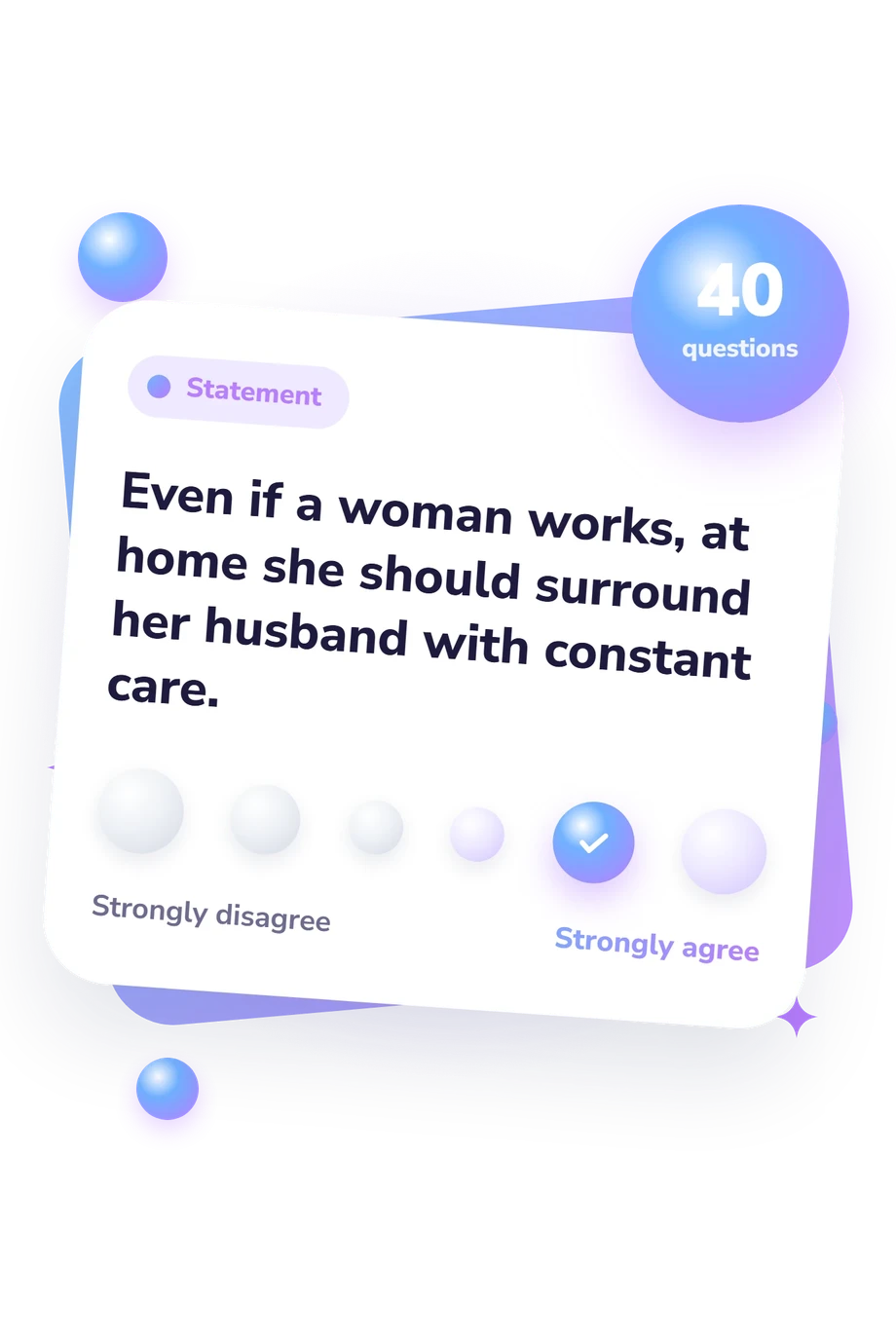
Below is a series of statements about men and women and their relationships in contemporary society. Please indicate the extent to which you agree or disagree with each statement.
    • Strongly disagree
    • Disagree
    • Somewhat disagree
    • Somewhat agree
    • Agree
    • Strongly agree
    • Strongly disagree
    • Disagree
    • Somewhat disagree
    • Somewhat agree
    • Agree
    • Strongly agree
    • Strongly disagree
    • Disagree
    • Somewhat disagree
    • Somewhat agree
    • Agree
    • Strongly agree
WHAT THE TEST MEASURES
About This Assessment
Ambivalence toward Men Scale, AMI Test

Ambivalence Toward Men Inventory (AMI) Test - Symptoms and Signs

sexism

This measure is designed to assess mixed evaluative attitudes toward men; the Ambivalence Toward Men Inventory (AMI) captures the co-occurrence of subjectively positive and negative appraisals within the same respondent. It is commonly used in research and clinical screening contexts to characterize ambivalent gender-related attitudes that may be relevant to interpersonal perceptions and reactions.

The instrument includes 20 items and typically requires about 4 minutes to complete. Respondents rate brief statements reflecting differing orientations toward men, supporting a profile of attitudinal inconsistency rather than a single unidimensional like-dislike score.

The Ambivalence Toward Men Inventory (AMI) can be used to inform hypothesis generation, treatment planning discussions, or research analyses when gender-related beliefs may be clinically or socially salient. Scores should be interpreted in context, alongside other assessment data and the individual’s cultural and relational background.

Author: Peter Glick, Susan T. Fiske
Literature: Glick, P., & Fiske, S. T. The ambivalence toward men inventory: Differentiating hostile and benevolent beliefs about men. Psychology of Women Quarterly. 1999.; Glick, P., & Fiske, S. T. The ambivalent sexism inventory: Differentiating hostile and benevolent sexism. Journal of Personality and Social Psychology. 1996.
Popular tests
Comments
Leave a Comment