
Altman Self-Rating Mania Scale (ASRM) Test
How the Scales are Structured
Who Usually Takes This Test?
See How You Compare
Below is a preview of how scores are typically distributed across each scale.
Example Questions From the Test
- I have been in my usual mood.
- I have had a more elevated mood than usual sometimes.
- I have had a more elevated mood than usual quite often.
- I have had a more elevated mood than usual most of the time.
- I have had a more elevated mood than usual all the time.
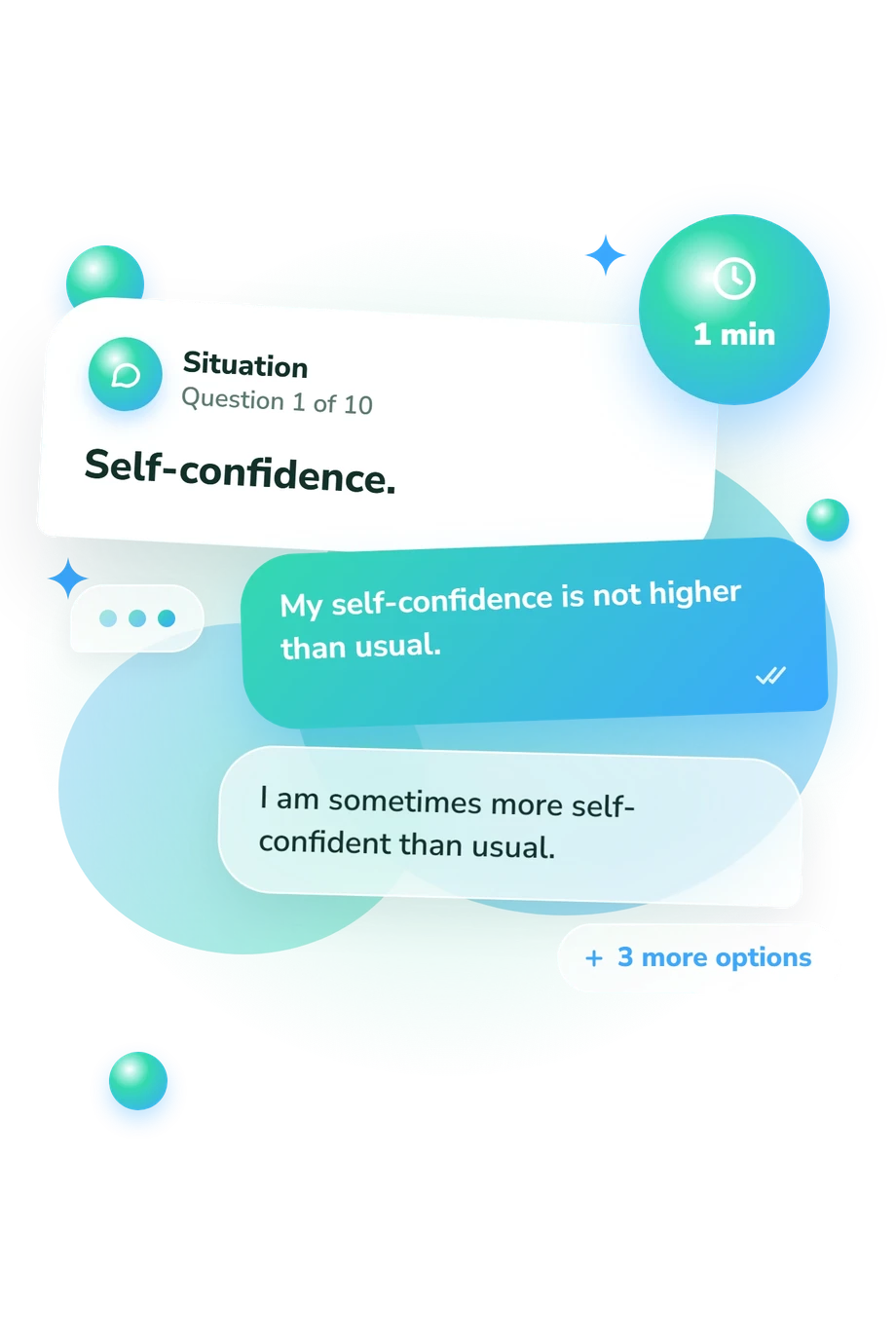
- My self-confidence is not higher than usual.
- I am occasionally more self-confident than usual.
- I am quite often more self-confident than usual.
- In most situations I am more self-confident than usual.
- I am almost always more self-confident than usual.
- I have the same need for sleep as usual.
- I sometimes feel that I need less sleep than usual.
- Quite often, I feel that I need less sleep than usual.
- I often feel that I need less sleep than usual.
- I can go without sleep all day and night and not feel tired.
Altman Self-Rating Mania Scale (ASRM) Test - Description and methodology of the test
People who notice an unusual rise in energy, confidence, activity, or reduced need for sleep may use the Altman Self-Rating Mania Scale (ASRM) Test to organize what they have been experiencing. This brief mania self-assessment is intended for people reflecting on current mood changes, including those monitoring symptoms associated with bipolar or other affective disorders. The result summarizes how strongly manic or hypomanic features are reported.
What This Assessment Explores
The questionnaire functions as a manic symptom assessment, examining changes associated with mania or hypomania by comparing experience with the respondent’s usual pattern. It suits people noticing shifts in mood, confidence, sleep, speech, or activity, including those monitoring symptoms linked with bipolar or other affective disorders.
The Altman Self-Rating Mania Scale runs from 0–20 and estimates manic symptom severity through self-report. Normal range 0–5 is followed by Elevated symptoms 6–20; higher totals suggest more pronounced mania or hypomania and may indicate diagnostic evaluation.
These five areas show what each part contributes:
- Mood indicates whether emotions feel more elevated than usual.
- Self-confidence captures unusually increased confidence and its frequency.
- Sleep need reflects functioning with less sleep.
- Speech tracks increased talking or difficulty being interrupted.
- Activity covers heightened work, sexual, social, or other activity and less need for rest.
Methodology and Evidence Base
Each item offers five ordered response options, moving from the usual state toward more frequent or intense changes. The prompts cover mood, self-confidence, sleep need, speech, and activity, producing a concise overall severity score rather than a diagnostic interview.
For scoring, the questionnaire reports a total score on the Altman scale. Named bands guide interpretation, but no separate item-weighting rule is stated; the result should therefore be read through its reported total and category, with attention to context and persistence.
The item content aligns conceptually with the original ASRM; a later comparison study evaluated that instrument against other self-rating measures for acute mania, and a Korean validation study examined a translated version in a non-clinical sample. Neither study establishes validation for this online presentation or identical norms, reliability, validity, or standardization.
Self-report can be influenced by current circumstances, memory, insight, and response style. A result is best used as a prompt for fuller clinical assessment, not as a diagnosis on its own.
- Altman, E.G., Hedeker, D., Peterson, J.L., Davis, J.M. (1997). The Altman Self-Rating Mania Scale. Biological Psychiatry, 42(10), 948-955. 10.1016/S0006-3223(96)00548-3
- Altman, E.G., Hedeker, D., Peterson, J.L., Davis, J.M. (2001). A comparative evaluation of three self-rating scales for acute mania. Biological Psychiatry, 50(6), 468-471. 10.1016/S0006-3223(01)01065-4
- Kim, B.N., Kwon, S.M. (2017). Initial Psychometric Properties of the Korean Altman Self-Rating Mania Scale: Preliminary Validation Study in a Non-Clinical Sample. Psychiatry Investigation, 14(5), 562-567. 10.4306/pi.2017.14.5.562
Updated: