
YBOCS Test Quiz

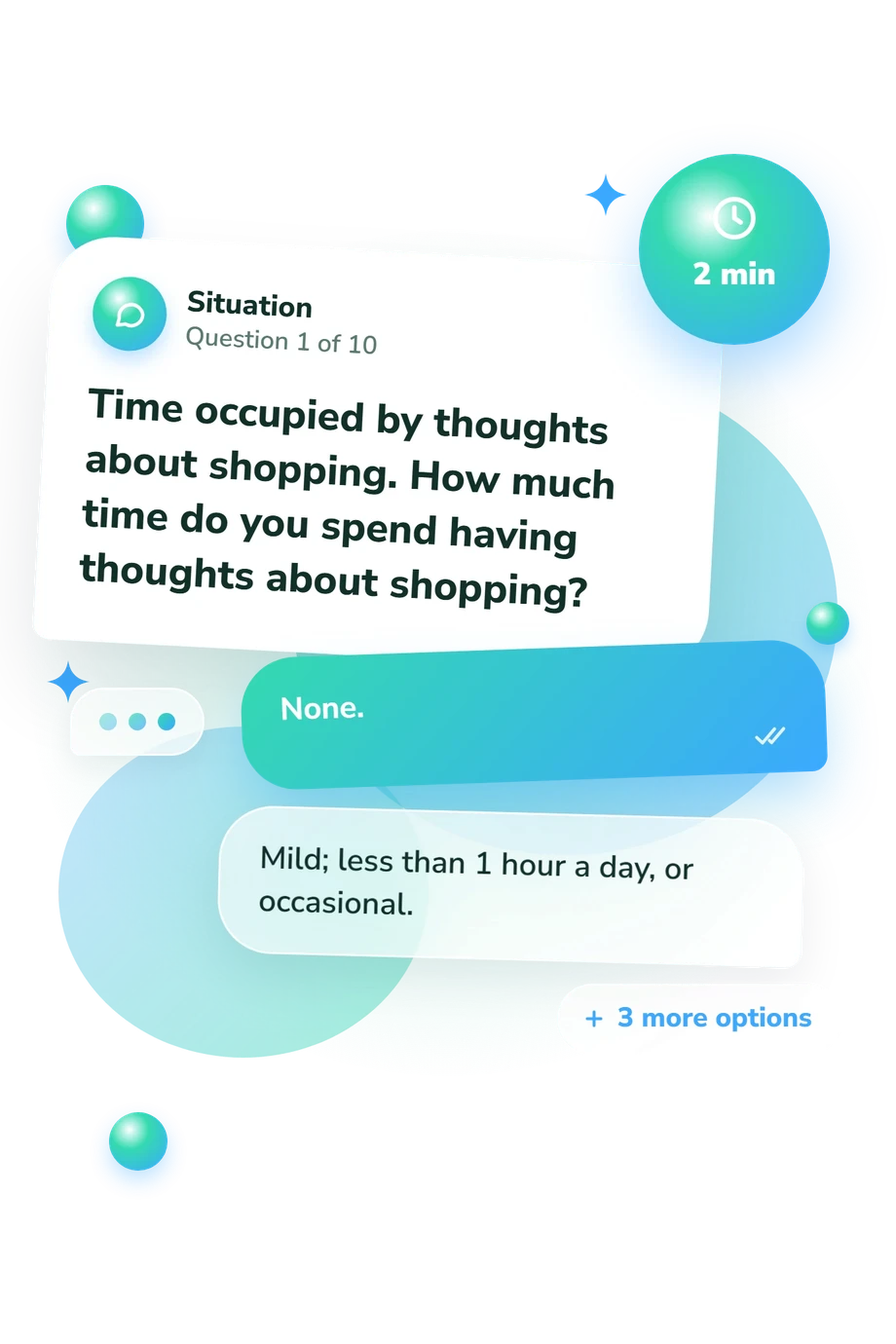
Measure the impact of compulsive shopping on your life in about 2 minutes. This ybocs test captures how intrusive urges and shopping impulses are affecting your daily functioning and decision-making.
Start Online Test
Questions102 minutes
Hi! My name is Freudly, i am an AI therapist, I will give you an interpretation of the test after you complete it.
08:30
October 2, 2025
October 2, 2025
Material has been updated
19,754 views
1,168 completions
990 likes
Verified by Daniel Hall
Psychologist with 25 years of experience
Share
Scale Explorer

How the Scales are Structured

example score
8/20
Thoughts (T)
Measures how frequent and intense intrusive shopping-related thoughts are and how much they interfere with daily functioning.
Low
Moderate
High
06Low713Moderate1420High
A score of 8 falls in the Moderate range, suggesting intrusive shopping thoughts are present at a noticeable level but not at the most severe end of the scale.
example score
21/40
Compulsive Buying Behavior Scale (CBBS)
Measures the severity of compulsive buying thoughts and behaviors and their impact on control and functioning.
Low
Moderate
High
05Low615Moderate1640High
A score of 21 falls in the High range, suggesting more frequent or intense compulsive buying urges with greater difficulty controlling spending and potential negative consequences.
example score
10/20
Behavior (B)
Measures the frequency and controllability of compulsive buying behaviors and how strongly they drive purchasing actions.
Low
Moderate
High
06Low713Moderate1420High
A score of 10 falls in the Moderate range, suggesting noticeable compulsive buying behaviors that can be difficult to control at times.
Start Online Test
just completed the test
DATA-BASED USER COHORTS

Who Usually Takes This Test?

Worried frequent shoppers
44%OF USERS
People who feel their shopping urges are hard to control and want to understand how much the thoughts and behaviors are interfering with daily life.
People in therapy
33%OF USERS
Clients working on compulsive buying who use the questions to track symptom severity and changes in control over time.
Clinicians and researchers
23%OF USERS
Mental health professionals and study teams who screen for compulsive buying symptoms and monitor treatment or research outcomes.
BASED ON AGGREGATED, ANONYMIZED DATA FROM TENS OF THOUSANDS OF FREUDLY USERS.
Benchmarking

See How You Compare

Once you complete the test, your results are compared with real-world data from people in your country.
Below is a preview of how scores are typically distributed across each scale.
Thoughts (T)
Average
10.3
Normal range
6.913.8
min.
0
max.
20
Majority
This curve shows how scores are typically distributed.
Once you complete the test, your result will appear on the scale so you can see how you compare.
Compulsive Buying Behavior Scale (CBBS)
Average
21.6
Normal range
15.527.6
min.
0
max.
40
Majority
This curve shows how scores are typically distributed.
Once you complete the test, your result will appear on the scale so you can see how you compare.
Behavior (B)
Average
7.7
Normal range
4.211.2
min.
0
max.
20
Majority
This curve shows how scores are typically distributed.
Once you complete the test, your result will appear on the scale so you can see how you compare.
Featured On
CLEAR ANSWERS TO COMMON QUESTIONS

Frequently Asked Questions

What exactly does a ybocs test measure?
This screening assesses the severity of compulsive shopping cognitions and behaviors by evaluating how pervasive shopping thoughts are, how much time they consume, the emotional distress they generate, and how much control you maintain over purchasing impulses.
How much time does the assessment require?
Completion typically takes 2 minutes or less. The instrument contains 10 items designed for efficient administration in clinical, occupational, and research settings.
How should I approach answering items on this ybocs test?
Select responses that honestly reflect your recent experience with shopping urges and behaviors. Choose the option that best captures your typical presentation during the past week rather than exceptional circumstances.
What score ranges indicate different severity levels?
Low scores (0-5) reflect minimal compulsive shopping. Moderate scores (6-20) indicate noticeable urges affecting functioning. High scores (21-40) suggest significant compulsive buying impacting wellbeing and daily responsibilities substantially.
Does this ybocs test establish a diagnosis?
No. The assessment measures symptom severity and supports clinical decision-making but does not independently diagnose obsessive-compulsive disorder or compulsive buying disorder. Professional evaluation is required for diagnostic determination.
How useful is this assessment for monitoring treatment progress?
Highly useful. Periodic reassessment provides objective measurement of whether therapy, medication, behavioral strategies, or other interventions are successfully reducing compulsive shopping severity and improving functional capacity.
Is retesting recommended?
Yes. Repeating the assessment monthly or as clinically indicated allows systematic tracking of symptom trajectory and treatment effectiveness over time.
WHAT THE TEST MEASURES
About This Assessment
Yale-Brown Obsessive Compulsive Scale for Compulsive Buying, YBOCS-SV Test

This brief screening instrument quantifies the severity of obsessive-compulsive patterns related to shopping and buying. The ybocs test evaluates how shopping preoccupation, urges, and behaviors interfere with daily life, emotional wellbeing, and functional capacity. Comprised of 10 concise items completed in approximately 2 minutes, it generates a total score reflecting symptom burden. Results support rapid triage, baseline measurement, and tracking of change during treatment or intervention.

Why Take a YBOCS Test

Shopping compulsivity often develops gradually, making it difficult to recognize when behavior has crossed from enjoyable spending into problematic territory. Taking a ybocs test provides objective measurement that helps distinguish normative shopping from compulsive patterns affecting finances, relationships, and psychological wellbeing. Understanding your current severity level supports informed conversations with healthcare providers about whether intervention is needed.

Regular reassessment through this evaluation allows you to monitor whether therapeutic work, behavioral strategies, or medication are successfully reducing the intensity and impact of compulsive buying patterns over time.

What This Assessment Measures

The measure captures key dimensions of shopping-related obsessive-compulsive presentations:

  • Shopping Preoccupation—intrusive thoughts about acquiring items and pervasiveness of shopping urges
  • Time Investment—hours consumed by shopping-related cognitions and behaviors daily
  • Functional Impact—degree to which compulsive shopping interferes with work, relationships, finances, and responsibilities
  • Emotional Burden—anxiety, guilt, shame, or distress accompanying shopping urges and purchasing
  • Behavioral Control—capacity to resist purchasing despite strong urges and awareness of negative consequences

Scores ranging from minimal to severe provide a clear picture of where someone falls on the spectrum of compulsive buying severity.

Who Should Take a YBOCS Test

This assessment serves anyone concerned about whether shopping behavior has become problematic. Users include individuals noticing escalating urges and loss of control over spending, people in treatment monitoring symptom response, family members gathering information about a loved one's shopping patterns, and clinicians conducting systematic screening. The ybocs test functions effectively in clinical, occupational health, and research contexts where objective measurement matters.

The tool is especially valuable for rapid assessment when time-constrained evaluation is needed and for establishing measurable baselines in treatment settings.

How to Interpret Your Results

Scores span 0-40 across severity categories. Low scores (0-5) indicate minimal compulsive shopping symptoms. Moderate scores (6-20) suggest noticeable shopping preoccupation and urges affecting functioning. High scores (21-40) reflect significant compulsive buying with substantial impact on wellbeing and daily life. Your profile shows which dimensions drive your overall score most prominently.

Results illuminate whether intervention through therapy, medication, financial counseling, or behavioral approaches would be helpful and appropriate.

Using Assessment Results Clinically

Share your assessment results with mental health professionals, primary care providers, or financial counselors to inform comprehensive treatment planning. If your score indicates moderate to high severity, explore evidence-based interventions including cognitive-behavioral therapy, exposure and response prevention, acceptance and commitment therapy, or psychiatric medication evaluation. Your baseline score becomes the reference point for evaluating treatment progress across subsequent reassessments.

Tracking changes in your score over weeks and months provides concrete feedback about whether chosen interventions are effectively reducing compulsive buying severity.

Limitations and Clinical Context

This screening tool identifies compulsive buying severity but does not independently diagnose obsessive-compulsive disorder or other diagnostic conditions. Scores should inform clinical conversation rather than determine diagnosis unilaterally. Comprehensive assessment by a qualified mental health professional is essential when scores are elevated or when compulsive shopping coexists with depression, anxiety, substance use, or other mental health concerns requiring integrated treatment.

Author: Goodman, W., Monahan, P.
Literature: Monahan, P., Black, D. W., & Gabel, J. Reliability and validity of a scale to measure change in persons with compulsive buying. Psychiatry Research. 1996.
Test Question Form
You Might Also Like
Yale-Brown Obsessive Compulsive Scale (Y-BOCS)
This measure is used to rapidly quantify the current severity of obsessive…
Start Test
Obsessive-Compulsive Inventory-Revised (OCI-R)
This self-report measure is used to screen for and quantify the severity of…
Start Test
Richmond Compulsive Buying Scale
This brief self-report measure is used to screen for problematic buying ten…
Start Test
Popular tests
Narcissistic Personality Inventory (NPI)
This self-report measure is used to assess narcissism as a personality trai…
Start Test
Yale-Brown Obsessive Compulsive Scale (Y-BOCS)
This measure is used to rapidly quantify the current severity of obsessive…
Start Test
CRAFFT Screening Test (CRAFFT 2.1)
This brief screening measure is designed to identify potential alcohol and…
Start Test
Patient Health Questionnaire-9 (PHQ-9)
This measure is commonly used to quickly screen for the presence and severi…
Start Test
Maslach Burnout Inventory (MBI)
This self-report measure is used to assess occupational burnout symptoms in…
Start Test
Adolescent Anxiety Questionnaire
This measure is designed to support a brief appraisal of anxiety symptoms a…
Start Test
Emotional Creativity Inventory (ECI)
This self-report measure assesses individual differences in the originality…
Start Test
Horne–Ostberg Morningness–Eveningness Questionnaire (MEQ)
Circadian preferences influence typical patterns of alertness and sleep tim…
Start Test
Ambivalent Sexism Inventory (ASI)
This measure is designed to assess attitudes toward women, including both o…
Start Test
Internalized Misogyny Scale (IMS)
This measure is designed to assess internalized negative beliefs and stereo…
Start Test
Perceived Stress Scale (PSS-10)
This self-report measure assesses the degree to which individuals appraise…
Start Test
Impulsive Behavior Scale (SUPPS-P)
Impulsivity is a multidimensional construct that is often assessed with bri…
Start Test
Clinical Institute Withdrawal Assessment for Alcohol, Revised (CIWA-Ar)
This rating scale is used to rapidly assess the severity of alcohol withdra…
Start Test
Positive and Negative Affect Schedule (PANAS)
This measure provides a brief self-report assessment of current or typical…
Start Test
Light Triad Scale (LTS)
This self-report measure assesses prosocial personality tendencies and orie…
Start Test
Suicidal Ideation Scale
In clinical settings, the Suicidal Ideation Scale is used to structure an i…
Start Test
Body Dysmorphic Disorder Scale (BDD-D)
This brief self-report measure is designed to screen for and quantify distr…
Start Test
Beck Anxiety Inventory (BAI)
This measure is a brief self-report inventory used to screen for anxiety sy…
Start Test
Differential Test of Perfectionism
This instrument is used to screen for perfectionism-related attitudes and t…
Start Test
Locus of Control Scale
This measure assesses generalized expectancies regarding the degree to whic…
Start Test
New Apathy Scale
This brief self-report measure is used to screen for apathy-related symptom…
Start Test
Perth Alexithymia Questionnaire (PAQ)
This measure assesses individual differences in alexithymia, including diff…
Start Test
Social Intelligence Scale
This brief self-report measure is designed to support rapid screening of in…
Start Test
Fear Test
This measure is designed to evaluate individual differences in fear-related…
Start Test
Neuroticism Level Scale
The measure is intended for brief screening of an individual’s propensity t…
Start Test
Aggressiveness Indicators Screening Questionnaire
This screening tool is designed to quickly identify behavioral indicators a…
Start Test
Comments
Leave a Comment