
De Jong Gierveld Loneliness Scale (DJGLS) Test
How the Scales are Structured
Who Usually Takes This Test?
See How You Compare
Below is a preview of how scores are typically distributed across each scale.
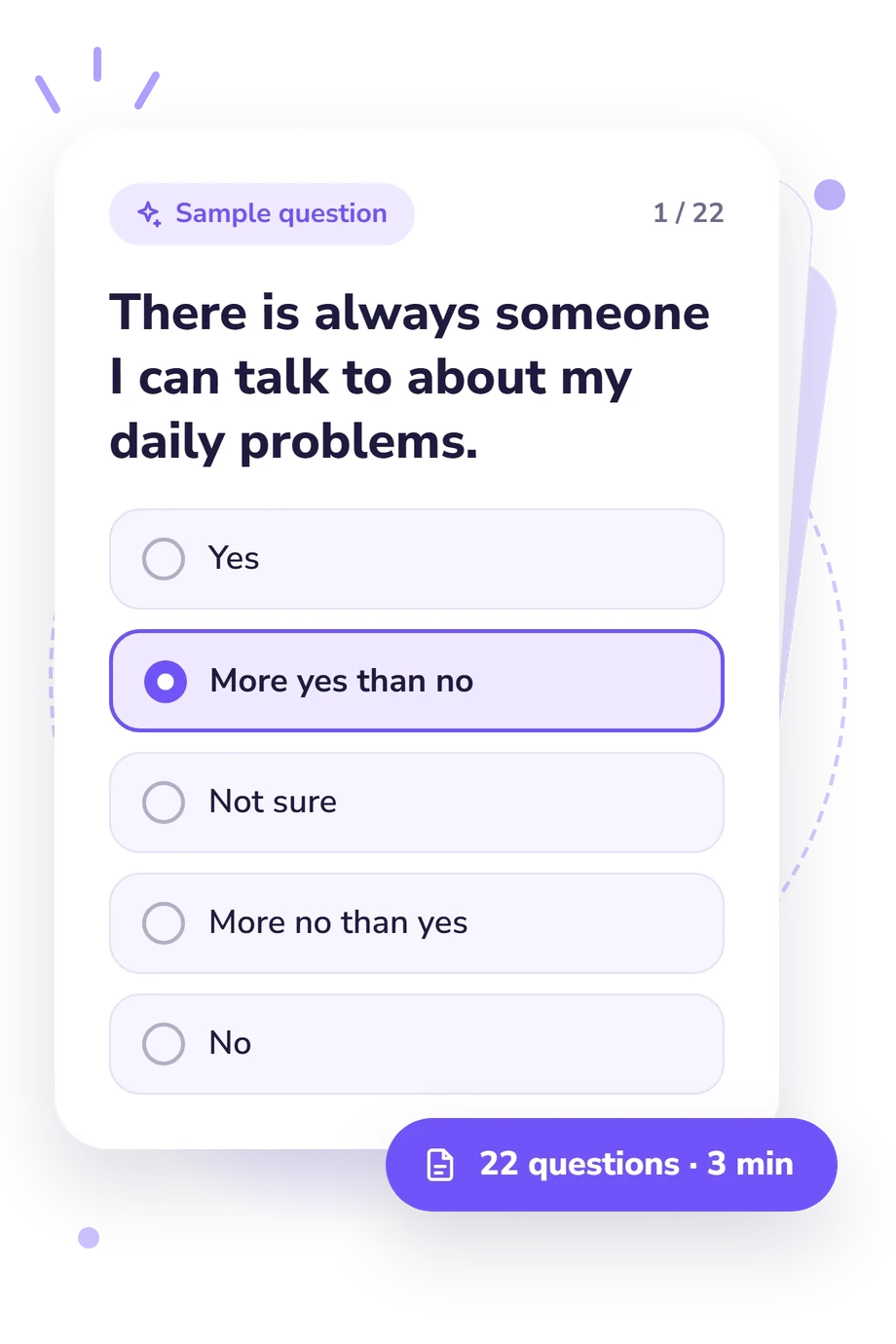
Example Questions From the Test
- Yes
- More yes than no
- Not sure
- More no than yes
- No
- Yes
- More yes than no
- Don't know
- More no than yes
- No
- Yes
- More yes than no
- Don't know
- More no than yes
- No
De Jong Gierveld Loneliness Scale (DJGLS) Test - Description and methodology of the test
People deciding whether to examine their current relationships may use the De Jong Gierveld Loneliness Scale (DJGLS) Test as a structured self-report exercise. An assessment of loneliness can help readers decide whether a fuller look at their experience would be useful, with the result providing a structured starting point for personal reflection before drawing personal conclusions.
What This Assessment Explores
Rather than treating loneliness as a single experience, the questionnaire separates limited social contact from the pain of lacking close emotional bonds. Its statements cover trust, dependable help, friendship, company, rejection, emptiness, and whether a person feels their social circle is sufficient. This makes the DJGLS loneliness test useful for reflecting on present relationships and perceived support.
The three displayed results are:
- Social Loneliness (5-25) reflects social contacts and belonging: Low 5-8, Moderate 9-17, High 18-25.
- Emotional (6-30) reflects missing close bonds and warmth: Low 6-8, Moderate 9-19, High 20-30.
- Loneliness (11-55) combines both components: Low loneliness 11-15, Moderate loneliness 16-35, High loneliness 36-55.
Taken together, higher scores indicate more pronounced difficulty in the relevant area, while lower scores suggest greater connection or less loneliness.
Methodology and Evidence Base
Each statement offers five response options from yes to no, with intermediate choices for uncertainty or a leaning either way. Some items describe available support and others unmet connection, so scoring follows the questionnaire's assigned direction rather than treating every yes alike. Responses are combined into component and overall scores, and the displayed bands classify those ranges.
The De Jong Gierveld loneliness questionnaire is conceptually consistent with the published De Jong Gierveld Loneliness Scale, a Rasch-type instrument whose manual describes the 11-item structure and component interpretation. Spanish and Mexican studies provide relevant validation contexts but do not establish norms or independent validation for this English online form.
Scores may shift with current circumstances, self-awareness, and response bias, so the profile works best as structured reflection on perceived relationships. Reviewing the result alongside recent experiences can help you consider whether it reflects a persistent concern or a temporary change.
- de Jong-Gierveld, J., & Kamphuis, F. (1985). The Development of a Rasch-Type Loneliness Scale. Applied Psychological Measurement, 9(3), 289-299. 10.1177/014662168500900307
- de Jong-Gierveld, J., & van Tilburg, T. G. (1999). Manual of the Loneliness Scale. Department of Social Research Methodology, Vrije Universiteit Amsterdam. 10.17605/osf.io/u6gck
- Buz, J., & Pérez-Arechaederra, D. (2014). Psychometric properties and measurement invariance of the Spanish version of the 11-item De Jong Gierveld loneliness scale. International Psychogeriatrics, 26(9), 1553-1564. 10.1017/S1041610214000507
- Giraldo-Rodríguez, L., Álvarez-Cisneros, T., & Agudelo-Botero, M. (2023). Psychometric Properties of the 11-Item De Jong Gierveld Loneliness Scale in a Representative Sample of Mexican Older Adults. Healthcare, 11(4), 489. 10.3390/healthcare11040489
Updated: