
Metacognitive Regulation Scale Test
How the Scales are Structured
Who Usually Takes This Test?
See How You Compare
Below is a preview of how scores are typically distributed across each scale.
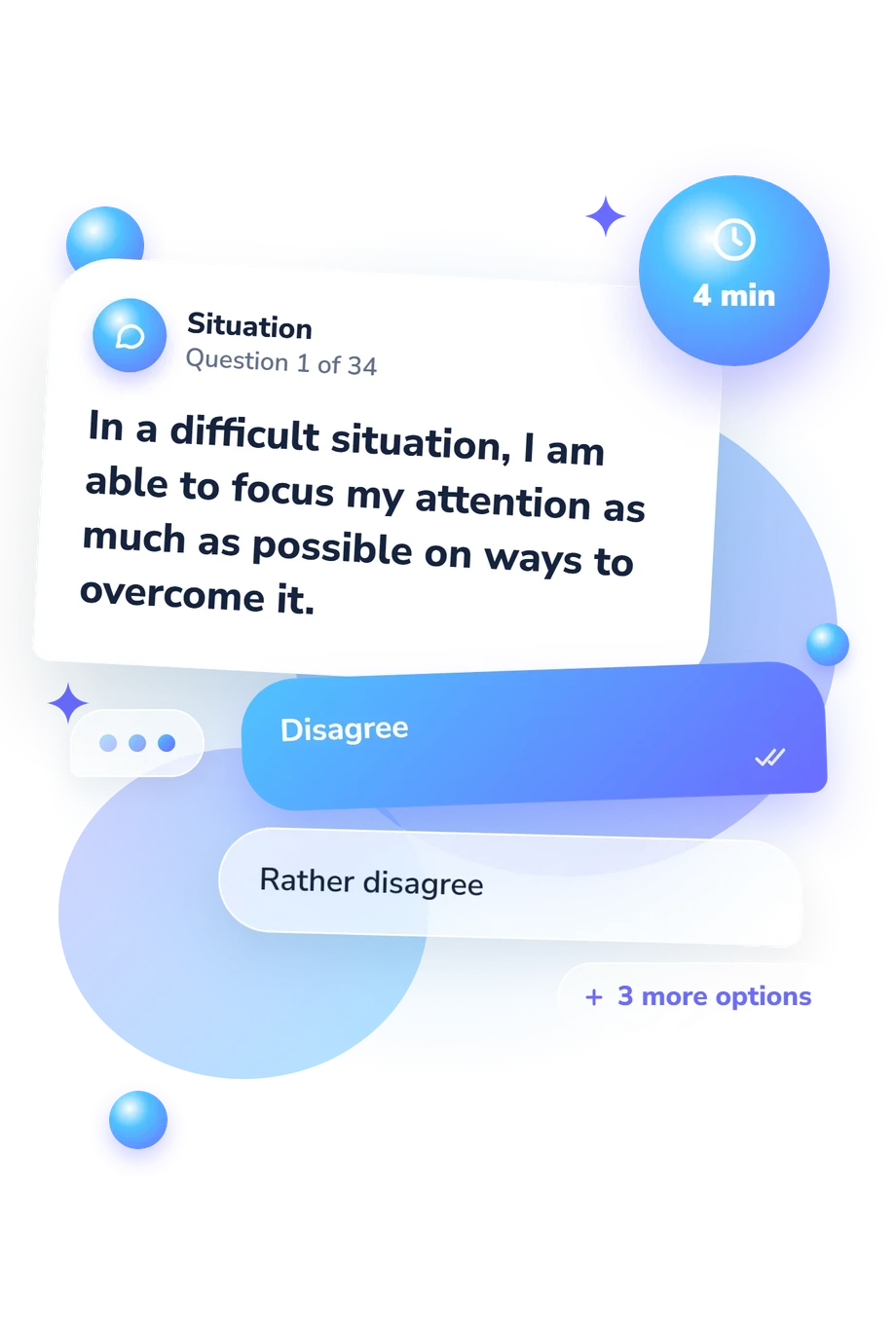
Example Questions From the Test
- Disagree
- Rather disagree
- Not sure
- Rather agree
- Completely agree
- Disagree
- Somewhat disagree
- Not sure
- Somewhat agree
- Strongly agree
- Disagree
- Somewhat disagree
- Not sure
- Somewhat agree
- Strongly agree
Metacognitive Regulation Scale Test - Description and methodology of the test
For people reflecting on how they think and act under pressure, this questionnaire offers a practical metacognitive self-assessment of perceived regulation capacities in difficult situations. The Metacognitive Regulation Scale Test helps respondents compare which resources feel more or less available when circumstances become demanding, creating a profile for focused personal reflection.
What This Assessment Measures
During difficult situations, this metacognitive regulation assessment examines perceived resources for thought, emotion, memory, and social response. It suits readers reflecting on pressure, conflict, anxiety, and demanding decisions.
The four result dimensions are:
- Intuitive Understanding of People (1-5) measures the effectiveness of reading feelings and intentions: Limited 1-2.64, Developing 2.65-4.29, Strong 4.3-5.
- Memory Functioning (1-5) measures effective memory use under challenge: Low 1-2.32, Moderate 2.33-4.45, High 4.46-5.
- Anxiety Control (1-5) measures the ability to manage anxiety as it arises: Limited control 1-1.73, Developing control 1.74-3.82, Strong control 3.83-5.
- Behavioral Self-Control (1-5) measures composure, self-regulation, and purposeful action: Low self-control 1-3.16, Moderate self-control 3.17-4.59, High self-control 4.6-5.
The profile indicates which resources feel more available or less reliable.
Methodology and Evidence Base
Each statement uses a five-point agreement format, moving from disagreement through uncertainty to agreement. Items address attention and solution finding, memory reliability, social inference, anxiety regulation, and behavioral control. Because some statements describe effective coping and others describe difficulty, the result depends on the questionnaire's scoring procedure rather than one answer.
MIRTZHS (Filenko & Bogomaz, 2024) is the closest published reference for metacognitive resources in difficult circumstances. This online metacognitive questionnaire is conceptually consistent with that work, but it has no established standardization or normative sample; Schraw and Dennison's Metacognitive Awareness Inventory and Flavell's account are related conceptual sources for metacognitive monitoring and regulation, not validation evidence for this questionnaire.
Results use named scale bands rather than percentages or diagnostic cutoffs. Since item weights and reverse-keying are unspecified, band width cannot show how many points an answer contributes. Self-report can shift with stress, self-awareness, memory, and impression management; read the profile as perceived resources alongside wider circumstances.
- Filenko, Igor A., and Sergey A. Bogomaz. "Standardizing a Questionnaire of Metacognitive Resources of Human Behavior Regulation in Difficult Circumstances." SibScript, 2024, 26(5), 685-700. 10.21603/sibscript-2024-26-5-685-700
- Schraw, Gregory, and Rayne Sperling Dennison. "Assessing Metacognitive Awareness." Contemporary Educational Psychology, 1994, 19(4), 460-475. 10.1006/ceps.1994.1033
- Flavell, John H. "Metacognition and Cognitive Monitoring: A New Area of Cognitive-Developmental Inquiry." American Psychologist, 1979, 34(10), 906-911. 10.1037/0003-066X.34.10.906
Updated: