
Freudly+971 508685814hello@freudly.ai
Freudly
compliance

Healthcare Attitudes Scale Test
Take the online Healthcare Attitudes Scale Test - AI psychologist FreudlyYou can take Healthcare Attitudes Scale Testhere. Online version of a simple and accurate psychological test with interpretation.en
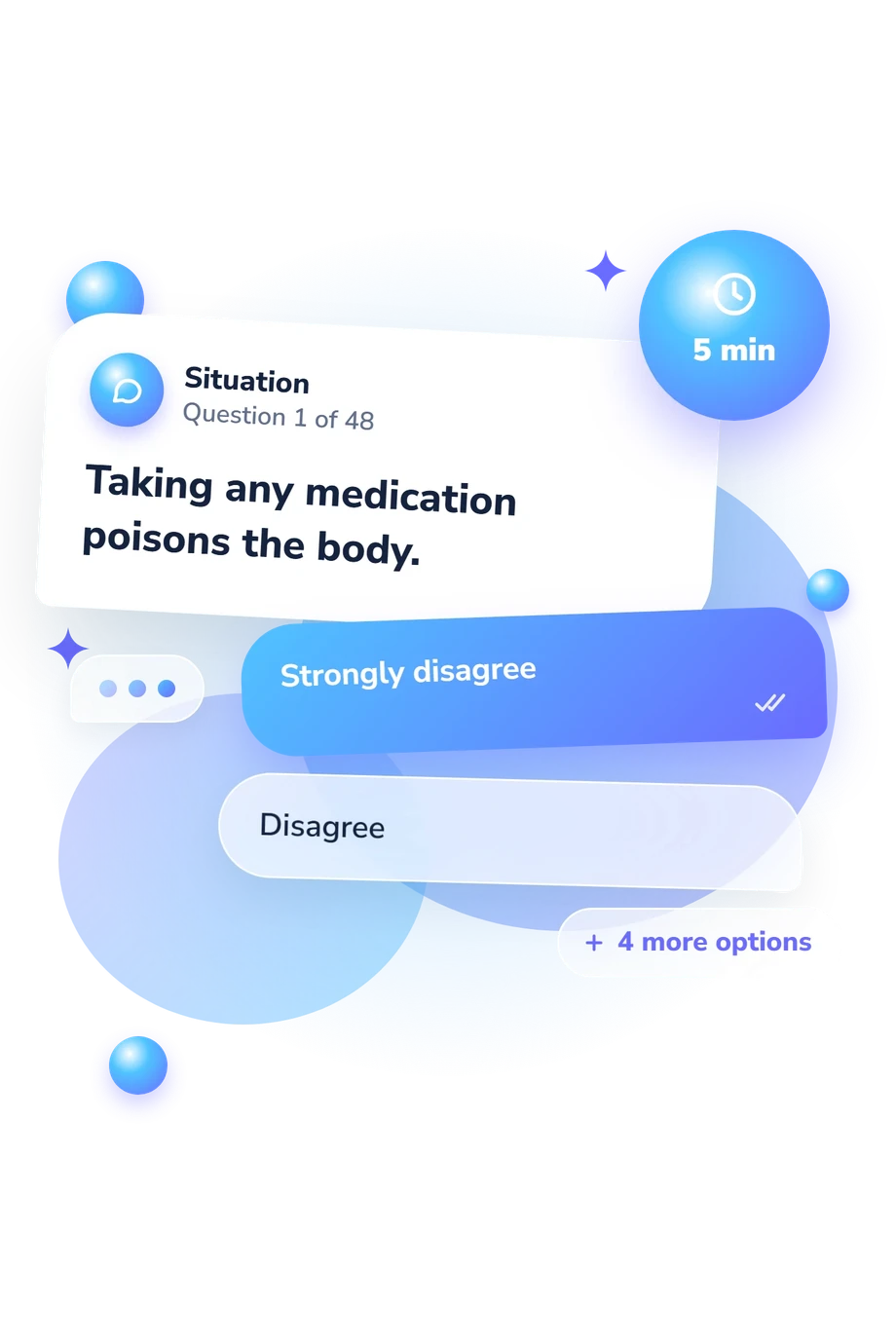
Understand your views on doctors, treatment, and the healthcare system in about 5 minutes. With 24 items, it spots barriers like mistrust or fear to support better care and communication.
Start Online Test
Questions: 245 minutes
08:30
October 2, 2025
October 2, 2025
Material has been updated
October 2, 2025
Material has been published
26,719 views
1,983 completions
1,631 likes
Verified by Daniel Hall
Psychologist with 25 years of experience
Share
Scale Explorer

How the Scales are Structured

example score
15/18
Age Discrimination (AD)
Measures the extent of age-based bias in evaluating medical professionals, favoring older and more experienced clinicians over younger doctors.
Low bias
Moderate bias
High bias
311: Low bias | 1214: Moderate bias | 1518: High bias
A score of 15 falls in the High bias range, indicating a strong tendency to distrust younger doctors and prefer older, more experienced specialists.
example score
10/18
Deontological (Physician) (D)
Measures attitudes toward a physician’s professional duty and the perceived humanity of doctor–patient communication.
Low
Moderate
High
39: Low | 1013: Moderate | 1418: High
A score of 10 falls in the Moderate range, suggesting a mixed or situational view of physicians’ professional responsibility and interpersonal conduct.
example score
11/18
Deontological (Nurse) (D)
Measures negative or critical perceptions of nurses’ communication and attentiveness that may hinder patient–nurse interaction.
Low concern
Moderate concern
High concern
310: Low concern | 1112: Moderate concern | 1318: High concern
A score of 11 falls in the Moderate concern range, suggesting some reservations about nurses’ friendliness or attentiveness that could occasionally complicate communication.
example score
15/18
Anti-Bureaucratic (AB)
Measures the extent of negative attitudes toward bureaucratic procedures and formalism in medical institutions that may interfere with accessing care.
Low
Moderate
High
312: Low | 1314: Moderate | 1518: High
A score of 15 falls in the High range, suggesting strong frustration with medical bureaucracy and a tendency to view formal processes as obstructive.
example score
13/18
Anti-Elitist (AE)
Measures the degree of negative attitudes about the cost and accessibility of healthcare and distrust toward free or low-cost services.
Low
Moderate
High
310: Low | 1114: Moderate | 1518: High
A score of 13 falls in the Moderate range, suggesting noticeable concerns about treatment costs and access and some mistrust of free or low-cost care.
example score
12/18
Stoic (S)
Measures the extent to which a person views illness as challenging yet potentially meaningful and value-shaping.
Low stoic attitude
Moderate stoic attitude
High stoic attitude
311: Low stoic attitude | 1213: Moderate stoic attitude | 1418: High stoic attitude
A score of 12 suggests a moderate stoic attitude, reflecting some tendency to see illness as difficult but also potentially personally enriching and clarifying of priorities.
example score
7/18
Secondary Gain (SG)
Measures the extent to which a person adopts a “sick role” attitude by valuing illness for its perceived secondary benefits (e.g., relief from duties, attention, or material gain).
Low sick-role orientation
Moderate sick-role orientation
High sick-role orientation
37: Low sick-role orientation | 811: Moderate sick-role orientation | 1218: High sick-role orientation
A score of 7 falls in the low range, suggesting minimal tendency to view illness as beneficial through secondary gains.
example score
11/18
Anti-Medication (AM)
Measures the degree of skepticism and distrust toward prescription medications and preference for non-pharmaceutical approaches.
Low antimedication
Moderate antimedication
High antimedication
39: Low antimedication | 1013: Moderate antimedication | 1418: High antimedication
A score of 11 falls in the Moderate antimedication range, suggesting a noticeable but not extreme tendency to view medications as more risky or unhelpful than beneficial.
Start Online Test
just completed the test
DATA-BASED USER COHORTS

Who Usually Takes This Test?

Chronic condition patients
41%OF USERS
People managing long-term illness use it to spot beliefs and habits that affect adherence, trust in clinicians, and daily self-care.
Anxious or mistrustful patients
34%OF USERS
People who feel fear, skepticism, or frustration about doctors, tests, or medications take it to understand what drives avoidance or conflict.
Clinicians and health researchers
25%OF USERS
Professionals use it for quick screening to identify attitude barriers that may reduce treatment effectiveness and communication quality.
BASED ON AGGREGATED, ANONYMIZED DATA FROM TENS OF THOUSANDS OF FREUDLY USERS.
Benchmarking

See How You Compare

Once you complete the test, your results are compared with real-world data from people in your country.
Below is a preview of how scores are typically distributed across each scale.
Age Discrimination (AD)
Average
7.6
Normal range
5.59.8
min.
3
max.
18
This curve shows how scores are typically distributed.
Once you complete the test, your result will appear on the scale so you can see how you compare.
Deontological (doctor) (D()
Average
10.9
Normal range
8.213.6
min.
3
max.
18
This curve shows how scores are typically distributed.
Once you complete the test, your result will appear on the scale so you can see how you compare.
Deontological (nurse) (D()
Average
13
Normal range
10.415.7
min.
3
max.
18
This curve shows how scores are typically distributed.
Once you complete the test, your result will appear on the scale so you can see how you compare.
Anti-bureaucratic (A)
Average
12.2
Normal range
9.614.9
min.
3
max.
18
This curve shows how scores are typically distributed.
Once you complete the test, your result will appear on the scale so you can see how you compare.
Anti-elitist (A)
Anti-elitist (A)
Average
12.4
Normal range
9.715.1
min.
3
max.
18
This curve shows how scores are typically distributed.
Once you complete the test, your result will appear on the scale so you can see how you compare.
Stoic (S)
Stoic (S)
Average
11.4
Normal range
9.113.6
min.
3
max.
18
This curve shows how scores are typically distributed.
Once you complete the test, your result will appear on the scale so you can see how you compare.
Rentier (R)
Rentier (R)
Average
6.9
Normal range
49.7
min.
3
max.
18
This curve shows how scores are typically distributed.
Once you complete the test, your result will appear on the scale so you can see how you compare.
Antimedication (A)
Antimedication (A)
Average
9.4
Normal range
6.912
min.
3
max.
18
This curve shows how scores are typically distributed.
Once you complete the test, your result will appear on the scale so you can see how you compare.
Featured On
SAMPLE QUESTIONS

Example Questions From the Test

Please indicate your personal opinion regarding each of the statements presented below. Because these items concern your personal views, there are no right or wrong answers.
    • Completely disagree
    • Disagree
    • Rather disagree
    • Rather agree
    • Agree
    • Completely agree
    • Strongly disagree
    • Disagree
    • Somewhat disagree
    • Somewhat agree
    • Agree
    • Strongly agree
    • Completely disagree
    • Disagree
    • Somewhat disagree
    • Somewhat agree
    • Agree
    • Completely agree
WHAT THE TEST MEASURES
About This Assessment
Health Attitudes Scale Test

Healthcare Attitudes Scale Test - Symptoms and Signs

compliance
health

In clinical and research settings, the Healthcare Attitudes Scale is used to assess an individual’s attitudes toward health care and related experiences. It is intended to clarify how respondents perceive medical professionals, treatment, medications, and the health care system.

The measure (Fishbein & Ajzen) consists of 24 items and typically takes about 5 minutes to complete. Respondents rate statements reflecting beliefs and feelings across multiple domains, supporting identification of negative or maladaptive attitudes that may be associated with reduced engagement in care or strained interactions with providers.

Results from the Healthcare Attitudes Scale can inform case conceptualization and guide patient-centered communication and intervention planning by highlighting specific attitudinal targets for discussion or change. Interpretation should consider clinical context and be integrated with other assessment data.

Author: Icek Ajzen, Martin Fishbein
Literature: Champion, V. L., & Skinner, C. S. The health belief model. In K. Glanz, B. K. Rimer, & K. Viswanath (Eds.), Health behavior: Theory, research, and practice. Jossey-Bass. 2015.
Popular tests
Comments
Leave a Comment