
Marital Intelligence Scale Test
How the Scales are Structured
Who Usually Takes This Test?
See How You Compare
Below is a preview of how scores are typically distributed across each scale.
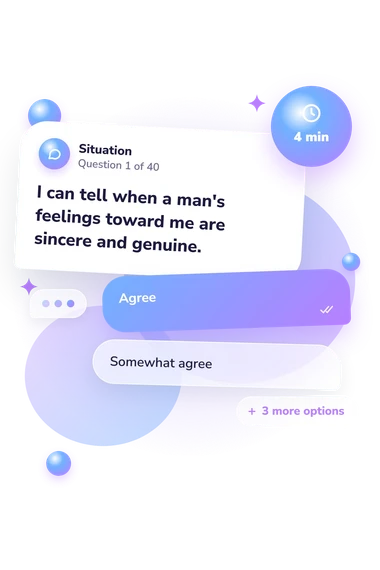
Example Questions From the Test
- Agree
- Somewhat agree
- Not sure
- Somewhat disagree
- Disagree
- Agree
- Somewhat agree
- Not sure
- Somewhat disagree
- Disagree
- Agree
- Somewhat agree
- Not sure
- Somewhat disagree
- Disagree
Marital Intelligence Scale Test - Description and methodology of the test
For readers reflecting on how they interpret romantic interest, communicate, and present themselves in courtship, the Marital Intelligence Scale Test offers a focused self-report profile. As a marital intelligence questionnaire, it is most relevant to people examining partner-selection skills and expectations about relationship success. The result indicates an overall level of these skills, supporting honest self-reflection about related relationship patterns and choices.
What This Assessment Explores
The questionnaire examines tendencies in partner search and selection: reading romantic interest, communicating during courtship, presenting strengths, and judging relationship possibilities. Items also touch attractiveness, status, persuasion, family competence, confidence, adaptive self-deception, manipulation, distorted representations, and interpretations of rejection or deception. This marital intelligence assessment suits readers considering heterosexual courtship and partner-selection expectations.
The result is one Marital Intelligence scale, ranging from 20-100: Developing (20-59), Adequate (60-79), or Strong (80-100). Higher scores indicate more developed skills for integrating reproductively relevant information, selecting partners adaptively, and building successful relationships.
These themes are brought together in the result:
- Reading signals describes recognition of attention and intentions from a potential partner.
- Courtship expression describes communication, attraction, persuasion, manipulation, and showing personal strengths.
- Relationship judgment describes confidence, distorted representations, and expectations about partnership success.
Methodology and Scientific Basis
Each statement uses a five-point agreement continuum from Agree to Disagree, with intermediate choices such as Somewhat agree, Not sure, and Somewhat disagree. These are self-descriptions rather than performance tasks, so the result depends on how candidly the respondent judges typical beliefs and behavior. Respondents taking this marital intelligence test receive one displayed result with the bands; the test does not state how responses are combined or weighted.
The questionnaire is conceptually consistent with the published Mating Intelligence Scale, which frames mating intelligence as processing socially and reproductively relevant information during partner choice and courtship. Later psychometric work by Geher and colleagues examined its validity and structure, while Najarpourian and Samavi evaluated a related Iranian scale. Those studies support the construct’s relevance, but do not show that this online version is the same validated administration or uses their norms.
Interpret the band as a tendency captured by the items, not a fixed measure of desirability or outcome. Mood, experience, self-awareness, cultural expectations, and impression management can affect self-report, so the result cannot determine compatibility, deception, or future marital success.
- Najarpourian, S., & Samavi, S. A. (2019). Psychometric Evaluation of the Mating Intelligence Scale in Iran. SAGE Open, 9(3), 1-7. 10.1177/2158244019867857
- Geher, G., Kaufman, S. B., Garcia, J. R., Kaufman, J. C., & Dawson, B. B. (2016). The validity and structure of mating intelligence. Evolution, Mind and Behaviour, 14(1), 1-22. 10.1556/2050.2016.0001
- Geher, G., & Kaufman, S. B. (2007). The mating intelligence scale. Psychology Today, 40(1), 78-79.