
Freudly+971 508685814hello@freudly.ai
Freudly
social competence

Social Interaction Competence Assessment Scale Test
Take the online Social Interaction Competence Assessment Scale Test - AI psychologist FreudlyYou can take Social Interaction Competence Assessment Scale Testhere. Online version of a simple and accurate psychological test with interpretation.en
Understand how you handle tough social situations and solve interpersonal problems in about 6 minutes. 30 quick items pinpoint strengths and gaps to guide targeted coaching, training, or support.
Start Online Test
Questions: 306 minutes
08:30
October 2, 2025
October 2, 2025
Material has been updated
October 2, 2025
Material has been published
25,287 views
2,666 completions
2,317 likes
Verified by Daniel Hall
Psychologist with 25 years of experience
Share
Scale Explorer

How the Scales are Structured

example score
57/100
Personal-Creative Style (PCS)
Measures how effectively a person uses a personal, creative approach to build trust and resolve difficulties in informal relationships.
Limited
Developing
Strong
039: Limited | 4069: Developing | 70100: Strong
A score of 57 falls in the Developing range, suggesting a generally workable personal-creative style in informal relationships with room to apply it more consistently across situations.
example score
50/100
Normative/Stereotypical (N)
Measures the extent to which a person relies on familiar, normative interaction patterns in informal relationships rather than more individualized approaches.
Flexible/Individualized
Balanced Normative Use
Highly Stereotypical
033: Flexible/Individualized | 3466: Balanced Normative Use | 67100: Highly Stereotypical
A score of 50 suggests a moderate tendency to use familiar social scripts in informal settings, generally supporting smooth interaction while allowing some flexibility for more personal connection.
example score
61/100
Counterproductive (C)
Measures the degree to which a person’s communication style in informal relationships tends to create obstacles to trust, harmony, and effective problem resolution.
Low
Moderate
High
033: Low | 3466: Moderate | 67100: High
A score of 61 falls in the Moderate range, suggesting occasional patterns in informal interactions that may complicate building trusting, harmonious personal connections.
example score
82/100
Personal-Creative Style (PCS)
Measures how creatively and individually a person adapts their communication style to solve challenges within formal or official relationships.
Conventional
Adaptive
Personal-creative
049: Conventional | 5074: Adaptive | 75100: Personal-creative
A score of 82 falls in the Personal-creative range, suggesting a strong tendency to use flexible, individualized, and sometimes unconventional approaches in formal interactions.
example score
49/100
Normative/Stereotyped (N)
Measures the tendency to rely on established rules and stereotypical norms when interacting in formal relationships.
Flexible / less rule-bound
Balanced
Strongly normative
033: Flexible / less rule-bound | 3466: Balanced | 67100: Strongly normative
A score of 49 suggests a balanced use of formal norms, combining adherence to rules with some situational flexibility.
example score
59/100
Counterproductive (C)
Measures the tendency toward ineffective or strained behavior in formal or business interactions that can impede goal achievement.
Low
Moderate
High
033: Low | 3466: Moderate | 67100: High
A score of 59 falls in the Moderate range, suggesting occasional counterproductive patterns in formal interactions that may sometimes complicate cooperation or task progress.
example score
46/100
Personal-Creative (PC)
Measures how flexibly and creatively a person approaches social interactions to solve interpersonal challenges and build relationships.
Developing
Moderate
Strong
039: Developing | 4069: Moderate | 70100: Strong
A score of 46 indicates a moderate personal-creative style, suggesting some flexibility and originality in social situations with room to expand the range of adaptive interaction strategies.
example score
17/100
Normative/Stereotypical (N)
Measures the extent to which a person relies on commonly accepted social norms and stereotyped behavior patterns when handling interpersonal situations.
Low normative reliance
Moderate normative reliance
High normative reliance
033: Low normative reliance | 3466: Moderate normative reliance | 67100: High normative reliance
A score of 17 indicates low reliance on stereotypical social norms, suggesting a tendency to use less conventional or more individually adapted interaction strategies.
example score
39/100
Counterproductive (C)
Measures the degree to which a person tends to use ineffective or potentially destructive strategies during social interactions.
Low
Moderate
High
033: Low | 3466: Moderate | 67100: High
A score of 39 falls in the Moderate range, suggesting occasional counterproductive reactions in communication that may reduce effectiveness in some challenging situations.
example score
23/60
Social Interaction Competence Level (SICL)
Measures how effectively a person adapts and responds to challenging social situations using flexible communication strategies.
Basic
Developing
Personal-creative
1537: Basic | 3842: Developing | 4360: Personal-creative
A score of 23 falls in the Basic range, suggesting social interaction strategies are more limited and may be less flexible across different contexts.
Start Online Test
just completed the test
DATA-BASED USER COHORTS

Who Usually Takes This Test?

Team leaders and managers
41%OF USERS
They use it to gauge how effectively they handle workplace conversations, conflict, and collaboration under pressure.
Students and young adults
33%OF USERS
They take it to understand how they come across in new groups and build communication skills for study, internships, and friendships.
Counseling and therapy clients
26%OF USERS
They complete it to identify social situations that feel difficult and pinpoint practical areas to practice and improve.
BASED ON AGGREGATED, ANONYMIZED DATA FROM TENS OF THOUSANDS OF FREUDLY USERS.
Benchmarking

See How You Compare

Once you complete the test, your results are compared with real-world data from people in your country.
Below is a preview of how scores are typically distributed across each scale.
Personal and Creative (Informal Relationships Sphere) (PaC(RS)
Average
25.3
Normal range
12.138.5
min.
0
max.
100
This curve shows how scores are typically distributed.
Once you complete the test, your result will appear on the scale so you can see how you compare.
Normative/Stereotypical (Sphere of Informal Relationships) (N(oIR)
Average
61.8
Normal range
46.477.2
min.
0
max.
100
This curve shows how scores are typically distributed.
Once you complete the test, your result will appear on the scale so you can see how you compare.
Counterproductive (Informal Relationships Sphere) (C(RS)
Average
45.3
Normal range
28.362.4
min.
0
max.
100
This curve shows how scores are typically distributed.
Once you complete the test, your result will appear on the scale so you can see how you compare.
Personal-Creative (Sphere of Formal Relationships) (P(oFR)
Average
25.6
Normal range
12.139.2
min.
0
max.
100
This curve shows how scores are typically distributed.
Once you complete the test, your result will appear on the scale so you can see how you compare.
Normative/Stereotypical (Sphere of Formal Relationships) (N(oFR)
Average
44.7
Normal range
30.458.9
min.
0
max.
100
This curve shows how scores are typically distributed.
Once you complete the test, your result will appear on the scale so you can see how you compare.
Counterproductive (Field of Formal Relationships) (C(oFR)
Average
36.7
Normal range
1855.4
min.
0
max.
100
This curve shows how scores are typically distributed.
Once you complete the test, your result will appear on the scale so you can see how you compare.
Personal-Creative (P)
Average
29
Normal range
13.144.9
min.
0
max.
100
This curve shows how scores are typically distributed.
Once you complete the test, your result will appear on the scale so you can see how you compare.
Normative/stereotypical (N)
Average
26.1
Normal range
7.744.6
min.
0
max.
100
This curve shows how scores are typically distributed.
Once you complete the test, your result will appear on the scale so you can see how you compare.
Counterproductive (C)
Average
32.3
Normal range
13.950.6
min.
0
max.
100
This curve shows how scores are typically distributed.
Once you complete the test, your result will appear on the scale so you can see how you compare.
Level of social interaction competence (Losic)
Average
48.4
Normal range
4254.9
min.
15
max.
60
This curve shows how scores are typically distributed.
Once you complete the test, your result will appear on the scale so you can see how you compare.
Featured On
SAMPLE QUESTIONS

Example Questions From the Test

This instrument consists of a set of interpersonal interaction situations. Please rate the likelihood that you would choose each behavioral pattern in the situations presented using a 100% scale. That is, the total across the three patterns within each situation must equal 100%. Within a given situation, the percentage values must not be repeated, except for the 0% option. For each pattern (a, b, c), select a percentage. For example, Situation 1: a) 60% (i.e., this is how I would act in 60% of cases), b) 30%, c) 10%. The sum of all selections must equal 100%. There is no time limit, but please respond as quickly as possible.
    • I will make contact with students in the other group easily and quickly, but will limit it to working relationships only.
    • I will try to establish friendly acquaintances, with the prospect of developing them into friendships.
    • Most likely, I will keep to myself in the new group and maintain my existing contacts.
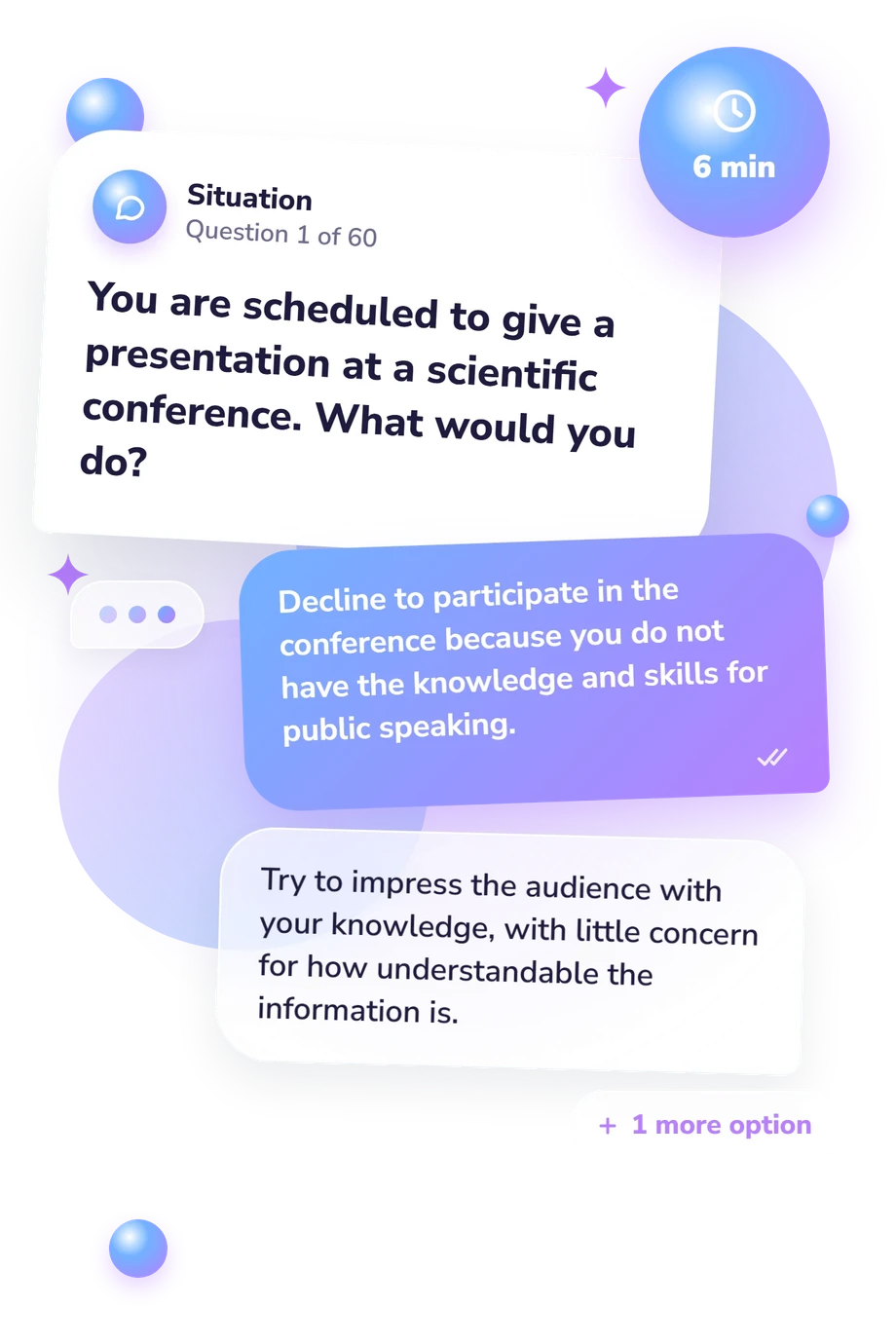
    • Decline to participate in the conference because you do not have the knowledge and skills for public speaking.
    • Try to impress the audience with your erudition, with little concern for how accessible the information is.
    • Try to present the material in the most engaging way possible and in a manner that is clear and accessible to the audience.
    • Tell the instructor you do not have your grade record book only after the result has been entered on the grade sheet.
    • Tell the instructor right away and, by giving appropriate reasons, arrange to have the result entered in your grade record book the next day.
    • Come back to take the assessment another time.
WHAT THE TEST MEASURES
About This Assessment
Social Interaction Competence Assessment Scale Test

Social Interaction Competence Assessment Scale Test - Symptoms and Signs

social competence
social intelligence

This measure is designed to support a brief appraisal of social-interaction skills in context. The Social Interaction Competence Assessment Scale presents respondents with interpersonal situations and asks them to indicate how they would typically respond, allowing clinicians to characterize perceived effectiveness and adaptability in social problem-solving.

The instrument includes 30 items and typically requires about 6 minutes to complete. It may be used as part of a broader assessment to identify relative strengths and areas that could benefit from skills development or targeted intervention, with results interpreted alongside clinical history and other data sources.

The Social Interaction Competence Assessment Scale is attributed to Ronald E. Riggio and is intended for use in educational, organizational, or clinical settings where social functioning and interpersonal competence are relevant to case formulation or treatment planning.

Author: Ronald E. Riggio
Literature: Riggio, R. E. Assessment of basic social skills. Journal of Personality and Social Psychology. 1986.
Popular tests
Comments
Leave a Comment