
Hamilton Anxiety Rating Scale (HARS) Test
How the Scales are Structured
Who Usually Takes This Test?
See How You Compare
Below is a preview of how scores are typically distributed across each scale.
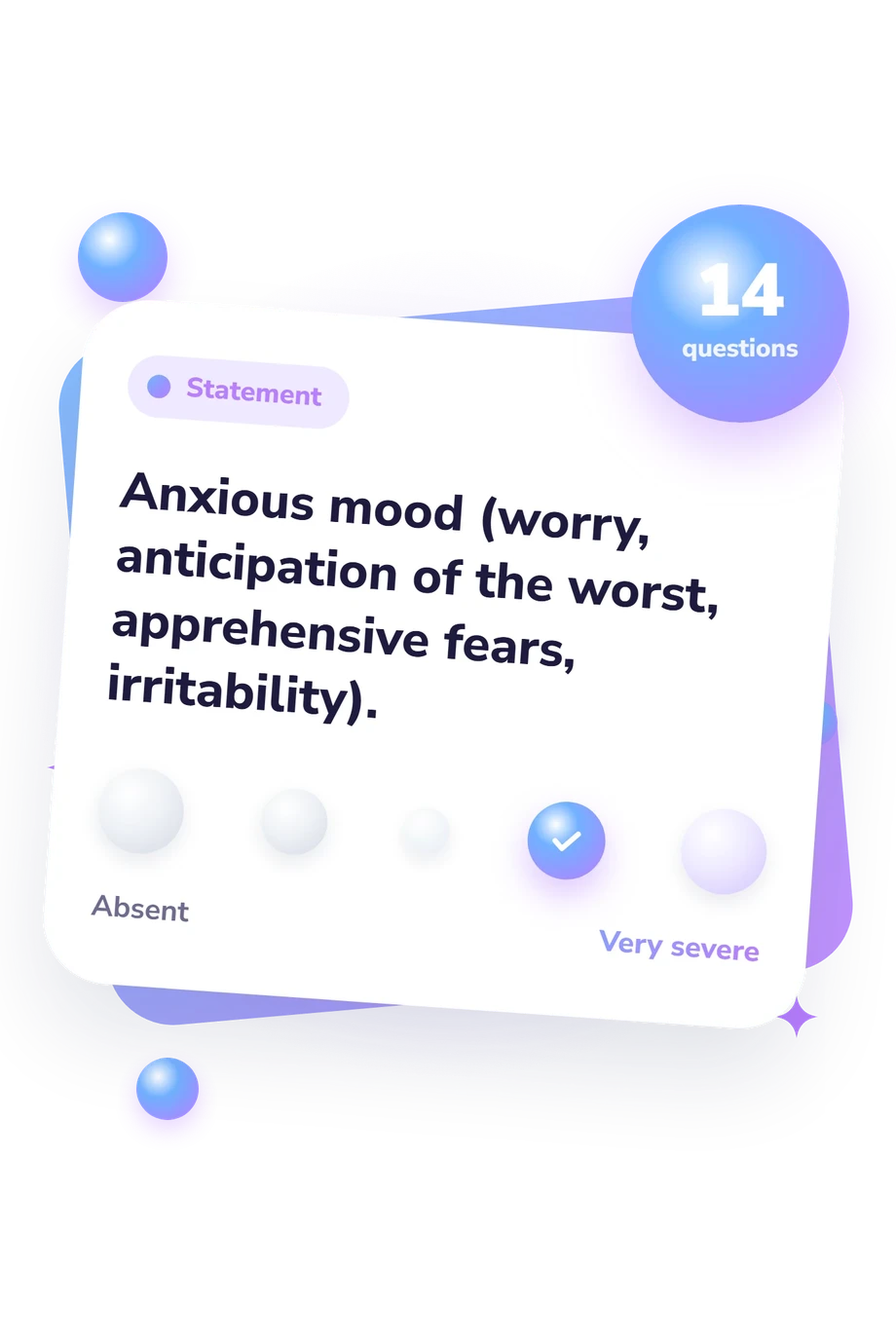
Example Questions From the Test
- Absent
- Mild
- Moderate
- Severe
- Very severe
- Absent
- Mild
- Moderate
- Severe
- Very severe
- Absent
- Mild
- Moderate
- Severe
- Very severe
Hamilton Anxiety Rating Scale (HARS) Test - Description and methodology of the test
For people who want an anxiety self-assessment, this questionnaire offers a structured way to reflect on the severity and range of emotional, cognitive, behavioral, and physical anxiety symptoms. It is suited to readers considering worry, tension, fears, sleep disruption, concentration difficulties, low mood, or stress-related bodily sensations. The Hamilton Anxiety Rating Scale (HARS) Test provides an overall estimate rather than separate domain scores.
What This Assessment Explores
Anxiety is treated here as a multidimensional symptom pattern rather than a single feeling. The questions cover anxious mood, tension, specific fears, insomnia, concentration and memory difficulties, depressed mood, visible restlessness, and symptoms involving muscular, sensory, cardiovascular, respiratory, gastrointestinal, genitourinary, and autonomic functions. This breadth helps the respondent consider the range of symptoms included, while the overall rating of anxiety symptoms summarizes anxiety severity rather than producing separate domain scores.
The result is the Hamilton Anxiety Rating Scale Total Score, ranging from 0-35. The catalogue presents these bands:
- None/minimal (0-17) indicates no or minimal measured anxiety symptoms.
- Moderate (18-24) indicates moderate anxiety symptom severity.
- Severe (25-35) indicates severe anxiety symptom severity across the assessed profile.
These labels describe the intensity represented by the selected responses; they do not identify a cause or explain why a symptom is present.
Methodology and Scientific Basis
The questionnaire is conceptually consistent with the Hamilton Anxiety Scale (Hamilton, 1969), a clinician-rated framework for psychological, behavioral, and somatic features, but is not an adaptation. Each area uses five choices, from Absent to the most severe response. As a digital anxiety assessment, it captures perceived intensity without reproducing clinician-led conditions.
The displayed result combines ratings into a severity estimate. This online format provides a total-score estimate with bands, but no additional weighting or reverse-scoring procedure is defined for this administration. This online questionnaire is not a standardized administration of the clinician-rated HARS.
Hamilton's 1959 work established the rating approach. Maier, Buller, Philipp, and Heuser (1988) examined the Hamilton Anxiety Scale, reporting consistency, construct validity, and responsiveness to change. The instrument can monitor change in clinical and research contexts, but this does not validate the online version.
Interpretation should consider current context, sleep, health, and honest reporting. Bodily symptoms may have other causes, while self-report is shaped by attention and context. The result is a structured reflection on symptom severity, not a diagnosis or substitute for broader professional assessment.
- Hamilton, M. (1969). Diagnosis and rating of anxiety. In M. H. Lader (Ed.), Studies of Anxiety (British Journal of Psychiatry Special Publication No. 3, pp. 76-79). Headley Brothers.
- Hamilton, M. (1959). The assessment of anxiety states by rating. British Journal of Medical Psychology, 32(1), 50-55. 10.1111/j.2044-8341.1959.tb00467.x
- Maier, W., Buller, R., Philipp, M., & Heuser, I. (1988). The Hamilton Anxiety Scale: Reliability, validity and sensitivity to change in anxiety and depressive disorders. Journal of Affective Disorders, 14(1), 61-68. 10.1016/0165-0327(88)90072-9
Updated: