
Medication Adherence Scale Test
How the Scales are Structured
Who Usually Takes This Test?
See How You Compare
Below is a preview of how scores are typically distributed across each scale.
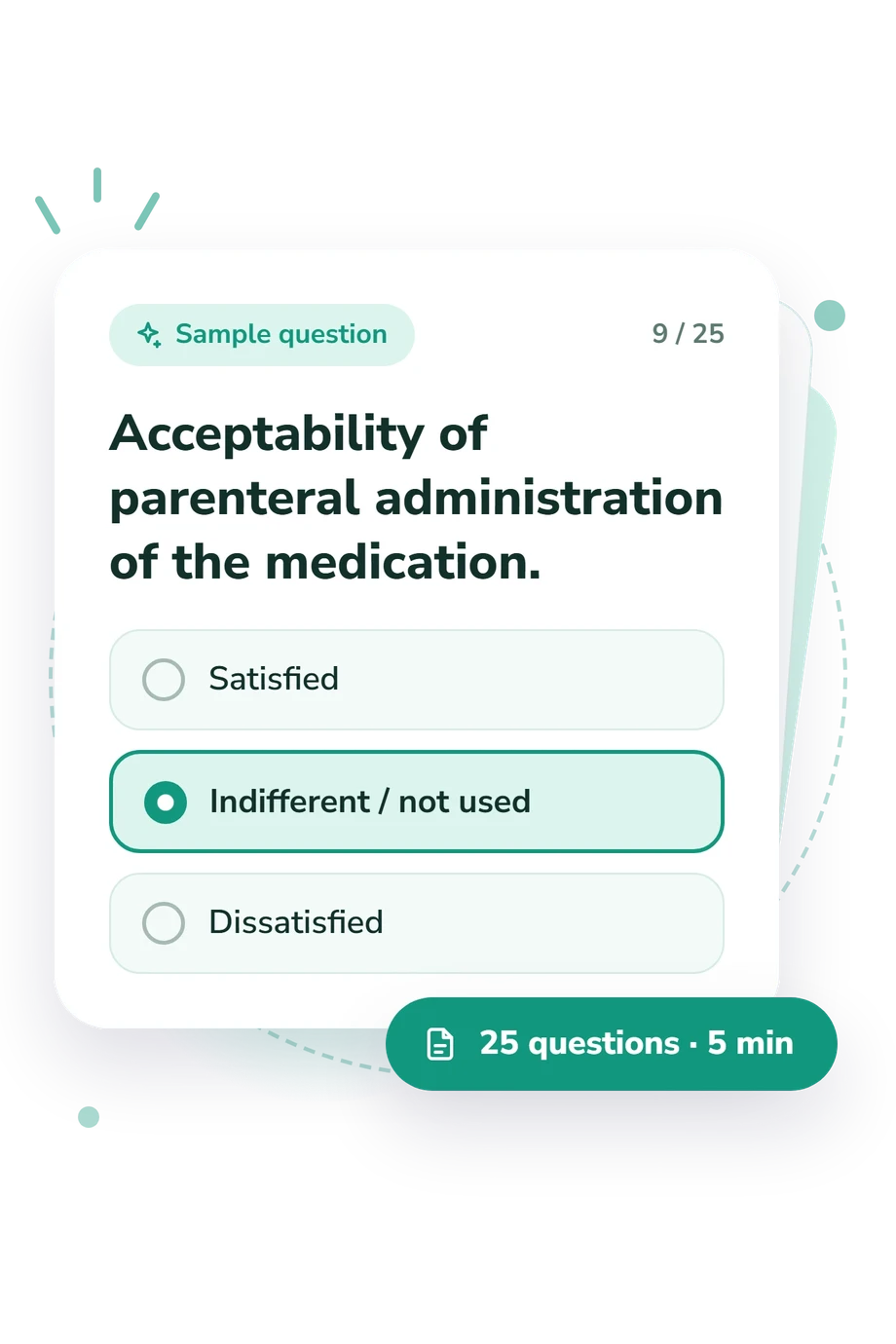
Example Questions From the Test
- Takes medication independently
- Takes medication under supervision of medical staff or relatives
- Avoids taking medication (avoids or refuses)
- No nonadherence
- Reducing medication doses
- Irregular medication taking
- Stopping medication
- Taking medications not prescribed by the clinician
- Positive
- Neutral / has not taken them before
- Negative
Medication Adherence Scale Test - Description and methodology of the test
For people who want to understand what may help or hinder consistent treatment, the Medication Adherence Scale Test offers a structured look at medication-taking behavior and the conditions around it. It is suited to patients reviewing their own treatment experience, as well as clinicians preparing a more focused conversation. This medication adherence assessment considers practical barriers from attitudes, relationships, and clinical factors that can shape follow-through.
What This Assessment Measures
The items cover medication-taking behavior, treatment experience, relationships, social context, and clinical follow-up. They also consider side effects, insight, relapse, functioning, access, and other conditions that may alter adherence. By combining these influences, this medication adherence measure looks beyond a single missed-dose score.
Five scales organize results:
- Overall Adherence (0-55) shows readiness: Low adherence risk (0-18), Moderate adherence (19-37), High adherence (38-55).
- Physician-Related Factors (0-4) shows rapport: Low rapport (0-1), Moderate rapport (2-3), High rapport (4-4).
- Close Social Environment Factors (0-5) shows others’ influence: Low support / negative influence (0-1), Mixed influence (2-3), Strong supportive influence (4-5).
- Patient-Related Factors (0-15) reflects personal motivation, health-related knowledge, and attitudes toward health that may influence adherence: Low patient readiness (0-5), Moderate patient readiness (6-10), High patient readiness (11-15).
- Attitudes Toward Medication (0-31) shows acceptance: Low acceptance (0-10), Mixed/variable acceptance (11-21), High acceptance (22-31).
Methodology and Evidence Base
Responses use ordered choices, present/absent items, and low/moderate/high categories. This medication adherence questionnaire combines behavior, attitudes, relationships, and clinical context. Selected answers feed the five displayed scales. The online version presents those scales and bands, but no item-level scoring rule or independent normative basis is established for it.
The closest reference is the Medication Compliance Scale (Lutova et al., 2007), a multidimensional model covering patient, physician, social-environment, and medication-attitude factors. Sorokin, Lutova, and Wied (2017) frame treatment motivation as interacting subsystems, while Sorokin et al. (2021) support a holistic view of compliance. This questionnaire is conceptually consistent with those works, not a validated adaptation of them.
Use the profile with information about regimen, side effects, access, therapeutic alliance, and clinical history. Self-report can shift with memory, insight, stigma, mood, or pressure to appear compliant. The displayed bands organize results into levels and should be interpreted with the wider treatment context.
- Lutova N.B., Bortsov A.V., Wied V.D., Vuks A.Ya. Method for Predicting Drug Compliance in Psychiatry: Guidelines. Saint Petersburg: V.M. Bekhterev Saint Petersburg Research Psychoneurological Institute; 2007. 24 p. ISBN: 978-5-94651-029-5.
- Sorokin M.Yu., Neznanov N.G., Lutova N.B., Wied V.D. Revisiting Drug Compliance: The Need for a Holistic Approach in the Treatment of Severe Mental Disorders. Consortium Psychiatricum. 2021;2(3):17-25. 10.17816/CP93.
- Sorokin M.Yu., Lutova N.B., Wied V.D. The Role of Treatment Motivation Subsystems in the Overall Structure of Compliance in Patients Undergoing Psychopharmacotherapy. Neuroscience and Behavioral Physiology. 2017;47(8):890-894. 10.1007/s11055-017-0486-z.
Updated: