
Present Moment Awareness Scale (PMAQ) Test
How the Scales are Structured
Who Usually Takes This Test?
See How You Compare
Below is a preview of how scores are typically distributed across each scale.
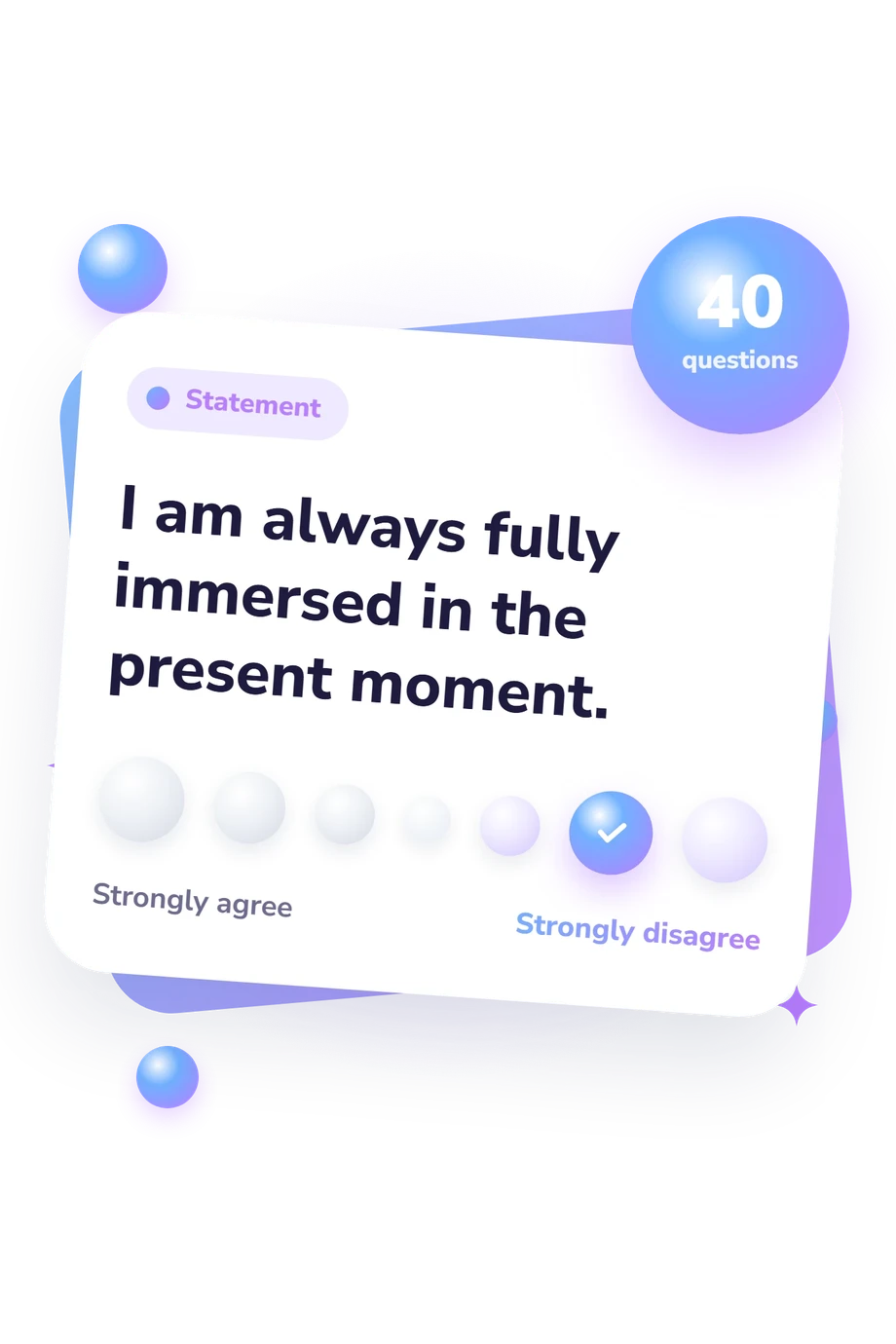
Example Questions From the Test
- Strongly agree
- Agree
- Somewhat agree
- Neither agree nor disagree
- Somewhat disagree
- Disagree
- Strongly disagree
- Strongly agree
- Agree
- Somewhat agree
- Neither agree nor disagree
- Somewhat disagree
- Disagree
- Strongly disagree
- Strongly agree
- Agree
- Somewhat agree
- Neither agree nor disagree
- Somewhat disagree
- Disagree
- Strongly disagree
Present Moment Awareness Scale (PMAQ) Test - Description and methodology of the test
People who want to understand how they relate to immediate experience may use the Present Moment Awareness Scale (PMAQ) Test as a structured self-reflection exercise. It suits readers exploring attention, emotional acceptance, bodily awareness, and a sense of connection in daily life, including anyone seeking a mindfulness self-assessment. The result describes a current tendency toward present engagement rather than a fixed personal identity.
What This Assessment Explores
These items examine how readily a person notices thoughts, feelings, bodily sensations, surroundings, and experience. They also address acceptance, gratitude, calm, attention control, intuitive responding, openness to uncertainty, and connection with life. As a present-moment awareness assessment, the result describes a self-reported tendency, not a permanent state.
The questionnaire produces one result, Present-Moment Awareness, scored from 20-140: Low awareness (20-59), Moderate awareness (60-99), and High awareness (100-140). Higher scores reflect greater reported present-moment awareness, which the scale definition links with happiness and psychological well-being.
The main themes represented by the items are:
- Attention and perception show awareness of immediate thoughts, sensations, and surroundings.
- Acceptance and openness show how emotions and uncertainty are allowed.
- Regulation and response show how attention meets difficult situations.
- Connection and vitality show gratitude, aliveness, peace, joy, and belonging.
Methodology and Evidence Base
The self-report questionnaire presents statements about everyday experiences, relationships, uncertainty, negative thoughts, and difficult situations. All 20 items use seven-point agreement options ranging from strong or complete agreement to strong or complete disagreement, and they yield one displayed total. The questionnaire does not specify how each response option is weighted.
This present-moment awareness questionnaire is an online presentation of Atkinson's Present-Moment Awareness Scale (2012). Yelshansky, Anufriev, Kamaletdinova, Saparin, and Semyonov (2016) examined psychometric indicators for a Russian-language version of Atkinson’s scale. That evidence concerns the related source measure and does not establish identical reliability, norms, or validity for this online form.
Interpret the result as a snapshot of self-perceived awareness. A higher band may reflect easier access to attention, acceptance, and attention to the present, while a lower band may suggest these capacities feel less available when answering. These bands are descriptive categories for this online questionnaire, not established population norms or diagnostic thresholds. Mood and self-awareness can also shape responses.
- Atkinson, Mark. (2012). True Happiness: Your Complete Guide to Emotional Health. London: Piatkus Books.
- Yelshansky, S. P., Anufriev, A. F., Kamaletdinova, Z. F., Saparin, O. E., & Semyonov, D. V. (2016). Psychometric indicators of the Russian-language version of M. Atkinson's Present-Moment Awareness Scale. Alma Mater (Vestnik Vysshey Shkoly), (3), 43-49. 10.20339/AM.03-16.043
Updated: