
Organizational Identification Scale Test
How the Scales are Structured
Who Usually Takes This Test?
See How You Compare
Below is a preview of how scores are typically distributed across each scale.
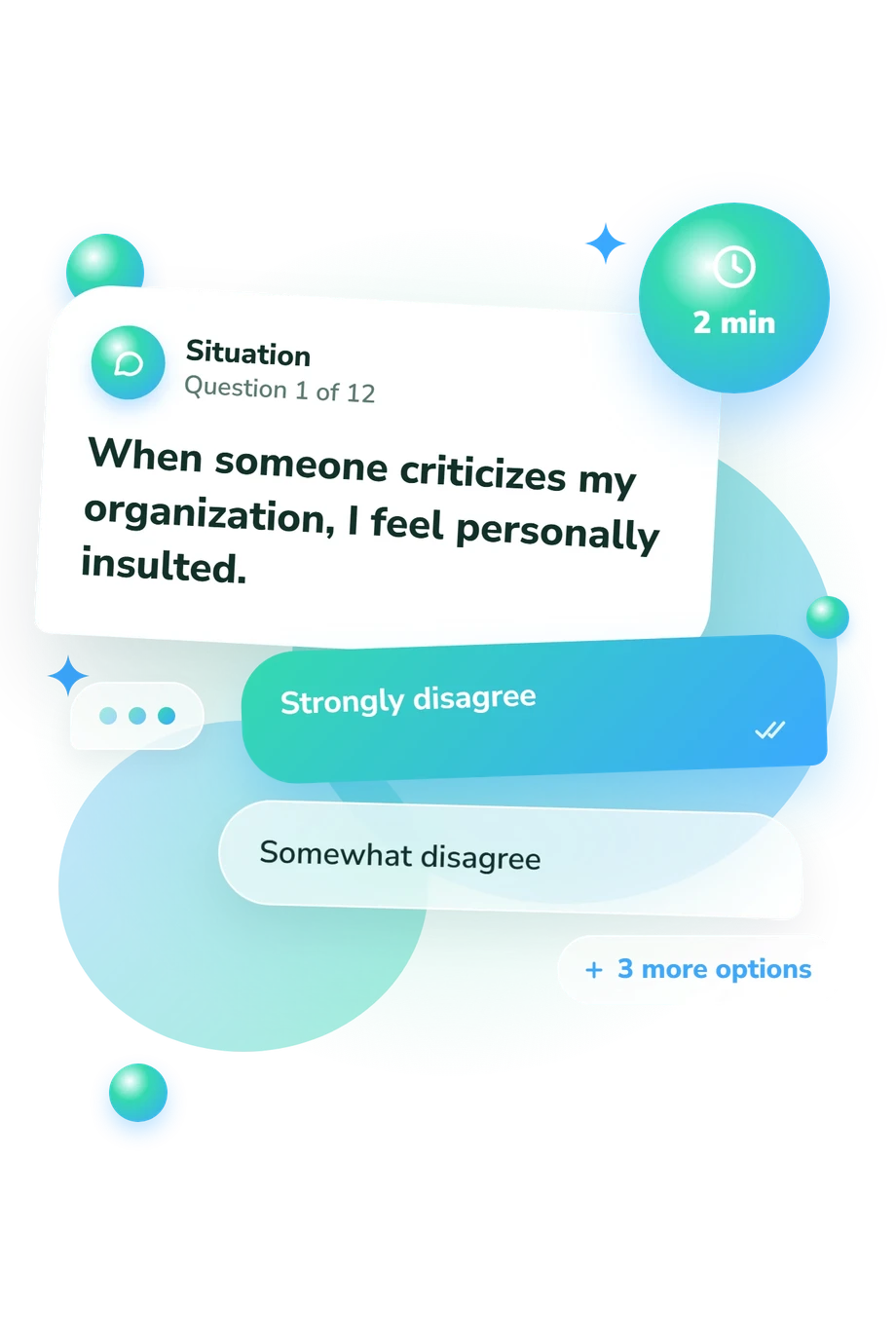
Example Questions From the Test
- Strongly disagree
- Somewhat disagree
- Not sure
- Somewhat agree
- Strongly agree
- Strongly disagree
- Disagree
- Not sure
- Agree
- Strongly agree
- Strongly disagree
- Somewhat disagree
- Not sure
- Somewhat agree
- Strongly agree
Organizational Identification Scale Test - Description and methodology of the test
For people whose organization forms part of their identity, the Organizational Identification Scale Test offers a focused self-report measure. It helps readers examine belonging, emotional connection, shared purpose, and reactions to praise or criticism. Readers can use this organizational identification questionnaire to clarify whether the organization feels personally meaningful and provide a structured starting point for reflection.
What This Assessment Explores
Membership can feel connected to the self, making organizational belonging part of how a person describes their identity. The items address membership, reactions to criticism and praise, interest in outsiders’ opinions, “we” language, organizational success, and shame.
The organizational identification measure reports one overall dimension: Organizational Identification (6-30). Higher scores indicate stronger identification through membership awareness, positive affect toward belonging, shared core goals, and acceptance of organizational behavioral norms. Bands are Low identification (6-13), Moderate identification (14-22), and High identification (23-30).
These themes show what the result may mean:
- Membership awareness shows how prominent belonging is in the respondent’s self-description.
- Emotional significance indicates whether praise, criticism, success, or shame carries personal weight.
- Shared purpose reflects how closely organizational goals and achievements feel connected to the respondent’s own.
- Norm alignment describes acceptance of behavioral expectations associated with membership.
Methodology and Scientific Basis
The questionnaire uses self-report agreement items. Each statement is rated on a five-point scale from strong disagreement to strong agreement, with an uncertain midpoint. It presents one overall Organizational Identification result, so interpretation concerns the general strength of identification represented by the responses.
Its clearest research connection is the published six-item Mael-Ashforth instrument (1992), which operationalized organizational identification within a social identity approach. Ashforth and Mael’s theory explains how group membership can shape self-definition, affect, and perceptions of shared fate. This online questionnaire is a separate online version of that instrument; the original study’s sample and validation findings do not establish properties of this version.
Interpret the result alongside role, length of membership, recent events, and the person’s lived sense of belonging when using this organizational identity assessment. Responses may change after conflict, criticism, praise, promotion, or plans to leave. Self-report depends on honest self-awareness, and this online version has no stated independent standardization, norms, or reliability evidence. A higher score therefore signals stronger reported identification across these themes, while a lower score suggests that membership is less central to the respondent’s current self-description.
- Mael, F., & Ashforth, B. E. (1992). Alumni and their alma mater: A partial test of the reformulated model of organizational identification. Journal of Organizational Behavior, 13(2), 103-123. 10.1002/job.4030130202
- Ashforth, B. E., & Mael, F. (1989). Social identity theory and the organization. Academy of Management Review, 14(1), 20-39. 10.5465/AMR.1989.4278999
Updated: