
Neurotic Asthenia Level Test
How the Scales are Structured
Who Usually Takes This Test?
See How You Compare
Below is a preview of how scores are typically distributed across each scale.
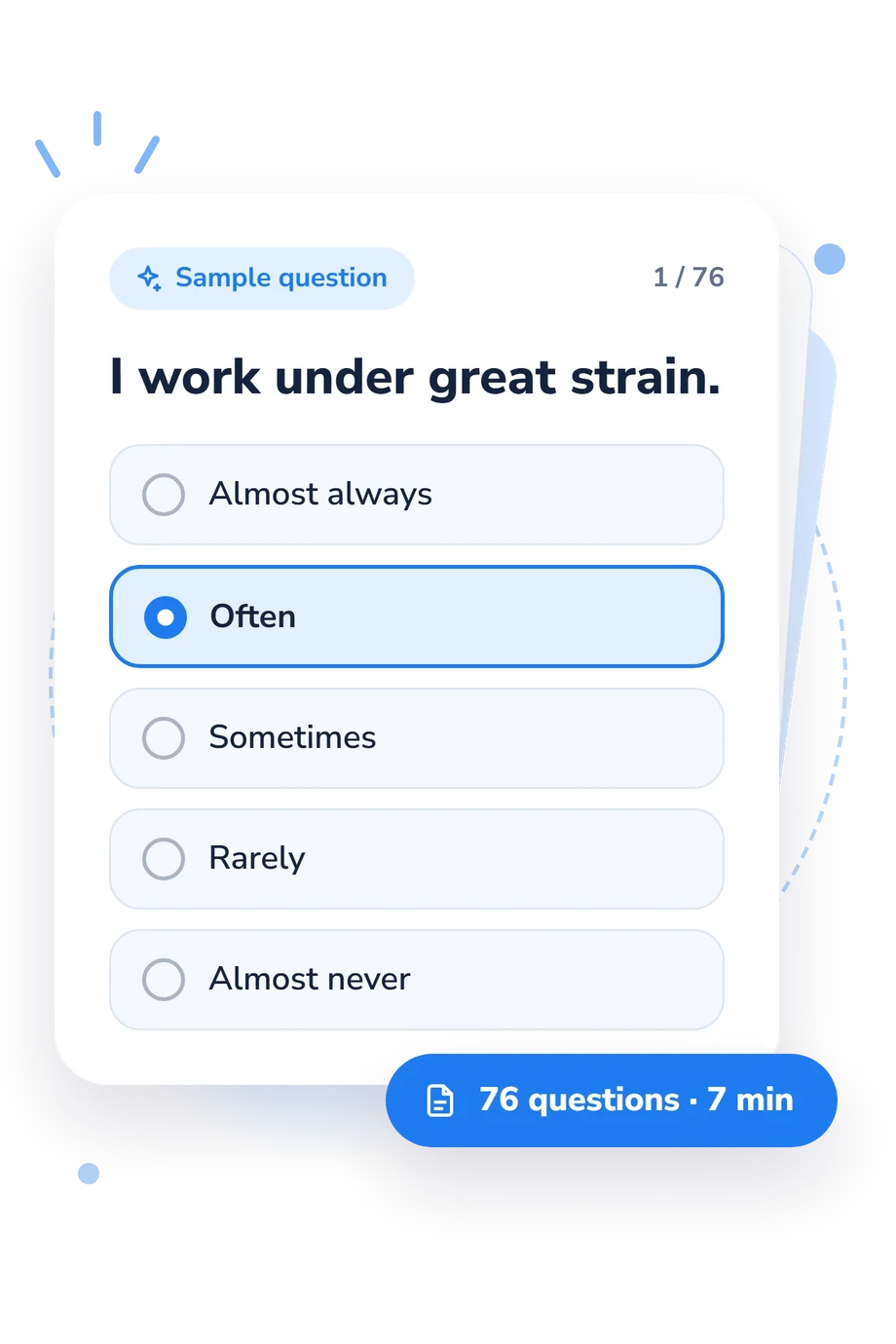
Example Questions From the Test
- Almost always
- Often
- Sometimes
- Rarely
- Almost never
- Almost always
- Often
- Sometimes
- Rarely
- Almost never
- Almost always
- Often
- Sometimes
- Rarely
- Almost never
Neurotic Asthenia Level Test - Description and methodology of the test
People seeking to understand persistent tension, weakness, concentration changes, or heightened emotional sensitivity may find the Neurotic Asthenia Level Test a useful structured starting point. A neurotic asthenia questionnaire organizes these experiences into a profile, helping the respondent see whether the overall pattern leans toward asthenia features or remains within the stated normative range.
What This Assessment Explores
The questionnaire examines a pattern associated with neurotic asthenia, including stamina, concentration, bodily sensations, sleep, and emotional vulnerability. In practical terms, this neurotic asthenia assessment connects reports of headaches, tremor, sweating, irritability, crying, and concentration difficulty with an overall result.
The item themes are:
- Strain and concentration show how work pressure, forgetfulness, and attention problems appear in the profile.
- Bodily activation captures weakness, headaches, twitching, sweating, digestive changes, and sensory sensitivity.
- Emotional reactivity reflects hurt feelings, irritability, anxiety-linked reactions, and uncontrolled laughter or crying.
- Rest and recovery indicate sleep onset, waking easily, and refreshing mornings.
The Neurotic Asthenia Level scale runs from -150 to 150. Its bands are Asthenia features likely (-150--1) and Within normal range (0-150). Positive totals indicate greater likelihood of no asthenic condition and normative-group classification, while negative totals suggest neurotic asthenia; qualitative review remains important.
Methodology and Evidence Base
Each item uses a five-point frequency format, from Almost always to Almost never. The statements cover recurring mental, physical, and emotional experiences, with responses combined into the displayed total score. Selecting a frequency option records how often the respondent experiences each statement, while the total organizes these reports into a structured self-report result.
This neurotic asthenia test is conceptually consistent with the published UNA scale, while broader clinical-psychology texts provide context but do not establish psychometric properties for this digital presentation.
Interpret the result as showing whether the reported pattern leans toward asthenia features or the normative group; qualitative analysis of responses can help identify significant asthenic manifestations. Exact item weights or reverse-scoring rules should not be inferred from the response labels. Current stress, sleep, physical health, expectations, and willingness to disclose sensitive experiences can affect scores, so the response pattern and personal context matter alongside the total.
- Wasserman, L. I., Vuks, A. Ya., Iovlev, B. V., Isurina, G. L., Karpova, E. B., Malkova, L. D., Sergeev, V. A., & Gubanova, I. V. Scale for Psychological Diagnosis of the Level of Neurotic Asthenia (UNA): Methodological Recommendations. St. Petersburg: V. M. Bekhterev Psychoneurological Institute, 1998.
- Wasserman, L. I., Trifonova, E. A., & Schelkova, O. Yu. Psychological Diagnostics and Correction in a Somatic Clinic: A Scientific and Practical Guide. St. Petersburg: Rech, 2011. ISBN 978-5-9268-1190-9.
- Wasserman, L. I., & Schelkova, O. Yu. (Eds.). Psychological Diagnosis of Emotional and Personality Disorders: Collective Monograph. St. Petersburg: Scythia-print, 2014. 408 pp.
- Shchelkova, O. Y., Grandilevskaya, I. V., Burina, E. A., & Trabczynski, P. K. Research Areas of the Department of Medical Psychology and Psychophysiology of Saint Petersburg State University. Archives of Psychiatry and Psychotherapy. 2017;1:56-61. 10.12740/APP/67330.
Updated: