
Pain Catastrophizing Scale (PCS) Test
How the Scales are Structured
Who Usually Takes This Test?
See How You Compare
Below is a preview of how scores are typically distributed across each scale.
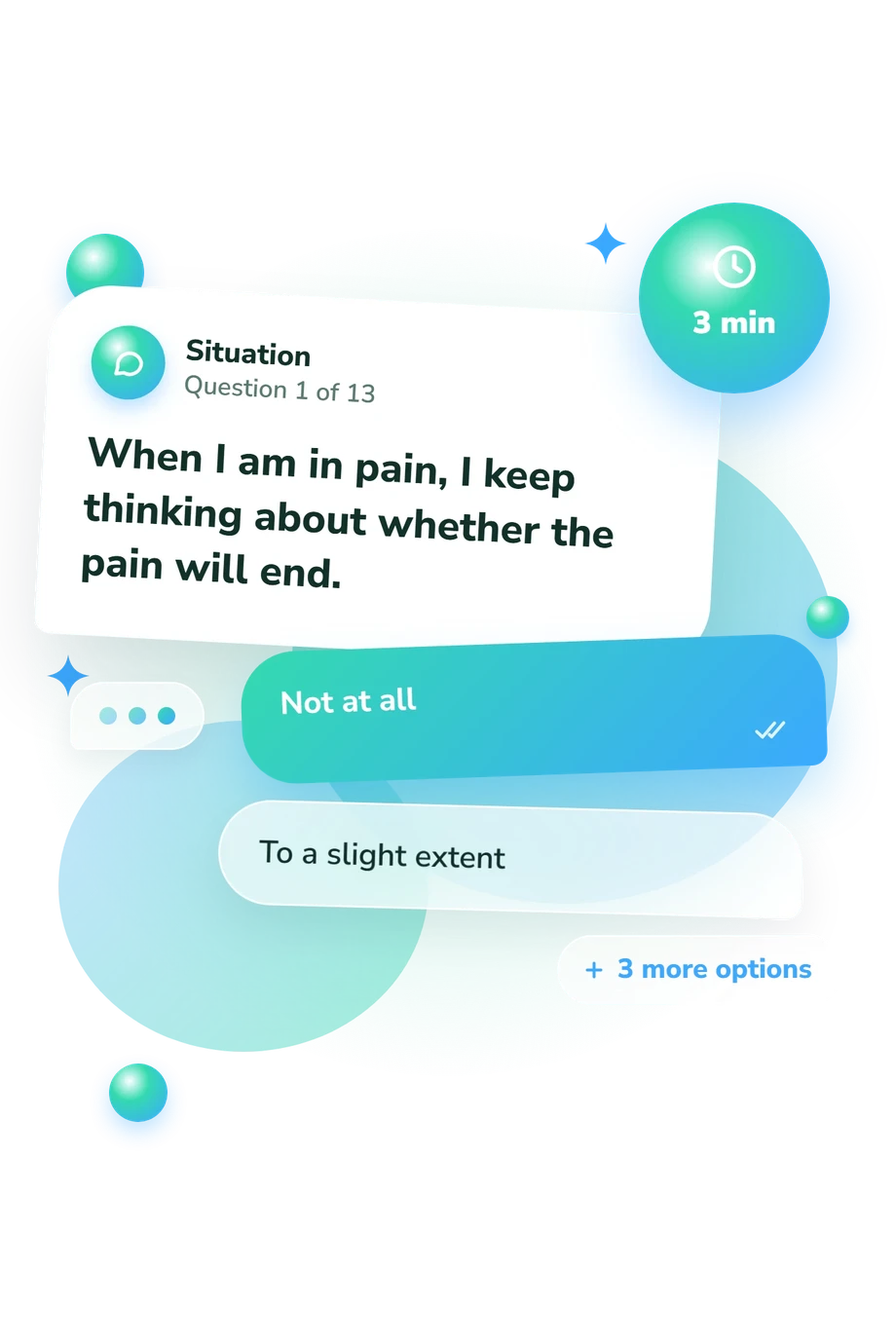
Example Questions From the Test
- Not at all
- To a slight extent
- To a moderate extent
- To a great extent
- All the time
- Not at all
- To a slight extent
- To a moderate extent
- To a great extent
- All the time
- Not at all
- To a slight degree
- To a moderate degree
- To a great degree
- All the time
Pain Catastrophizing Scale (PCS) Test - Description and methodology of the test
People with ongoing or acute pain can use the Pain Catastrophizing Scale (PCS) Test as a structured self-report exercise. A pain catastrophizing questionnaire organizes reactions such as dwelling on pain, fearing it will worsen, or feeling unable to influence it. Its focus is how these responses cluster around pain, not the medical cause of symptoms.
What This Assessment Explores
The assessment examines how pain-related thoughts and expectations shape perceived coping, rather than tissue damage or medical cause. Items address attention to pain, fear of worsening, expectations that it will not improve, and beliefs that nothing can reduce its intensity. As a pain catastrophizing assessment, the questionnaire separates three components and an overall profile.
The displayed dimensions are:
- Helplessness (0-24) measures perceived lack of control; Low helplessness 0-8, Moderate helplessness 9-16, High helplessness 17-24.
- Magnification (0-12) measures perceived exaggeration of pain’s intensity or consequences; Low magnification 0-3, Moderate magnification 4-7, High magnification 8-12.
- Rumination (0-16) measures attention to pain sensations and pain-related thoughts; Low 0-5, Moderate 6-10, High 11-16.
- Pain Catastrophizing (0-52) measures the overall tendency to catastrophize pain and integrates rumination, magnification, and helplessness; higher scores may indicate pronounced preoccupation with pain and difficulty coping psychologically; Low 0-17, Moderate 18-34, High 35-52.
Methodology and Scientific Basis
Each statement uses five response options, from Not at all to All the time, with intermediate degrees of intensity or frequency. The items concern pain-related thoughts, not pain severity. Ratings are combined into component and overall scores; displayed ranges do not reveal how many points any answer contributes.
The evidence base is the published Pain Catastrophizing Scale (PCS), a self-report instrument evaluated in adult samples. Osman and colleagues (2000) extended its psychometric evaluation, while Van Damme and colleagues (2002) reported a comparable three-factor model in clinical and non-clinical groups. Turner and Aaron (2001) describe catastrophizing as repetitive attention, magnified threat, and perceived inability to cope. The online questionnaire is conceptually consistent with the published PCS; evidence supporting that instrument does not automatically establish separate norms for this version.
Interpretation should account for current pain, distress, memory, willingness to answer candidly, and limited self-awareness. A higher band means stronger endorsement of the tendency defined by that scale, not greater tissue damage or a confirmed disorder. This pain catastrophizing test identifies reflection topics that should be considered alongside the person’s health context.
- Sullivan, Michael J. L., Scott R. Bishop, and Jayne Pivik. The Pain Catastrophizing Scale: Development and Validation. Psychological Assessment, 7(4), 524-532 (1995). 10.1037/1040-3590.7.4.524
- Osman, A., Barrios, F. X., Gutierrez, P. M., Kopper, B. A., Merrifield, T., and Grittmann, L. The Pain Catastrophizing Scale: Further Psychometric Evaluation with Adult Samples. Journal of Behavioral Medicine, 23(4), 351-365 (2000). 10.1023/A:1005548801037
- Van Damme, Stefaan, Geert Crombez, Patricia Bijttebier, Liesbet Goubert, and Boudewijn Van Houdenhove. A Confirmatory Factor Analysis of the Pain Catastrophizing Scale: Invariant Factor Structure across Clinical and Non-Clinical Populations. Pain, 96(3), 319-324 (2002). 10.1016/S0304-3959(01)00463-8
- Turner, Judith A., and Leslie A. Aaron. Pain-Related Catastrophizing: What Is It? Clinical Journal of Pain, 17(1), 65-71 (2001). 10.1097/00002508-200103000-00009
Updated: