
UCLA Loneliness Scale (Version 3) Test
How the Scales are Structured
Who Usually Takes This Test?
See How You Compare
Below is a preview of how scores are typically distributed across each scale.
Example Questions From the Test
- Never
- Rarely
- Sometimes
- Often
- Never
- Rarely
- Sometimes
- Often
- Never
- Rarely
- Sometimes
- Often
UCLA Loneliness Scale (Version 3) Test - Description and methodology of the test
People who want to understand whether disconnection is shaping their everyday experience can use the UCLA Loneliness Scale (Version 3) Test as a structured self-report measure. It is suited to readers reflecting on companionship, belonging, and access to supportive relationships. As a UCLA loneliness questionnaire, it converts recurring social experiences into a loneliness score that helps clarify the perceived strength of social disconnection.
What This Assessment Explores
This assessment looks beyond the number of relationships a person has. Its items address companionship, shared interests, closeness, belonging, being understood, and access to people who can offer support. They also include feeling left out, isolated, shy, or alone among others. A loneliness assessment reflects perceived connection, not merely solitude.
The main themes represented by the questions are:
- Belonging and shared interests show whether the respondent feels part of a group and connected through common ideas.
- Companionship and support indicate whether people seem available when company or someone to turn to is wanted.
- Closeness, understanding, exclusion, and isolation show whether relationships feel emotionally near, personally known, or genuinely connected.
Loneliness ranges from 20-80. Low means 20-29, Moderate 30-50, and High 51-80. Higher scores indicate stronger subjective loneliness and social isolation; lower scores indicate greater satisfaction with social contacts.
Methodology and Scientific Basis
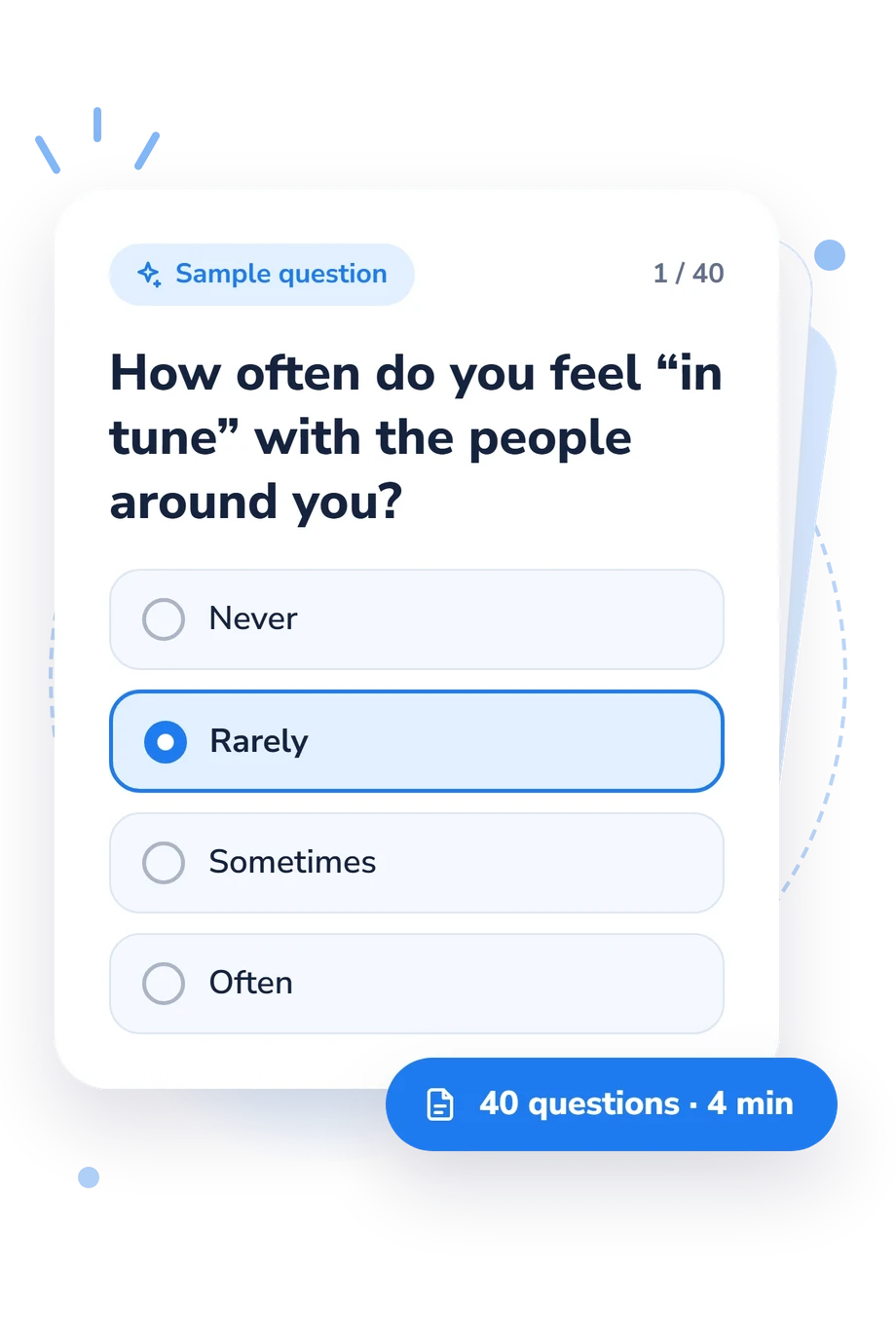
Each item asks how often a situation or feeling applies, using four ordered choices: Never, Rarely, Sometimes, and Often. The total combines these four-point responses, with positively worded items reverse-scored so a higher total consistently represents more loneliness. The result is therefore a global index, not a set of separate symptom scores.
Viewed as a social isolation test, the questionnaire is a self-report measure of perceived disconnection rather than an interview or behavioral observation. Its evidence base is the UCLA Loneliness Scale (Version 3), a standardized, psychometrically studied instrument associated with Daniel W. Russell. Russell’s 1996 study examined its reliability, validity, and factor structure, while the 1980 revised UCLA study provided earlier evidence on concurrent and discriminant validity. This online questionnaire is conceptually consistent with that instrument, not an adaptation of either published study.
Interpretation should consider current circumstances, relationship quality, mood, and the respondent’s willingness and ability to describe inner experience. Scores may shift after conflict, relocation, exclusion, or changes in support. The result is a structured indicator of perceived loneliness, not a clinical diagnosis.
- Russell, Daniel W. (1996). UCLA Loneliness Scale (Version 3): Reliability, Validity, and Factor Structure. Journal of Personality Assessment, 66(1), 20-40. 10.1207/s15327752jpa6601_2
- Russell, Daniel, Letitia A. Peplau, and Carolyn E. Cutrona. (1980). The revised UCLA Loneliness Scale: Concurrent and discriminant validity evidence. Journal of Personality and Social Psychology, 39(3), 472-480. 10.1037/0022-3514.39.3.472
Updated: