
Group Psychological Abuse Scale Test
How the Scales are Structured
Who Usually Takes This Test?
See How You Compare
Below is a preview of how scores are typically distributed across each scale.
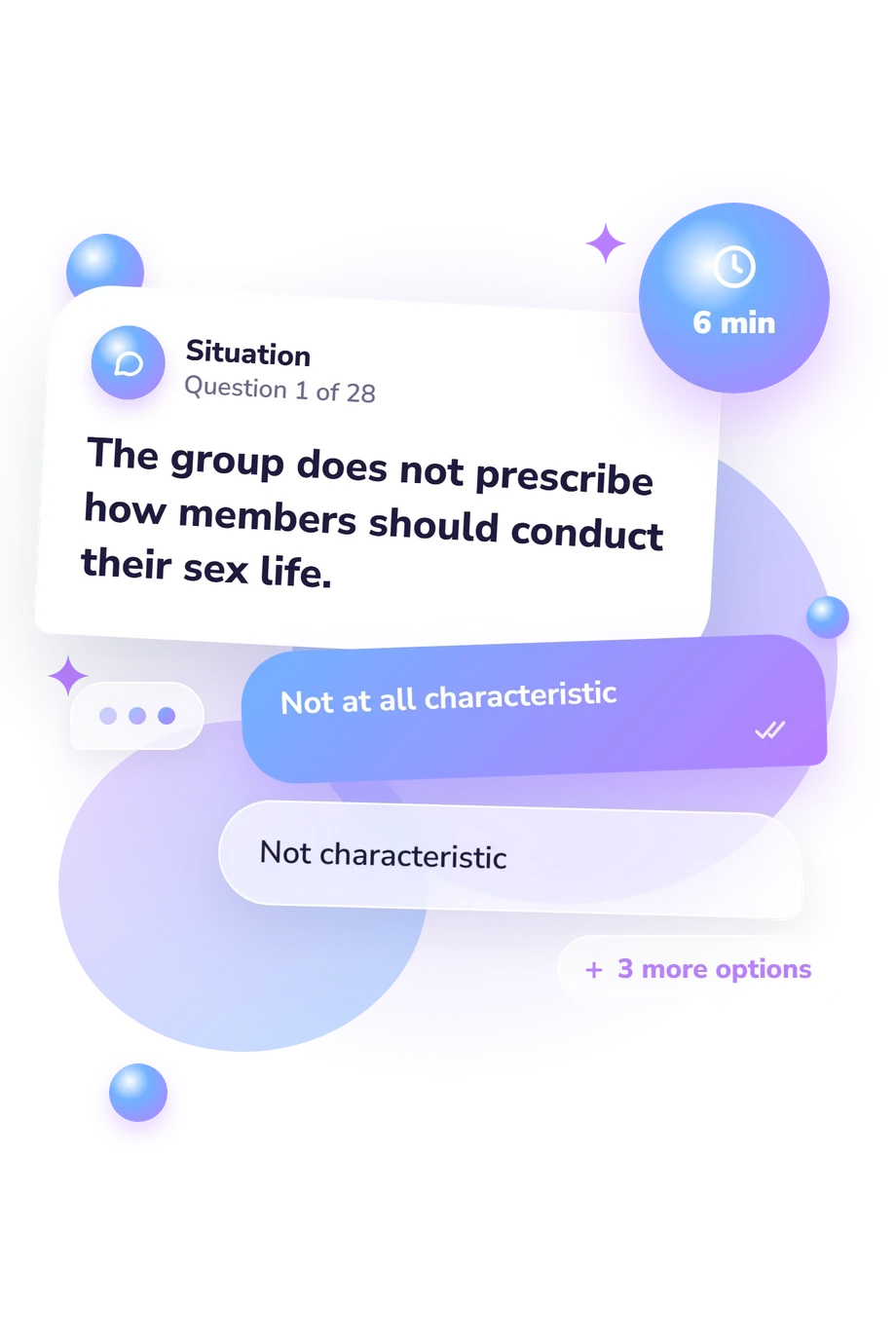
Example Questions From the Test
- Not at all characteristic
- Not characteristic
- Cannot say / not sure
- Characteristic
- Very characteristic
- Not at all characteristic
- Not characteristic
- Unable to say / not sure
- Characteristic
- Very characteristic
- Not at all characteristic
- Not characteristic
- Cannot say / not sure
- Characteristic
- Very characteristic
Group Psychological Abuse Scale Test - Description and methodology of the test
People who feel pressured, controlled, or used within a collective may want a structured way to examine those experiences. The Group Psychological Abuse Scale Test organizes that reflection around group influence and recurring group practices rather than a single incident. As a group psychological abuse questionnaire, it can help current or former members reflect on their own participation and experience within the group and identify patterns that deserve closer attention.
What This Assessment Explores
Questions examine how authority, beliefs, and rules affect choice and emotional security. They address relationships, health care, thinking, outsiders, recruitment, and service to leaders, especially when psychological abuse in groups is gradual or hard to describe.
The result organizes four dimensions plus a total score:
- Anxious Dependence (7-35) measures pressure-linked attachment: Low 7-20; High 21-35.
- Mind Control (7-35) measures interference with thinking, beliefs, and perception of reality: Low influence 7-20; High influence 21-35.
- Exploitation (7-35) measures use for group interests: Low exploitation 7-20; Elevated exploitation 21-35.
- Coerced Compliance (7-35) measures pressure to comply; above 21 indicates psychological abuse: Low pressure 7-20; Elevated pressure 21-35.
- Total Score (28-140) reflects the overall group psychological abuse experienced through manipulative and controlling influence: No abuse indicated 28-83; Abuse indicated 84-140.
Methodology and Scientific Basis
Each statement uses a five-point format from Not at all characteristic to Very characteristic, with an option for uncertainty. Items describe expectations and practices, so respondents rate how well they fit the group rather than choosing a label. Answers are summarized in four scale results and a total score with the displayed ranges and bands.
The closest source for this group psychological abuse assessment is the work of Chambers et al. (1994), which addresses dependence, thought reform, exploitation, and pressure to comply. Almendros et al. (2004) examined a Spanish version, while Saldaña et al. (2017) developed and validated a related measure of harm reported by group members. The questionnaire is conceptually consistent with Chambers et al.'s scale and related measures, but should not be presented as an adaptation, validated edition, or independently standardized version of those instruments unless documented.
Interpret it as perceived group influence, not standalone proof of intent, causation, or diagnosis. Self-report can shift with current distress, memory, social pressure, and willingness to disclose, so use findings to clarify patterns and guide broader reflection or assessment.
- Chambers, William V., Michael D. Langone, Arthur A. Dole, and James W. Grice. (1994). The Group Psychological Abuse Scale: A Measure of the Varieties of Cultic Abuse. Cultic Studies Journal, 11(1), 88-117.
- Almendros, Carmen, José Antonio Carrobles, Álvaro Rodríguez Carballeira, and Josep Maria Jansà. (2004). Psychometric Properties of the Spanish Version of the Group Psychological Abuse Scale. Psicothema, 16(1), 132-138.
- Saldaña, Omar, Álvaro Rodríguez-Carballeira, Carmen Almendros, and Jordi Escartín. (2017). Development and Validation of the Psychological Abuse Experienced in Groups Scale. The European Journal of Psychology Applied to Legal Context, 9(2), 57-64. 10.1016/j.ejpal.2017.01.002
Updated: