
Destructive Leadership Scale (DLS) Test
How the Scales are Structured
Who Usually Takes This Test?
See How You Compare
Below is a preview of how scores are typically distributed across each scale.
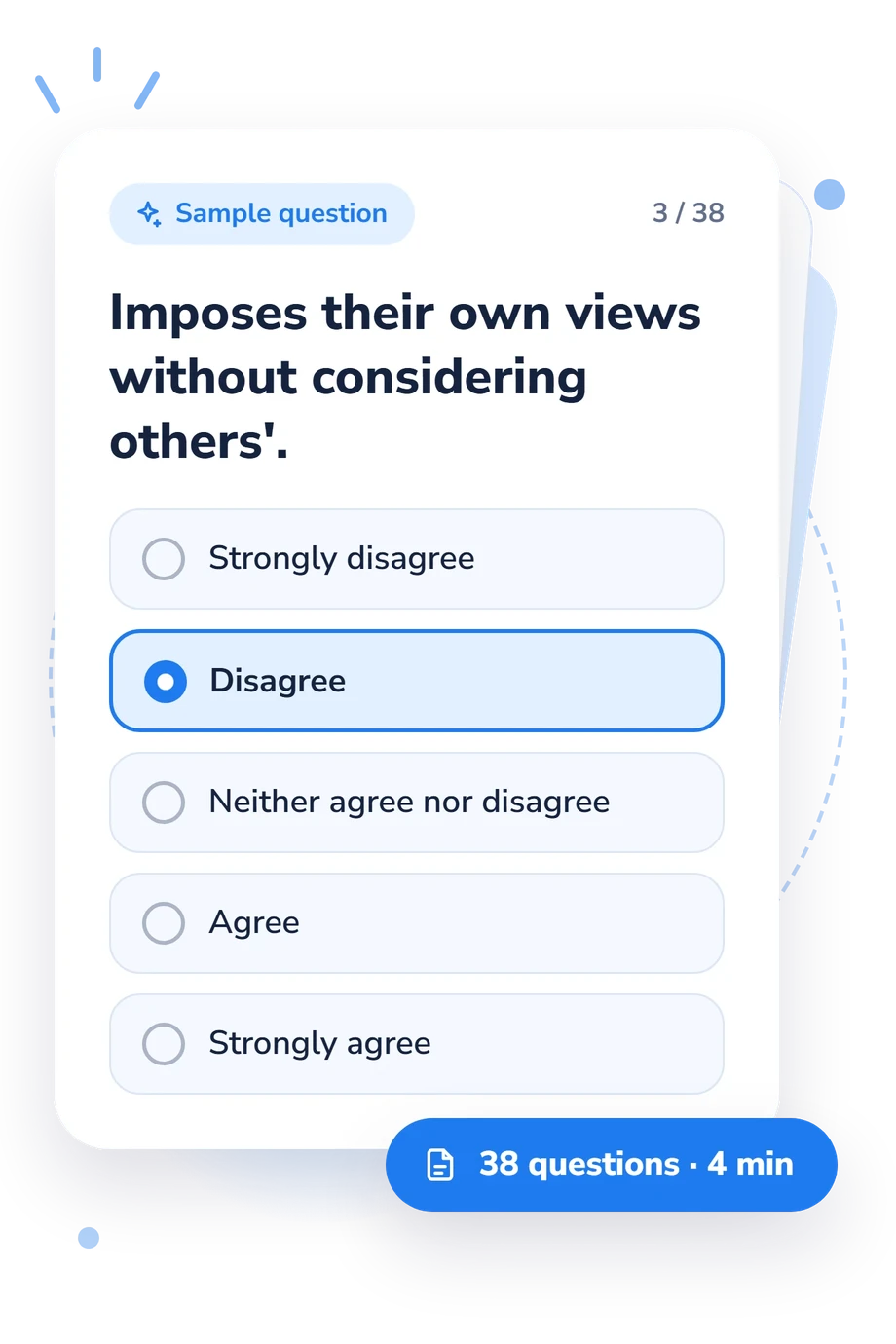
Example Questions From the Test
- Strongly disagree
- Disagree
- Neither agree nor disagree
- Agree
- Strongly agree
- Strongly disagree
- Disagree
- Neither agree nor disagree
- Agree
- Strongly agree
- Strongly disagree
- Disagree
- Neither agree nor disagree
- Agree
- Strongly agree
Destructive Leadership Scale (DLS) Test - Description and methodology of the test
People who want to examine difficult supervisory experiences may use the Destructive Leadership Scale (DLS) Test to organize recurring workplace behaviors into a clearer profile. It focuses on conduct that can erode the meaning of work, damage team belonging, weaken development, or restrict independence. As a destructive leadership assessment, it supports structured reflection on patterns rather than conclusions drawn from one disagreement.
What This Assessment Explores
This destructive leadership questionnaire covers workplace purpose, growth, relationships, and freedom through four distinct dimensions.
The profile contains four scales, with these displayed bands:
- Demotivating Leadership (1-5) describes behaviors that foster an employee’s sense that work is meaningless; Low 1-2.4, Moderate 2.5-3.4, High 3.5-5.
- Divisive Leadership (1-5) describes behaviors that isolate an employee and weaken belonging; Low 1-2.3, Moderate 2.4-3.6, High 3.7-5.
- Devaluing Leadership (1-5) describes behaviors that hinder professional development and foster feelings of incompetence; Low 1-2.3, Moderate 2.4-3.6, High 3.7-5.
- Coercive Leadership (1-5) describes behaviors that exert active control over work and can restrict autonomy and independence; Low coercion 1-2.4, Moderate coercion 2.5-3.4, High coercion 3.5-5.
Methodology and Evidence Base
For each statement, respondents select one of five agreement levels, from Strongly disagree to Strongly agree. The items cover imposed methods, blocked learning, demeaning messages, and conflict with colleagues. Respondents receive separate displayed results for the four dimensions rather than one overall label.
The questionnaire does not document how individual responses produce each displayed result. The bands are catalogue result categories for each dimension. The DLS, as a test of leadership behavior, is best read alongside specific examples and wider workplace context.
Conceptually, this questionnaire is consistent with the Disengaging Leadership Scale but is not an adaptation of it; Aasland and colleagues offer a broader framework for destructive leadership behavior. Bartholomew and colleagues explain how interpersonal control and thwarted psychological needs can diminish functioning, and Lipman-Blumen places destructive authority in a wider setting.
Because this is self-report, results can shift with current stress, memory, perspective, and willingness to disclose uncomfortable experiences; this online version has no established norms or validation.
- Nikolova, I., Caniëls, M. C. J., Schaufeli, W., & Semeijn, J. H. (2021). Disengaging Leadership Scale (DLS): Evidence of Initial Validity. International Journal of Environmental Research and Public Health, 18(6), 2824. DOI 10.3390/ijerph18062824
- Aasland, M. S., Skogstad, A., Notelaers, G., Nielsen, M. B., & Einarsen, S. (2010). The Prevalence of Destructive Leadership Behaviour. British Journal of Management, 21(2), 438-452. DOI 10.1111/j.1467-8551.2009.00672.x
- Bartholomew, K. J., Ntoumanis, N., Ryan, R. M., Bosch, J. A., & Thøgersen-Ntoumani, C. (2011). Self-Determination Theory and Diminished Functioning: The Role of Interpersonal Control and Psychological Need Thwarting. Personality and Social Psychology Bulletin, 37(11), 1459-1473. DOI 10.1177/0146167211413125
- Lipman-Blumen, J. (2005). The Allure of Toxic Leaders: Why We Follow Destructive Bosses and Corrupt Politicians-and How We Can Survive Them. Oxford University Press. DOI 10.1093/oso/9780195166347.001.0001
Updated: