
Moral Conformity Scale in Virtual Environments Test
How the Scales are Structured
Who Usually Takes This Test?
See How You Compare
Below is a preview of how scores are typically distributed across each scale.
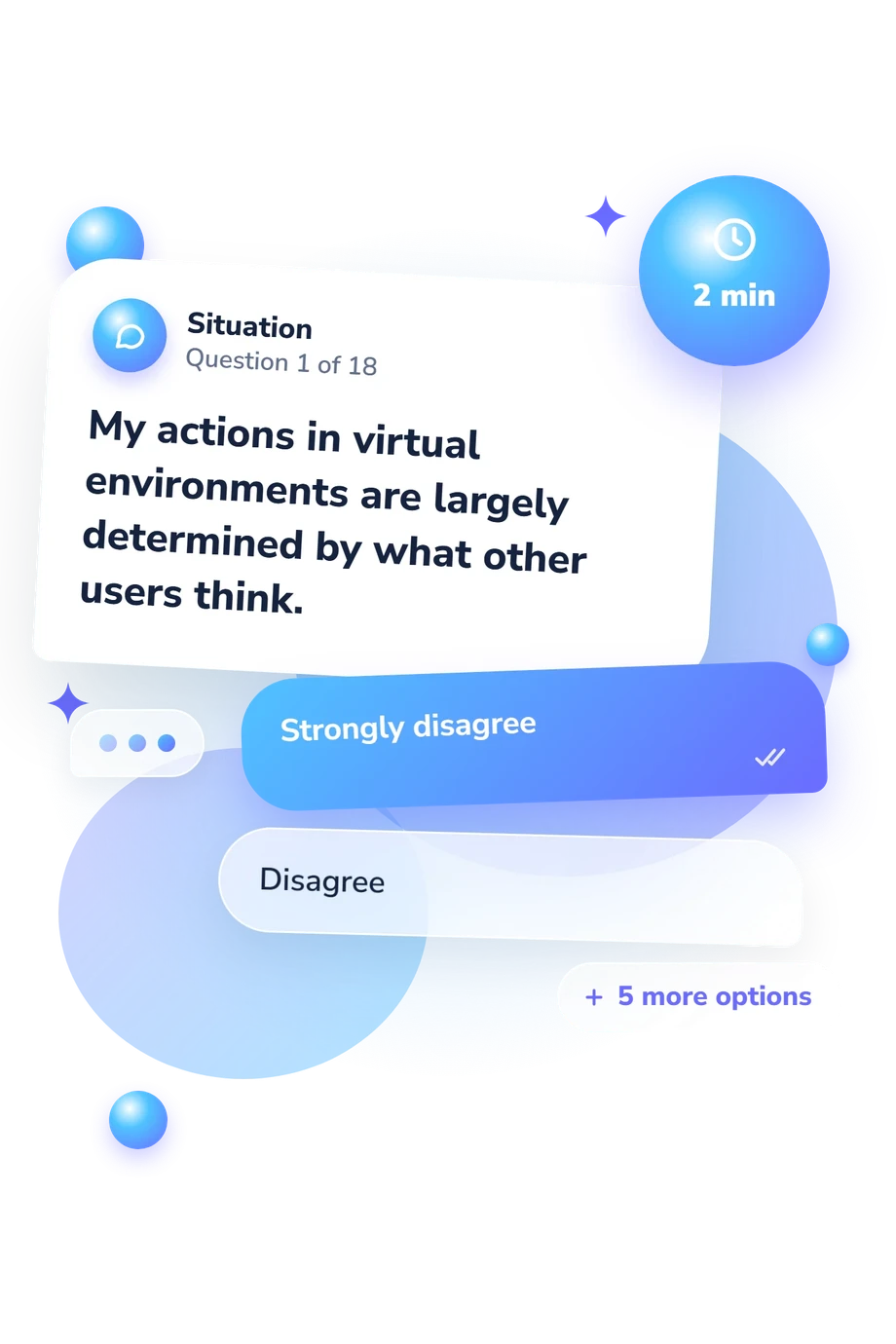
Example Questions From the Test
- Strongly disagree
- Disagree
- Somewhat disagree
- Neither agree nor disagree
- Somewhat agree
- Agree
- Strongly agree
- Strongly disagree
- Disagree
- Somewhat disagree
- Neither agree nor disagree
- Somewhat agree
- Agree
- Strongly agree
- Strongly disagree
- Disagree
- Somewhat disagree
- Neither agree nor disagree
- Somewhat agree
- Agree
- Strongly agree
Moral Conformity Scale in Virtual Environments Test - Description and methodology of the test
People who want to understand how strongly social expectations shape their digital choices can use the Moral Conformity Scale in Virtual Environments Test as a focused self-report exercise. It suits anyone reflecting on participation in online communities, especially when group opinion, approval, or shared values affect judgment. The result gives one overall indication of conformity to online moral norms and the degree to which independent judgment appears in those choices.
What This Assessment Measures
Rather than asking about a platform or incident, the questionnaire examines social influence online. Other users’ opinions, community expectations, negative reactions, and conflict make the result relevant to digital community behavior in forums, chats, games, social networks, and shared spaces.
The result is Moral Conformity in Virtual Environments: 9-63. It assesses adherence to moral norms and behavioral rules in online environments. Higher scores indicate greater conformity; lower scores indicate a tendency toward independent decision-making that may not always align with commonly accepted norms. The bands are Low conformity, 9-27; Moderate conformity, 28-45; and High conformity, 46-63.
These themes clarify conformity in virtual environments:
- Social approval shows how conduct changes after feedback or other users’ reactions.
- Conflict management shows whether compromise guides responses to disagreement.
- Community values show how shared standards and majority views shape judgment and expression.
Methodology and Evidence Base
Each statement uses a seven-point agreement response, ranging from Strongly disagree to Strongly agree, with minor wording differences across the answer choices. The questionnaire presents one displayed overall scale. The conversion from the seven-point responses to that result is not documented.
Kelly and colleagues (2017) are the most directly relevant reference because they examine moral conformity in online interactions. The questionnaire is conceptually consistent with that research, without establishing that it reproduces a named published instrument. Fedorov and Zlobina (2025) examine self-reported conformity within personality dispositions, while Fedorov and Rakhmanov (2024) study moral conformity under virtual pressure.
The result comes from an online self-report questionnaire and is best read as a current tendency rather than a fixed personal quality. Its statements cover social influence, responses to negative reactions, compromise in conflict, and the effect of community values on online decisions. Scores may shift with context, self-presentation, and self-awareness, so interpretation is strongest when the result is considered alongside specific situations.
- Fedorov, A. A., & Zlobina, M. V. (2025). Self-reported Conformity within the Structure of Personality Dispositions. Lomonosov Psychology Journal, 48(2), 188-216. 10.11621/LPJ-25-17
- Fedorov, A. A., & Rakhmanov, A. S. (2024). Moral Conformity under Different Forms of Virtual Pressure. Experimental Psychology (Russia), 17(1), 118-130. 10.17759/exppsy.2024170108
- Kelly, M., Ngo, L., Chituc, V., Huettel, S., & Sinnott-Armstrong, W. (2017). Moral conformity in online interactions: rational justifications increase influence of peer opinions on moral judgments. Social Influence, 12(2-3), 57-68. 10.1080/15534510.2017.1323007
Updated: