
Montgomery-Asberg Depression Rating Scale (MADRS) Test
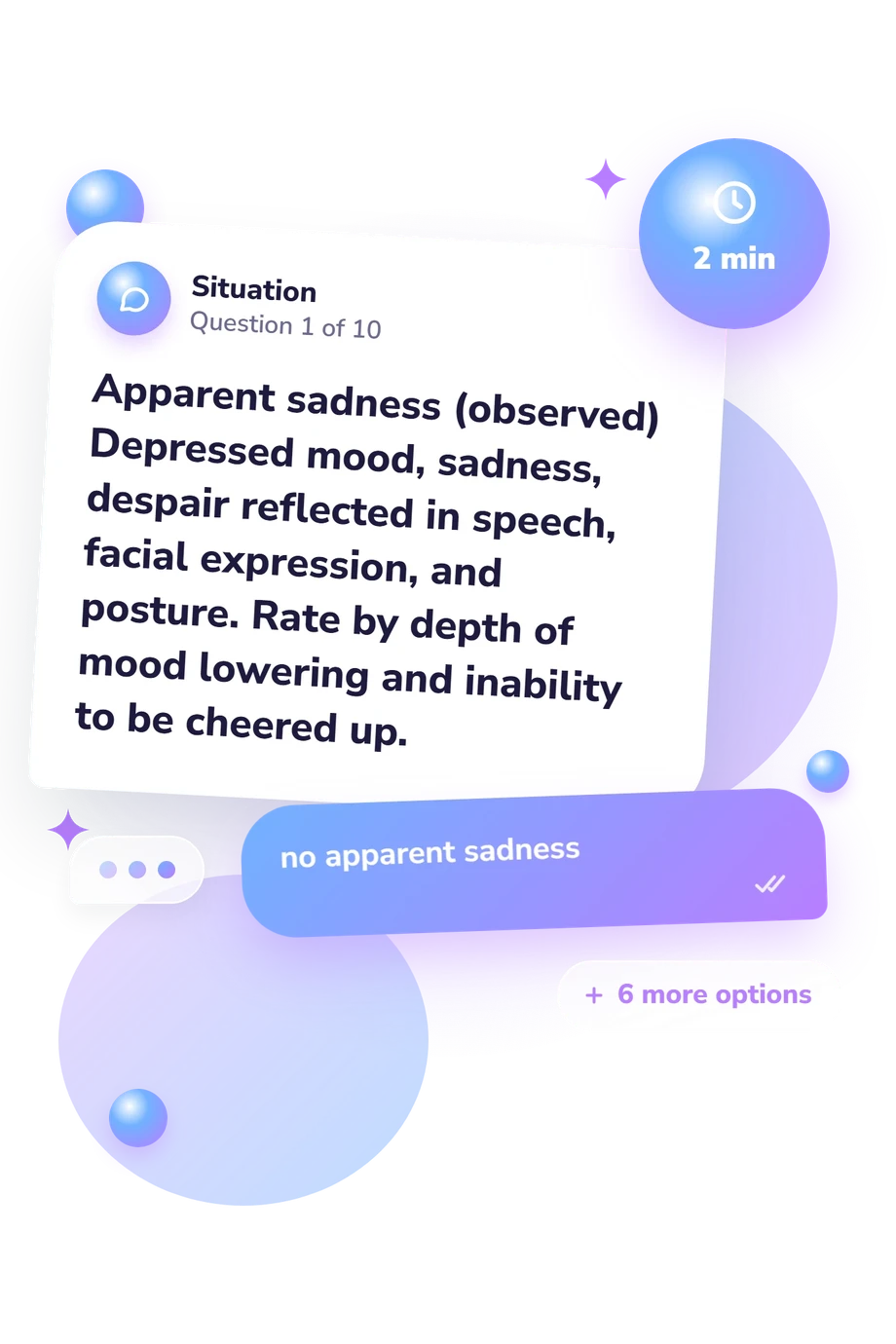
How the Scales are Structured
Who Usually Takes This Test?
See How You Compare
Below is a preview of how scores are typically distributed across each scale.
Example Questions From the Test
- no apparent sadness
- 1
- appears sad or downcast but can be easily cheered up
- 3
- appears sad and unhappy most of the time
- 5
- appears continuously despondent; extremely sad and unhappy
- occasional sadness, related to circumstances
- 1
- feels sad or depressed but is easily distracted
- 3
- pervasive feelings of low mood or gloom; mood is still influenced by external events
- 5
- persistent and unvarying feelings of sadness, despair, or misery
- Normal or increased appetite
- 1
- Slightly reduced appetite
- 3
- No appetite; food seems tasteless
- 5
- Eats only when urged or pressured
Montgomery-Asberg Depression Rating Scale (MADRS) Test - Description and methodology of the test
For people seeking a structured view of depressive symptoms, the Montgomery-Asberg Depression Rating Scale (MADRS) Test offers a focused way to consider mood, functioning, physical changes, and thoughts. This MADRS depression test can help a person decide whether a structured snapshot of current symptoms would be useful before choosing what kind of next step or conversation feels appropriate.
What This Assessment Explores
The questionnaire examines observable and personally experienced aspects of depression. It covers sadness, inner tension, sleep and appetite changes, concentration, reduced initiative, diminished emotional response, pessimistic self-evaluation, and suicidal thinking. These themes reflect emotional, physical, cognitive, behavioral, and interpersonal effects.
The Montgomery-Asberg Depression Rating Scale (MADRS) produces a 0-60 total. When interpreting the MADRS score, higher totals indicate greater symptom severity. The displayed bands are:
- None to mild (0-19) reflects little or limited symptom severity.
- Moderate (20-34) reflects a more substantial depressive symptom pattern.
- Severe (35-60) reflects a high level of depressive symptom severity.
The result offers a snapshot for noticing priorities and tracking change over time, including response to treatment.
Methodology and Scientific Basis
Each item presents a symptom or situation with four ordered response bands: 0, 1-2, 3-4, and 5-6. Choices describe increasing frequency, persistence, interference, or intensity. Some prompts concern observable presentation, while others address inner experience. Results are reported as a total and interpreted using the displayed bands.
The questionnaire is conceptually consistent with the published MADRS, described by Montgomery and Asberg in 1979 and designed to detect change in depressive symptoms. Davidson and colleagues reported reliability and validity for that instrument. Williams and Kobak’s SIGMA work concerns a structured interview guide for consistent MADRS administration. Those findings apply to the cited instruments, not this online version. For this depression symptom severity test, those studies do not establish its standardization or clinical performance.
This online self-rating format covers observable presentation and inner experience, unlike the standardized clinical administration studied in those sources. Results may reflect current circumstances, memory, self-awareness, and response style. They cannot establish a diagnosis or explain symptom causes. Immediate suicidal danger requires urgent real-world support rather than reliance on the score.
- Montgomery, S. A., and Asberg, M. (1979). A new depression scale designed to be sensitive to change. The British Journal of Psychiatry, 134(4), 382-389. 10.1192/bjp.134.4.382
- Davidson, J., Turnbull, C. D., Strickland, R., Miller, R., and Graves, K. (1986). The Montgomery-Asberg Depression Scale: reliability and validity. Acta Psychiatrica Scandinavica, 73(5), 544-548. 10.1111/j.1600-0447.1986.tb02723.x
- Williams, J. B. W., and Kobak, K. A. (2008). Development and reliability of a structured interview guide for the Montgomery-Asberg Depression Rating Scale (SIGMA). The British Journal of Psychiatry, 192(1), 52-58. 10.1192/bjp.bp.106.032532
Updated: