
Utrecht Proactive Coping Competence Scale (UPCC) Test
How the Scales are Structured
Who Usually Takes This Test?
See How You Compare
Below is a preview of how scores are typically distributed across each scale.
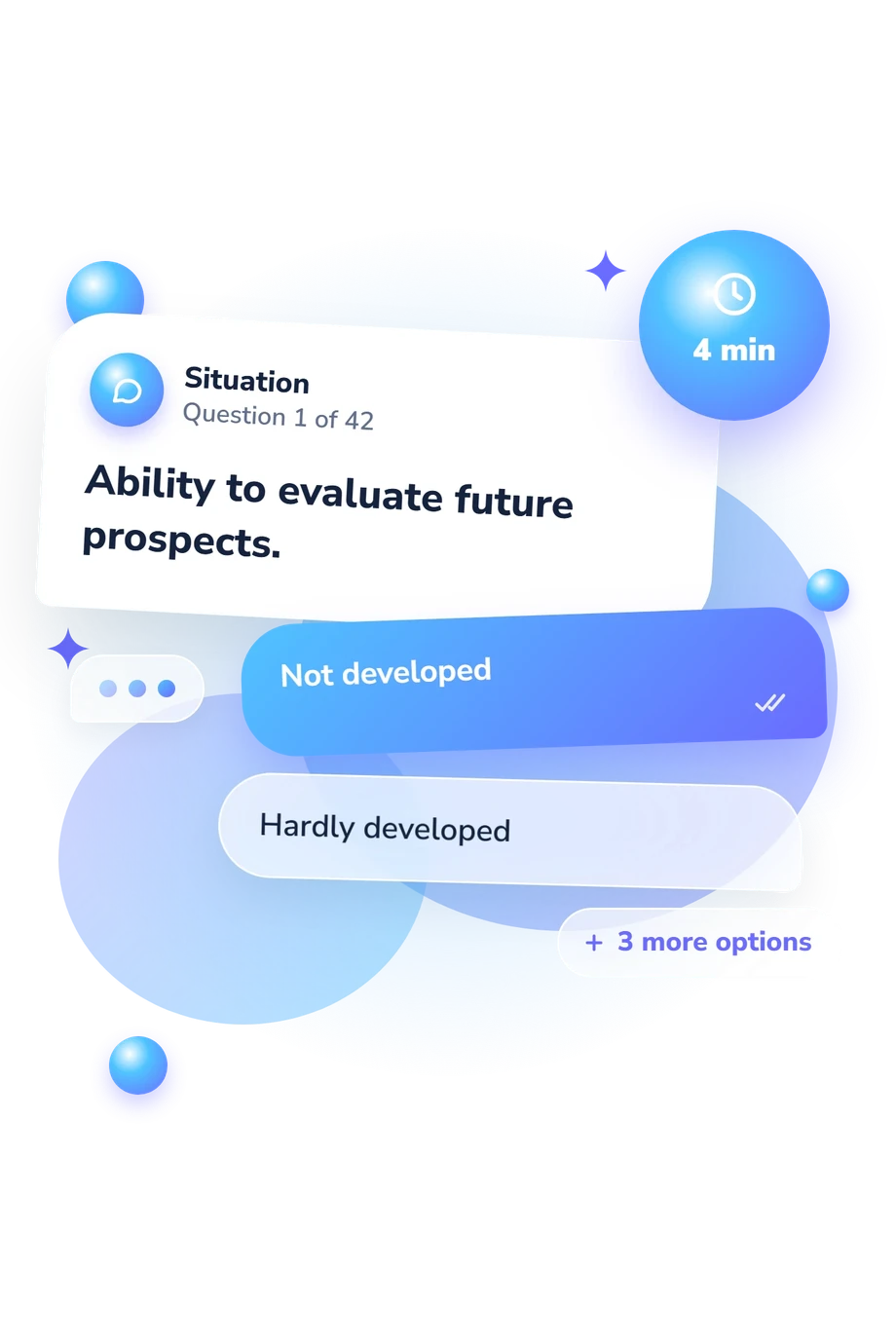
Example Questions From the Test
- Not developed
- Hardly developed
- Weakly developed
- More or less developed
- Fully developed
- Not developed
- Hardly developed
- Poorly developed
- More or less developed
- Fully developed
- Not developed
- Hardly developed
- Poorly developed
- More or less developed
- Fully developed
Utrecht Proactive Coping Competence Scale (UPCC) Test - Description and methodology of the test
People who want to understand how they prepare for demands, setbacks, and future goals can use this structured self-reflection. The Utrecht Proactive Coping Competence Scale (UPCC) Test organizes responses into a profile of analytical, anticipatory, planning, self-appraisal, and support-seeking tendencies. As a proactive coping assessment, it offers a focused way to notice strengths and areas that may deserve deliberate practice without reducing coping to one overall label.
What This Assessment Explores
Items assess judgment, self-appraisal, problem solving, persistence, and help seeking. This coping skills questionnaire gives a profile, not a verdict. Its five dimensions are:
- Situation Analysis (7-35) measures analysis of circumstances and solutions under stress: Limited analysis (7-22); Adequate analysis (23-33); Strong analysis (34-35).
- Awareness of Personal Limitations (5-25) measures self-criticism and resource matching: Needs more realism (5-15); Generally realistic (16-23); Highly resource-aware (24-25).
- Social Support (4-20) measures seeking help and evaluating feedback: Limited support seeking (4-11); Adequate support seeking (12-18); Strong support seeking (19-20).
- Problem Anticipation (6-30) measures early detection, obstacle anticipation, perceptiveness, and intuition: Lower forecasting (6-19); Developing forecasting (20-28); Strong forecasting (29-30).
- Planning (7-35) measures goals, prospects, and plan implementation: Needs strengthening (7-20); Developing (21-33); Strong (34-35).
Methodology and Evidence Base
Each item asks the respondent to rate an ability on five ordered levels, from not developed to fully developed. Topics include anticipation, criticism, advice, alternative solutions, persistence, goal-outcome comparison, and learning from outcomes. Responses are grouped by dimension and read through the displayed ranges and bands, not as an overall diagnosis. These groupings connect forecasts, resource awareness, problem solving, goal setting, implementation, and interpersonal help seeking.
The published UPCC psychometric study examines the instrument's measurement properties, while a post-stroke UPCC study and a Russian-language adaptation examine its use in additional contexts. This online administration is distinct from those studies: it groups answers into the five displayed dimensions and presents a descriptive self-reflection profile.
Proactive coping theory describes proactive coping as self-regulation that anticipates demands and mobilizes resources, explaining the combination of planning, appraisal, and support seeking. This proactive coping skills profile is descriptive self-reflection: current stress, self-awareness, memory, and the wish to appear capable can shape answers, so results should be read in context rather than as fixed traits.
- Bekhter, A. A. (2025). Primary adaptation of the Russian-language version of the Utrecht Proactive Coping Competence Scale. Experimental Psychology (Russia), 18(2), 187-205. 10.17759/exppsy.2025180211
- Bode, C., Thoolen, B., & de Ridder, D. T. D. (2008). Measuring proactive coping: Psychometric characteristics of the Utrecht Proactive Coping Competence Scale (UPCC). Psychologie & Gezondheid, 36(2), 81-91. 10.1007/BF03077476
- Tielemans, N. S., Visser-Meily, J. M., Schepers, V. P., Post, M. W., & van Heugten, C. M. (2014). Proactive coping poststroke: Psychometric properties of the Utrecht Proactive Coping Competence Scale. Archives of Physical Medicine and Rehabilitation, 95(4), 670-675. 10.1016/j.apmr.2013.11.010
- Aspinwall, L. G., & Taylor, S. E. (1997). A stitch in time: Self-regulation and proactive coping. Psychological Bulletin, 121(3), 417-436. 10.1037/0033-2909.121.3.417
Updated: