
Shyness Scale Test
How the Scales are Structured
Who Usually Takes This Test?
See How You Compare
Below is a preview of how scores are typically distributed across each scale.
Example Questions From the Test
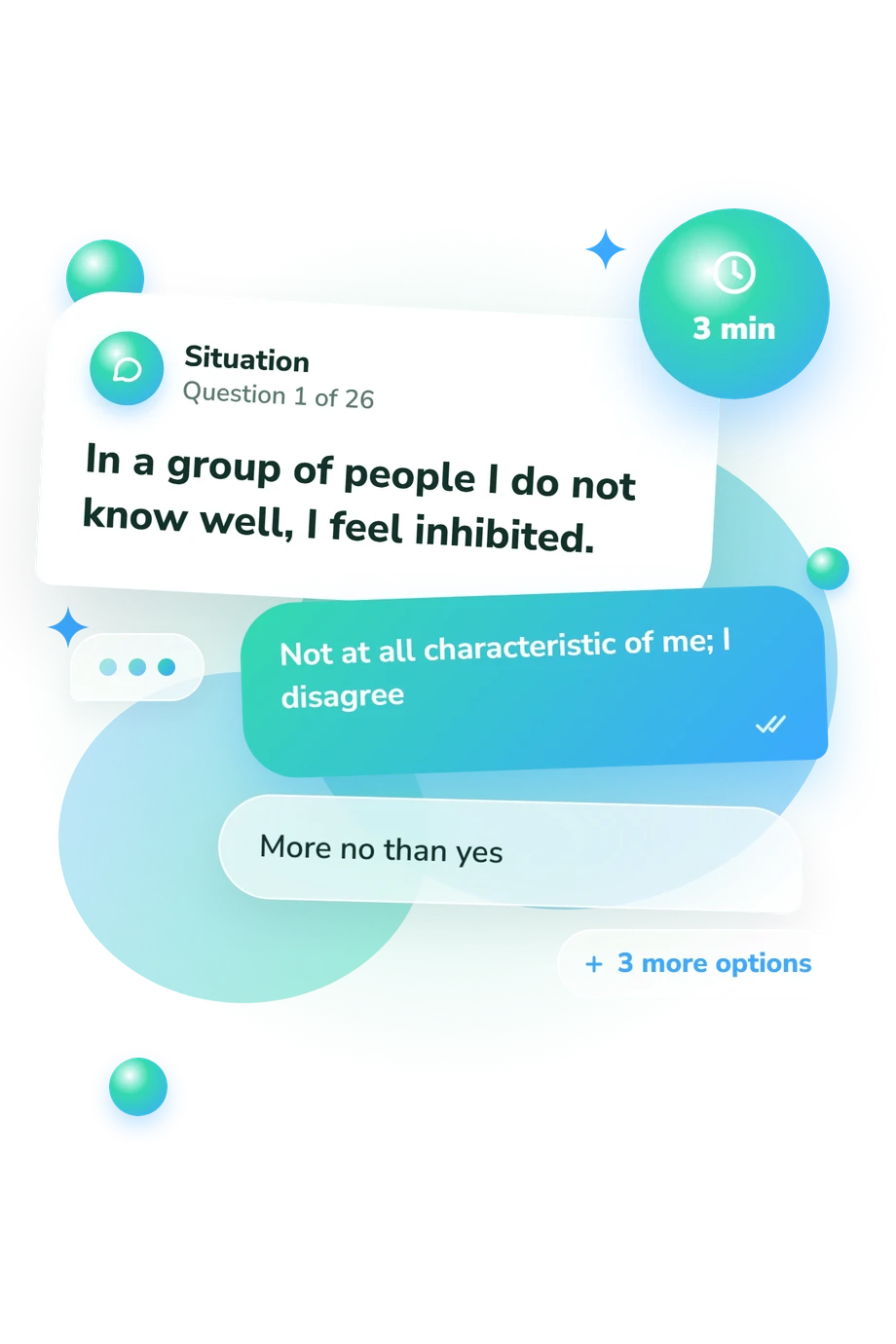
- Not at all characteristic of me; I disagree
- More likely no than yes
- Neither yes nor no
- More likely yes than no
- Very characteristic of me; exactly so
- Not at all characteristic of me; I disagree
- More no than yes
- Neither yes nor no
- More yes than no
- Extremely characteristic of me; exactly so
- Not at all true of me; I disagree
- More “no” than “yes”
- Neither “yes” nor “no”
- More “yes” than “no”
- Completely true of me; exactly so
Shyness Scale Test - Description and methodology of the test
People who are unsure whether social discomfort reflects a passing situation or a recurring pattern may find the Shyness Scale Test useful. A shyness questionnaire invites readers to consider when inhibition changes their participation and whether they want closer contact despite feeling held back. The result offers a focused question for self-reflection, not a label for personality.
What This Assessment Measures
Shyness is not equated with disliking people. The items examine inhibition that may coexist with wanting contact across unfamiliar groups, parties, conversation, eye contact, and moments when communication feels easy. The result reflects withdrawal and avoidance of new contacts while allowing for a desire to be with others.
Themes show how this tendency may appear:
- Unfamiliar contact shows whether meeting new people affects ease and spontaneity.
- Groups and settings indicate whether crowds or attention increase withdrawal.
- Communication situations capture asking questions, eye contact, and speaking freely.
The displayed scale, Shyness (13-65), has three bands: Low shyness (13-32), Moderate shyness (33-40), and High shyness (41-65). Lower scores indicate fewer reported withdrawal or avoidance tendencies; higher scores indicate a more pronounced pattern that can coexist with wanting social contact. A shyness assessment helps identify a pattern without reducing sociability to one score.
Methodology and Evidence Base
Each statement uses five response options, ranging from not at all characteristic or true to very characteristic or true. A neutral midpoint separates agreement or disagreement from uncertainty. The result is displayed in the three named bands, but the questionnaire does not state how ease-oriented responses combine; reverse coding and raw summation should not be inferred.
These 13 items are associated with Philip G. Zimbardo's 1977 book Shyness: What It Is, What to Do About It (Addison-Wesley, Reading, Massachusetts), the relevant original source. The online questionnaire is not thereby validated or standardized as the original instrument, so its norms and reliability cannot be assumed. Cheek and Buss's related shyness measures can support construct comparison but do not establish this questionnaire's provenance or validation.
Context matters when interpreting shyness scale results. Responses may shift with tiredness, social pressure, or a particular setting, and self-report depends on accurate self-observation. The score cannot determine whether discomfort reflects temperament, anxiety, unfamiliarity, or a relationship-specific situation; broader assessment is needed when distress or impairment is central.
- Cheek, J. M. (1983). The Revised Cheek and Buss Shyness Scale (RCBS). Unpublished manuscript, Wellesley College, Wellesley, Massachusetts.
- Hopko, D. R., Stowell, J., Jones, W. H., Armento, M. E., & Cheek, J. M. (2005). Psychometric Properties of the Revised Cheek and Buss Shyness Scale. Journal of Personality Assessment, 84(2), 185-192. 10.1207/s15327752jpa8402_08
- Cheek, J. M., & Buss, A. H. (1981). Shyness and sociability. Journal of Personality and Social Psychology, 41(2), 330-339. 10.1037/0022-3514.41.2.330
Updated: