
Risk Factors Assessment Test
How the Scales are Structured
Who Usually Takes This Test?
See How You Compare
Below is a preview of how scores are typically distributed across each scale.
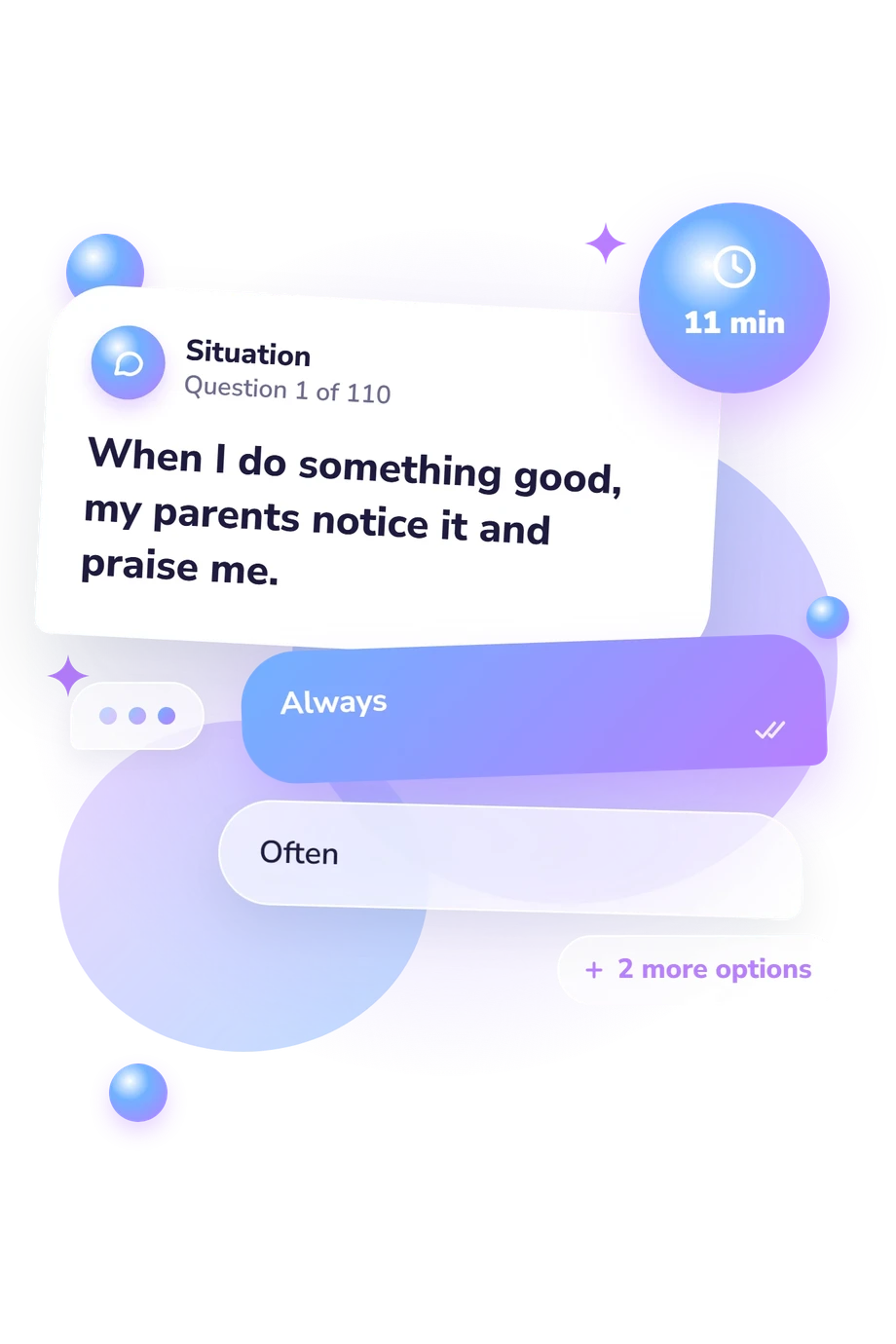
Example Questions From the Test
- Always
- Often
- Rarely
- Never
- Always
- Often
- Rarely
- Never
- Always
- Often
- Rarely
- Never
Risk Factors Assessment Test - Description and methodology of the test
Adolescents and adults supporting them can use this structured self-report to build a risk factor profile of circumstances that may need attention. The Risk Factors Assessment Test shows how strongly risk factors are represented in the respondent’s reported experience, helping readers interpret patterns across the result rather than treating one score as a complete explanation. Its questionnaire format supports focused discussion and self-reflection.
What This Assessment Explores
The profile shows where risk factors are concentrated for an adolescent, supporting adolescent risk assessment:
- School (0-22) measures academic difficulty, conflict, school changes, and absenteeism: Low (0-10), Moderate (11-16), High (17-22).
- Immediate Social Environment (0-60) measures deviant influences in the immediate environment, substance-use approval, and conflicted peer relationships: Low (0-22), Moderate (23-42), High (43-60).
- Psychological (0-48) measures free time, impulsivity, loneliness, difficult situations, and attitudes toward psychoactive substances: Low (0-16), Moderate (17-37), High (38-48).
- Family (0-46) measures family risk from absent shared values and goals, reduced social control, parental conflict, and inconsistent demands: Low (0-17), Moderate (18-33), High (34-46).
- Overall Risk (0-176) reflects cumulative risk across factors: Low risk (0-65), Moderate risk (66-128), High risk (129-176).
Together, these results identify contexts for prevention, conversation, or further assessment, not a single cause.
Methodology and Scientific Basis
The questionnaire uses mixed response formats: frequency and safety questions, Yes/No items, graded attitudes toward substances, access categories, peer-exposure estimates, and questions about school or family situations. Responses form domain totals and an overall score, but displayed ranges do not show how individual responses contribute, so points cannot be inferred.
The closest source is the methodological complex described by Demenko and colleagues. Related work by Rasskazova and colleagues examined psychological risk indicators among adolescents with delinquent or addictive behavior and comparison groups. This questionnaire is conceptually consistent with those studies, not a verbatim reproduction or equivalent standardized administration. Its substance use risk factors fit Jessor’s psychosocial framework linking behavior with personal and social context.
That ecological perspective matches the NRC/IOM emphasis on interacting individual, family, peer, school, and environmental influences. Displayed bands are this questionnaire’s categories; cited studies provide no population norms or validated cutoffs for this version. A high or elevated Overall Risk result indicates a need for preventive measures and additional professional attention. Self-report varies with memory, honesty, circumstances, and self-awareness; interpret the profile carefully, not diagnostically.
- Demenko, E.G., Rasskazova, E.I., Tkhostov, A.Sh., Brun, E.A., & Arshinova, B.V. (2018). Psychological diagnostics of risk factors for adolescent involvement in narcotic substance use: The development of a methodological complex. Part 1. Scale structure and psychometric characteristics. Bekhterev Review of Psychiatry and Medical Psychology, 3, 32-39. 10.31363/2313-7053-2018-3-32-39
- Rasskazova, E.I., Tkhostov, A.S., Falkovskaia, L.P., Kiseleva, A.L., Kremlev, A.E., & Artamonova, E.G. (2019). Psychological Indicators of Delinquent Behavior in Adolescents: The Potential of the Psychological Risk Factors of Deviant Behavior in Adolescents Inventory for Differentiating Between Adolescents with Delinquent Behavior, Drug Addiction, and Controls. Psychology in Russia: State of the Art, 12(3), 149-162. 10.11621/pir.2019.0311
- Jessor, R. (1991). Risk behavior in adolescence: A psychosocial framework for understanding and action. Journal of Adolescent Health, 12(8), 597-605. 10.1016/1054-139X(91)90007-K
- National Research Council and Institute of Medicine. (2001). Adolescent Risk and Vulnerability: Concepts and Measurement. Washington, DC: National Academies Press. 10.17226/10209
Updated: