
Fundamental Personality Traits Test
How the Scales are Structured
Who Usually Takes This Test?
See How You Compare
Below is a preview of how scores are typically distributed across each scale.
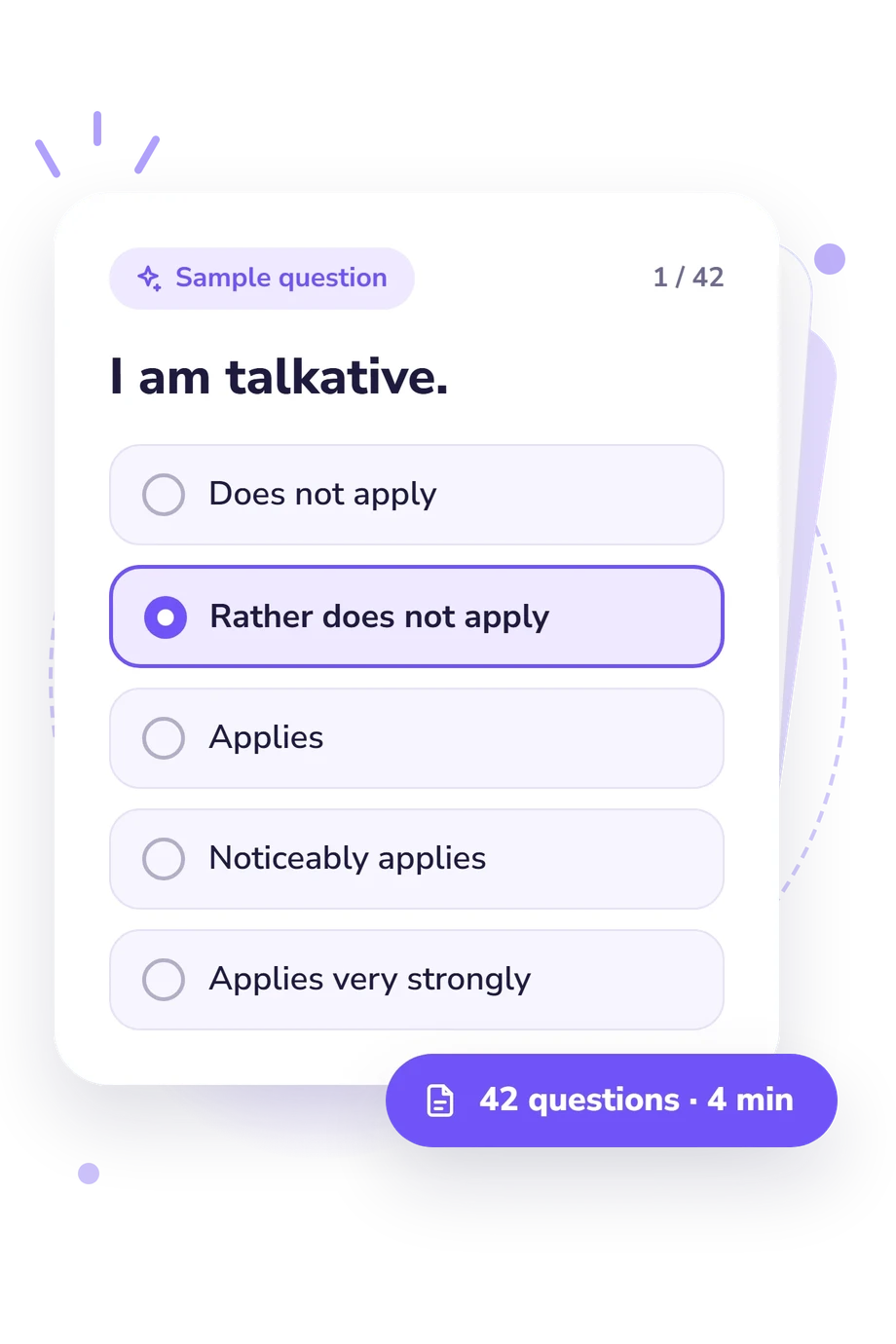
Example Questions From the Test
- Not true of me
- Somewhat untrue of me
- True of me
- Clearly true of me
- Very true of me
- Not characteristic
- Rather not characteristic
- Characteristic
- Noticeably characteristic
- Very characteristic
- Not pronounced
- Rather not pronounced
- Pronounced
- Clearly pronounced
- Very pronounced
Fundamental Personality Traits Test - Description and methodology of the test
Readers who want to connect everyday reactions with a three-dimensional result may use this personality test to examine social orientation, emotional sensitivity, and interpersonal style. The Fundamental Personality Traits Test organizes those areas into displayed ranges, giving readers a practical way to consider how the result may relate to everyday interactions.
What This Assessment Explores
Three broad personality dimensions connect the statements about sociability, nervousness, guilt, sensitivity to criticism, reactions to rudeness, empathy, organization, and willingness to take risks. Together, they describe how a person balances social energy, emotional reactivity, persistence, and interpersonal softness. The resulting personality profile is descriptive: it highlights a direction of tendency, not a permanent identity or a clinical category.
The following scales explain what each result means:
- Soft-Heartedness-Psychoticism (0-35) reflects egocentrism, social adaptability, persistence, and the balance between hardness and softness of character. Soft-hearted 0-16, Balanced 17-25, More psychoticism 26-35.
- Neuroticism-Stability (0-35) measures emotional stability and sensitivity to stress. More stable 0-16, Balanced 17-25, More sensitive 26-35.
- Introversion-Extraversion (0-35) assesses sociability, activity, optimism, and orientation toward social interaction. More introverted 0-16, Balanced 17-25, More extraverted 26-35.
Methodology and Evidence Base
Each statement uses a five-point response scale, from low endorsement to strong endorsement, although wording varies across items. Questions cover social comfort, emotional reactions, interpersonal responses, responsibility, and risk. There is no right answer; the profile depends on how accurately the respondent recognizes their usual behavior.
The questionnaire is conceptually consistent with the Eysenck Personality Questionnaire (EPQ), whose framework links psychoticism, neuroticism, and introversion-extraversion with broad personality differences. The published EPQ literature does not establish standardization or validity for this online personality assessment.
The questionnaire reports results on the three displayed scales and presents the corresponding bands for each result. The online questionnaire has no documented standardization against population norms, so these bands are interpretive categories rather than validated clinical cutoffs. Current mood, self-presentation, limited self-awareness, and answering context can influence self-report. Treat the profile as a structured starting point for reflection rather than a complete account of personality.
- Hanin, Y., Eysenck, S. B. G., Eysenck, H. J., & Barrett, P. (1991). A cross-cultural study of personality: Russia and England. Personality and Individual Differences, 12(3), 265-271. DOI 10.1016/0191-8869(91)90112-O
- Eysenck, H. J., & Eysenck, S. B. G. (1975). Manual of the Eysenck Personality Questionnaire (Junior and Adult). London: Hodder and Stoughton.
- Eysenck, S. B. G., & Eysenck, H. J. (1968). The Measurement of Psychoticism: A Study of Factor Stability and Reliability. British Journal of Social and Clinical Psychology, 7(4), 286-294. DOI 10.1111/j.2044-8260.1968.tb00571.x
Updated: