
Threatened Needs Scale – Ostracism Test
How the Scales are Structured
Who Usually Takes This Test?
See How You Compare
Below is a preview of how scores are typically distributed across each scale.
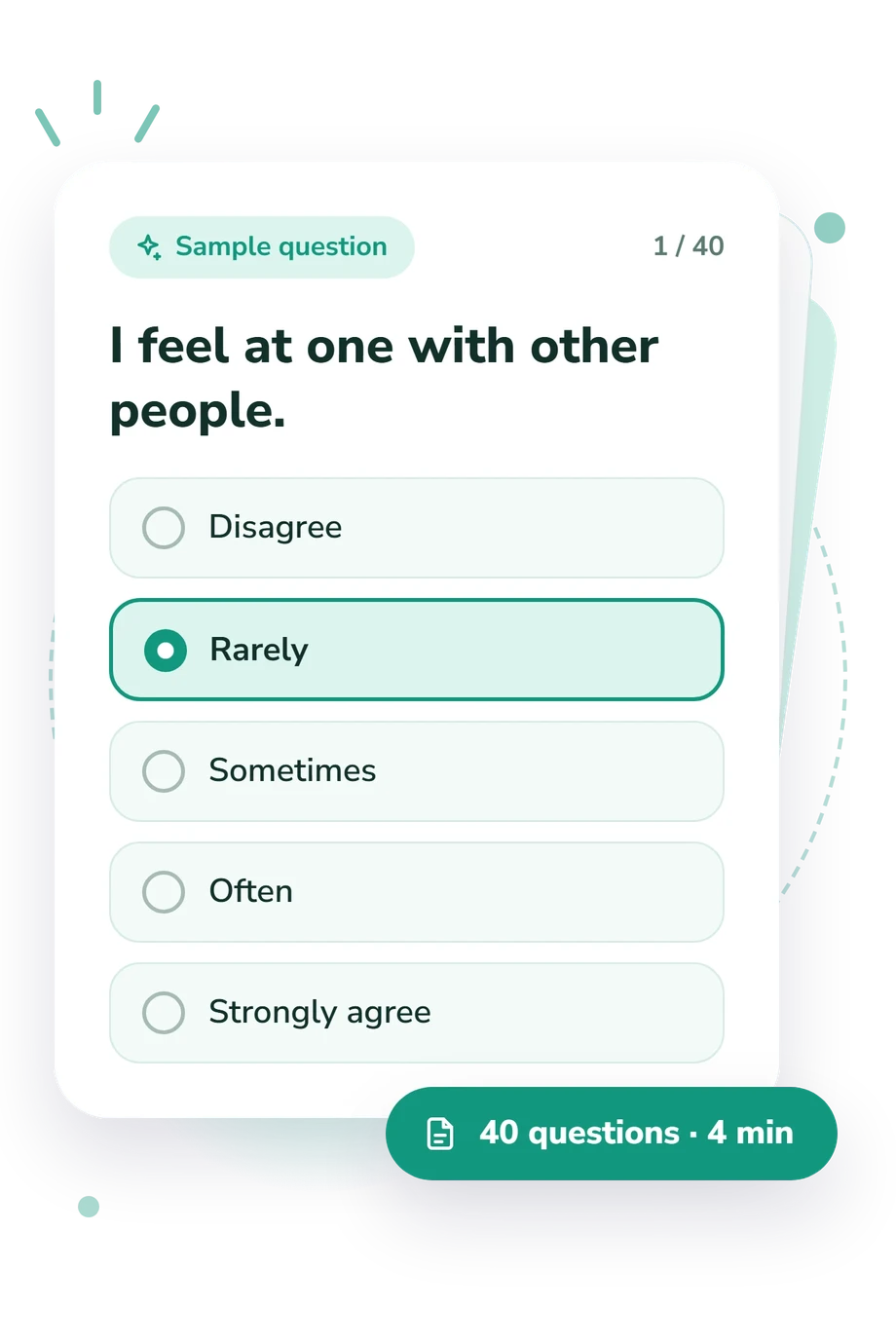
Example Questions From the Test
- Disagree
- Rarely
- Sometimes
- Often
- Strongly agree
- Disagree
- Rarely
- Sometimes
- Often
- Strongly agree
- Disagree
- Rarely
- Sometimes
- Often
- Completely agree
Threatened Needs Scale – Ostracism Test - Description and methodology of the test
People seeking a clearer picture of how exclusion may shape their social experience can use the Threatened Needs Scale - Ostracism Test as a structured self-reflection exercise. As an ostracism assessment, it focuses on perceived belonging, influence, recognition, and support. The exercise helps readers relate a social experience of exclusion to distinct aspects of need frustration, including significance, agency, self-worth, and belonging.
What This Assessment Explores
Social disconnection frames frustration across four needs: personal significance, agency, self-worth, and social belonging. Items cover support, recognition, usefulness, influence, acceptance, insecurity, helplessness, and feeling excluded. This threatened needs questionnaire suits readers reflecting on exclusion; the four dimensions are:
- Meaningful Existence (1-5) measures frustration around significance and recognition: Low frustration 1-1.9, Moderate frustration 2-3.2, High frustration 3.3-5.
- Control (1-5) measures difficulty influencing the social environment: Low frustration 1-1.7, Moderate frustration 1.8-2.8, High frustration 2.9-5.
- Self-Esteem (1-5) measures frustration in maintaining self-worth and significance to others: Low frustration 1-1.9, Moderate frustration 2-3.2, High frustration 3.3-5.
- Acceptance (1-5) measures dissatisfaction with acceptance and support: Low frustration 1-1.7, Moderate frustration 1.8-3, High frustration 3.1-5.
Methodology and Evidence Base
Responses use five options-Disagree, Rarely, Sometimes, Often, and Strongly agree or Completely agree, depending on the statement. Items cover connection, influence, rejection, usefulness, and dependence on others, so wording matters when interpreting each answer.
Because social exclusion can threaten several needs at once, this social exclusion test presents separate need-frustration dimensions rather than one global label. Each displayed dimension is reported separately with a score and a frustration band, allowing readers to consider the pattern without assuming a single overall result.
Conceptually, the questionnaire aligns with the Need Threat Scale (van Beest & Williams, 2006), which examines the needs threatened by ostracism. It also fits findings from Zadro, Williams, and Richardson (2004) and Williams’s (2009) temporal need-threat model, but it is not a direct reproduction or validated adaptation of those works.
Interpretation should stay close to context: a high band may reflect current interactions, mood, or a recent exclusion experience rather than a fixed trait. Because responses rely on self-report, personal interpretation and response bias can shape the result; it is a snapshot for reflection rather than a standalone diagnosis.
- van Beest, I., & Williams, K. D. (2006). When inclusion costs and ostracism pays, ostracism still hurts. Journal of Personality and Social Psychology, 91(5), 918-928. 10.1037/0022-3514.91.5.918
- Zadro, L., Williams, K. D., & Richardson, R. (2004). How low can you go? Ostracism by a computer is sufficient to lower self-reported levels of belonging, control, self-esteem, and meaningful existence. Journal of Experimental Social Psychology, 40(4), 560-567. 10.1016/j.jesp.2003.11.006
- Williams, K. D. (2009). Ostracism: A temporal need-threat model. In M. P. Zanna (Ed.), Advances in Experimental Social Psychology, 41, 275-314. Academic Press. 10.1016/S0065-2601(08)00406-1
Updated: