
Authenticity Scale Test
How the Scales are Structured
Who Usually Takes This Test?
See How You Compare
Below is a preview of how scores are typically distributed across each scale.
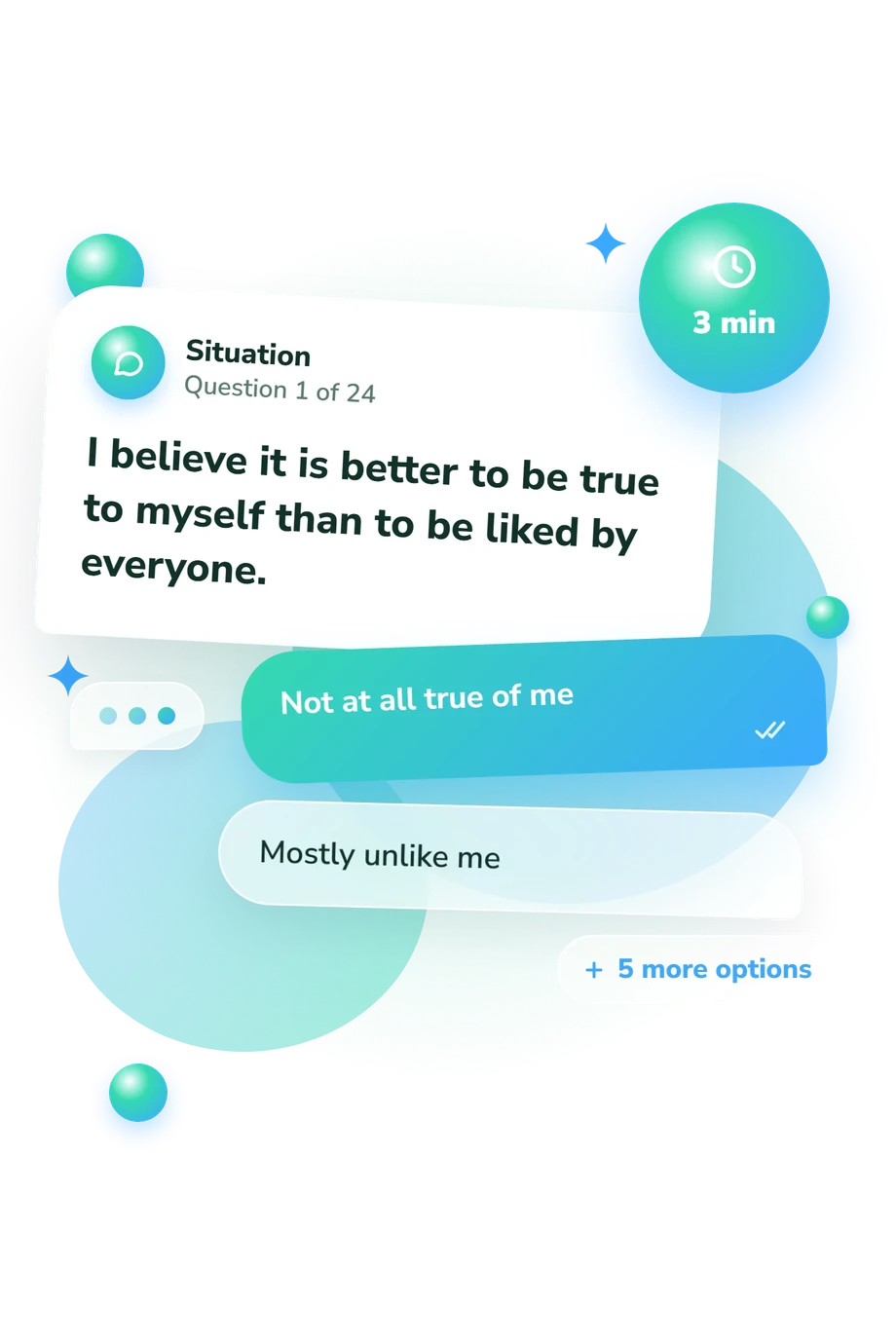
Example Questions From the Test
- Not at all like me
- Mostly unlike me
- Somewhat unlike me
- Neither like me nor unlike me
- Somewhat like me
- Mostly like me
- Describes me very accurately
- Does not apply to me at all
- Mostly not like me
- Rather not like me
- Neither agree nor disagree
- Somewhat like me
- Mostly like me
- Describes me very accurately
- Does not apply to me at all
- Mostly not like me
- Somewhat not like me
- Neither agree nor disagree
- Somewhat like me
- Mostly like me
- Describes me very accurately
Authenticity Scale Test - Description and methodology of the test
People who want to examine whether everyday choices reflect their own values can use the Authenticity Scale Test as a structured self-reflection exercise. It can help someone consider how approval, expectations, or uncertainty about the self affect choices in relationships, work, or personal commitments. This authenticity questionnaire produces a profile that offers a starting point for noticing patterns in decisions and identifying situations that merit closer attention.
What This Test Measures
Here, authenticity concerns how consistently a person recognises personal preferences, acts from values, and remains connected to the self while responding to others. The questions address values, expectations, social pressure, and uncertainty about inner experience. The measure reveals how self-direction and self-knowledge appear to the respondent across those situations.
The three displayed dimensions are:
- Authentic Living (4-28) shows how closely choices reflect personal beliefs and desires: Low alignment (4-19) or High alignment (20-28).
- Acceptance of External Influence (4-28) shows how strongly outside pressure shapes action: Low external influence (4-11) or Moderate to high external influence (12-28).
- Self-Alienation (4-28) shows how connected a person feels to the self: Low (4-11) or High (12-28), with higher scores reflecting a stronger wish to understand or change oneself.
Methodology and Evidence Base
The seven-point self-report format asks how accurately each statement describes the respondent, with choices ranging from not at all or mostly unlike me to highly accurate and a neutral midpoint. The items address personal fit, not factual knowledge.
The form displays three scale scores, and its result bands organise each score into a readable profile. Item aggregation, any reverse-scoring, and the normative basis of this online version are not documented. Interpretation is strongest when a result is considered alongside the statements that felt clear, difficult, or surprising.
The framework is conceptually consistent with the Authenticity Scale, whose three dimensions are represented in the displayed scales. It also corresponds with the multicomponent account described by Michael H. Kernis and Brian M. Goldman, while the study by Svetlana Nartova-Bochaver and colleagues provides validation evidence for a Russian cultural version. These sources support the construct but do not establish that this online form is identical to a published, normed administration.
Because answers depend on self-awareness, honesty, and current circumstances, the results are a snapshot for reflection rather than a diagnosis.
- Wood, A. M., Linley, P. A., Maltby, J., Baliousis, M., & Joseph, S. (2008). The Authentic Personality: A Theoretical and Empirical Conceptualization and the Development of the Authenticity Scale. Journal of Counseling Psychology, 55(3), 385-399. 10.1037/0022-0167.55.3.385
- Nartova-Bochaver, S., Reznichenko, S., & Maltby, J. (2021). The Authenticity Scale: Validation in Russian Culture. Frontiers in Psychology, 11, 609617. 10.3389/fpsyg.2020.609617
- Kernis, M. H., & Goldman, B. M. (2006). A Multicomponent Conceptualization of Authenticity: Theory and Research. Advances in Experimental Social Psychology, 38, 283-357. 10.1016/S0065-2601(06)38006-9
Updated: