
Organizational Cynicism Scale (OCS) Test
How the Scales are Structured
Who Usually Takes This Test?
See How You Compare
Below is a preview of how scores are typically distributed across each scale.
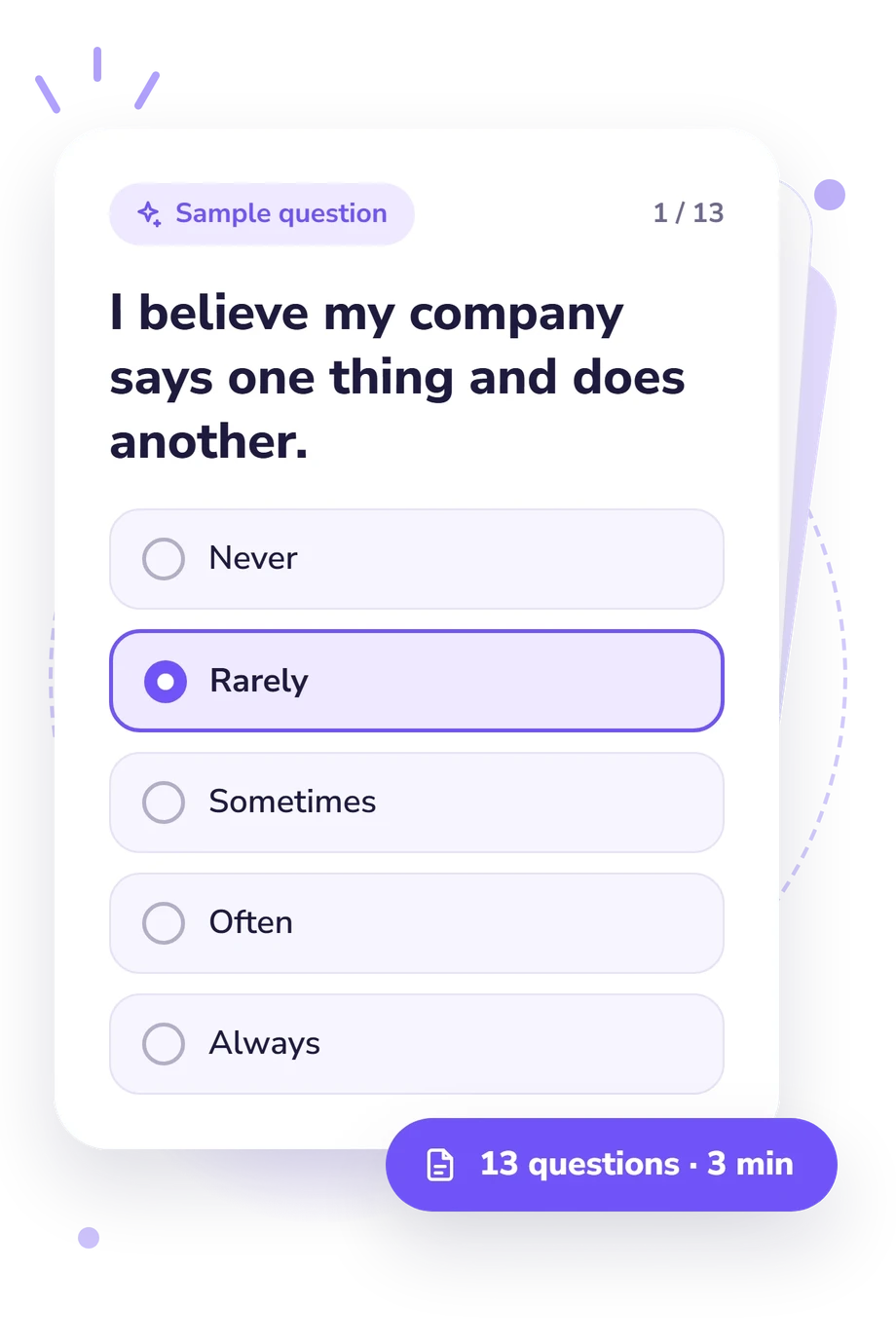
Example Questions From the Test
- Never
- Rarely
- Sometimes
- Often
- Always
- Never
- Rarely
- Sometimes
- Often
- Always
- Never
- Rarely
- Sometimes
- Often
- Always
Organizational Cynicism Scale (OCS) Test - Description and methodology of the test
Employees who want a clearer picture of how they experience their organization can use the Organizational Cynicism Scale (OCS) Test to examine distrust, frustration, and critical reactions at work. This workplace cynicism assessment is intended for employees examining how organizational promises, leadership behavior, and daily interactions shape their attitudes. The result combines an overall score with component scores rather than reducing responses to one undifferentiated label.
What This Assessment Explores
This test examines employees’ beliefs, feelings, and behaviors around organizational inconsistency at work. The four displayed results are:
- Behavioral Dimension (1-5) reflects critical or dismissive actions; Low 1-2.3, Moderate 2.4-3.6, High 3.7-5.
- Emotional Aspect (1-5) reflects negative feelings toward the organization; Low negativity 1-2.3, Moderate negativity 2.4-3.6, High negativity 3.7-5.
- Cognitive Aspect (1-5) reflects beliefs that organizational decisions or leadership lack honesty, consistency, or integrity; Low 1-2.3, Moderate 2.4-3.6, High 3.7-5.
- Organizational Cynicism (1-5) reflects the broader distrustful and skeptical attitude; Low cynicism 1-2.3, Moderate cynicism 2.4-3.6, High cynicism 3.7-5.
Together, the organizational cynicism questionnaire shows whether cynicism is concentrated in beliefs, feelings, behavior, or distributed across dimensions.
Methodology and Scientific Basis
Each statement uses five frequency options-Never, Rarely, Sometimes, Often, and Always. Respondents rate how often a belief, feeling, or reaction fits their experience. The profile reflects response patterns, and this questionnaire specifies no extra item weights or calculation rule.
The items group cognitive judgments, emotional responses, and behavioral expressions. This structure matches the three-part view of cynicism described by Dean, Brandes, and Dharwadkar, while the questionnaire is conceptually consistent with the Organizational Cynicism Scale. The online questionnaire is not presented as a verified reproduction or validated adaptation of that published instrument.
Interpret scores alongside recent events, leadership interactions, role demands, and workplace context. No population norms are stated for these results, so the bands are descriptive guides rather than universal thresholds. Current mood, memory, self-awareness, and pressure to appear fair or loyal may influence self-report. As an organizational cynicism measure, the profile is a structured snapshot for further reflection.
- Brandes, P., Dharwadkar, R., & Dean, J. W. (1999). Does organizational cynicism matter? Employee and supervisor perspectives on work outcomes. Eastern Academy of Management Proceedings, 2, 150-153.
- Dean, J. W., Brandes, P., & Dharwadkar, R. (1998). Organizational cynicism. Academy of Management Review, 23(2), 341-352. 10.5465/amr.1998.533230
Updated: