
Recovery Locus of Control Scale (RLOC) Test
How the Scales are Structured
Who Usually Takes This Test?
See How You Compare
Below is a preview of how scores are typically distributed across each scale.
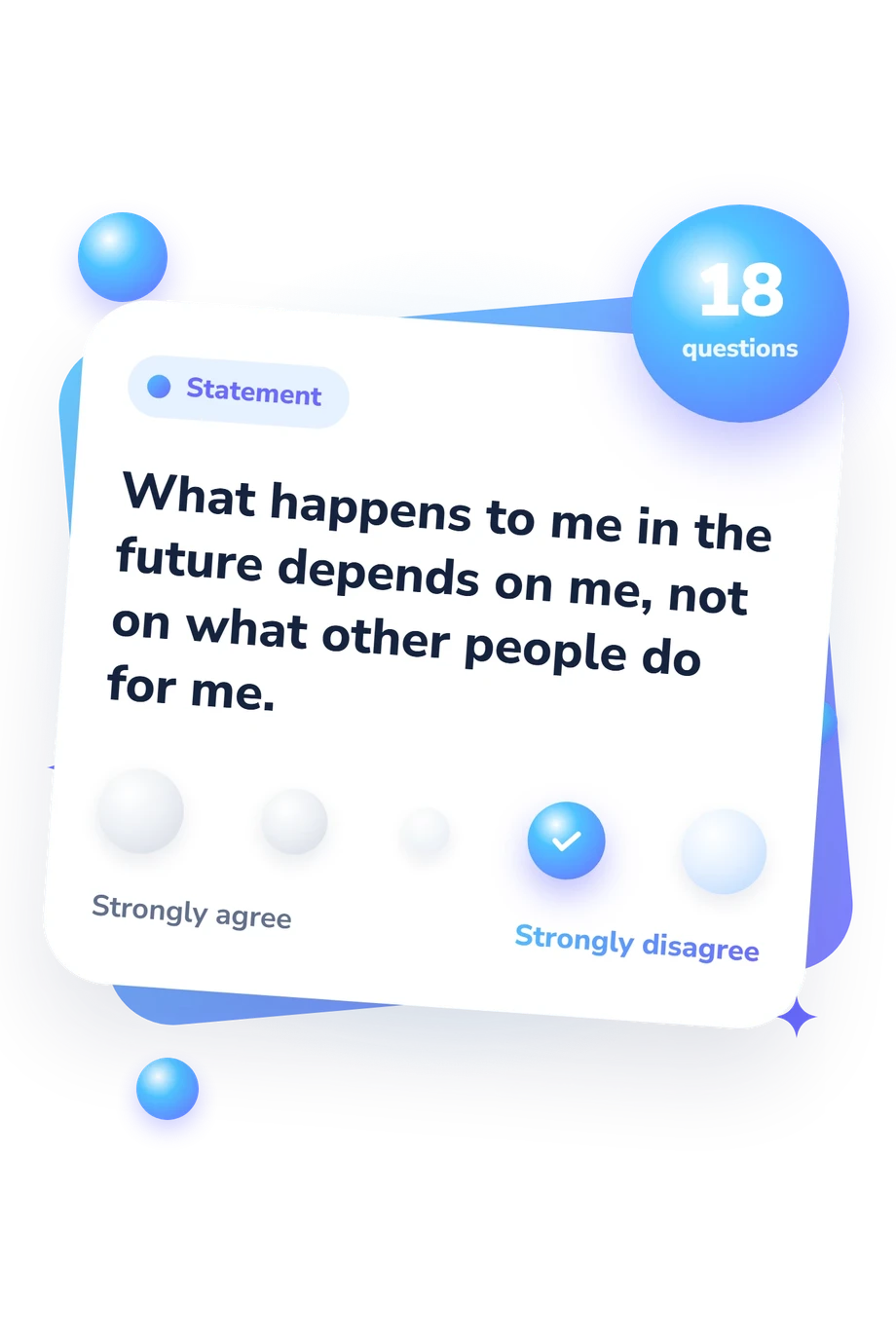
Example Questions From the Test
- Strongly agree
- Agree
- Not sure
- Disagree
- Strongly disagree
- Completely agree
- Agree
- Not sure
- Disagree
- Strongly disagree
- Strongly agree
- Agree
- Not sure
- Disagree
- Strongly disagree
Recovery Locus of Control Scale (RLOC) Test - Description and methodology of the test
For people considering how their own actions relate to rehabilitation, the Recovery Locus of Control Scale (RLOC) Test describes perceived influence during recovery from illness or injury. This recovery locus of control test can help a respondent reflect on motivation, determination, and reliance on support without reducing recovery to personal effort alone. The result is a focused snapshot of perceived agency.
What This Assessment Explores
The questionnaire examines perceived personal control over recovery after illness or injury. Its statements connect improvement with personal action, determination, outside help, circumstances, or waiting. It suits people reflecting on how much agency they bring to rehabilitation or recovery.
Within the RLOC questionnaire, the items address these interpretive themes:
- Personal agency shows whether actions and choices are seen as important to change.
- Recovery motivation reflects determination to do what is possible toward improvement.
- External reliance and passivity indicate whether other people, circumstances, or waiting carry more weight.
The single displayed scale, Recovery Locus of Control, runs from 0-36. Low internal control (0-12) indicates reduced perceived influence and motivation; Moderate internal control (13-24) indicates an intermediate position; High internal control (25-36) indicates stronger perceived influence and motivation. A high result still does not mean recovery requires no support.
Methodology and Evidence Base
Five choices run from strong or complete agreement to strong disagreement, with agreement, uncertainty, and disagreement between them. The items include agency-oriented and lower-control statements, so interpretation depends on the response pattern rather than agreement alone. Answers form one displayed score, but the questionnaire does not state each option's point assignment; no additional scoring rule should be inferred.
The questionnaire is conceptually consistent with the Recovery Locus of Control measure described by Partridge and Johnston in 1989, a published measure of perceived control over recovery from physical disability. Johnston and colleagues’ 1999 stroke study connected perceived control with coping after stroke, while Li and colleagues’ 2020 psychometric study reported findings for a Chinese version among people with myocardial infarction. These studies support the construct, but do not establish identical wording, norms, reliability, validity, or standardization for this online form. This recovery control assessment is therefore not a standardized reproduction.
Read the result as a snapshot of perceived influence when answered. Symptoms, mood, expectations, and self-awareness can affect self-report, while practical support may remain essential at any score. It can organize self-reflection, but it is not a diagnosis and should be weighed with the person's circumstances.
- Partridge, C., & Johnston, M. (1989). Perceived control of recovery from physical disability: Measurement and prediction. British Journal of Clinical Psychology, 28(1), 53-59. 10.1111/j.2044-8260.1989.tb00811.x
- Johnston, M., Morrison, V., MacWalter, R., & Partridge, C. (1999). Perceived control, coping and recovery from disability following stroke. Psychology & Health, 14(2), 181-192. 10.1080/08870449908407322
- Li, Y., Kong, D., Wang, W., Zhu, Y., & Liu, X. (2020). Psychometric properties of the Chinese version of the recovery locus of control (RLOC) Scale among patients with myocardial infarction. Nursing Open, 7, 1815-1821. 10.1002/nop2.568
Updated: