
Dialogicality Scale for Interpersonal Relationships Test
How the Scales are Structured
Who Usually Takes This Test?
See How You Compare
Below is a preview of how scores are typically distributed across each scale.
Example Questions From the Test
- Completely disagree
- Agree to a small extent
- Agree almost halfway
- Agree halfway
- Agree more than halfway
- Agree almost completely
- Agree completely
- Completely disagree
- Agree to a small extent
- Agree almost halfway
- Agree halfway
- Agree more than halfway
- Agree almost completely
- Completely agree
- Completely disagree
- Agree to a small extent
- Agree almost halfway
- Agree halfway
- Agree more than halfway
- Agree almost completely
- Completely agree
Dialogicality Scale for Interpersonal Relationships Test - Description and methodology of the test
Readers who want a clearer picture of their interpersonal patterns may use the Dialogicality Scale for Interpersonal Relationships Test to obtain a practical profile of cooperation, relational significance, and dialogue. As an interpersonal relationships test, it organizes self-reported tendencies into distinct dimensions for people examining how they respond in relationships. The result offers a starting point for noticing which tendencies are most prominent in everyday interactions.
What This Assessment Explores
Items examine how a person balances personal interests with another’s needs during shared goals. Themes include openness, compromise, conflict, respect, warmth, acceptance, cooperation, and relationship maintenance. Dialogicality means recognizing partners as active participants whose views matter. The profile maps relationship dynamics across three scales:
- Constructiveness (0-10) measures shared-goal effort, free expression, and satisfying interaction; Low 0-3, Moderate 4-7, High 8-10. Lower scores reflect independent, self-sufficient individuals.
- Self-Worth (0-10) measures relationship significance, affiliative feeling, and self-confidence; Low 0-3, Moderate 4-7, High 8-10. Average results indicate awareness of real-life demands and extraversion.
- Dialogicality of Relationships (0-10) measures recognition of a partner’s uniqueness, the relationship’s value and significance to both parties, open exchange, and mutual acceptance; Low dialogicality 0-3, Moderate dialogicality 4-7, High dialogicality 8-10. Moderate results indicate effective life planning and harmonious relationships, with less flexibility than high results; higher scores indicate greater flexibility.
Methodology and Scientific Basis
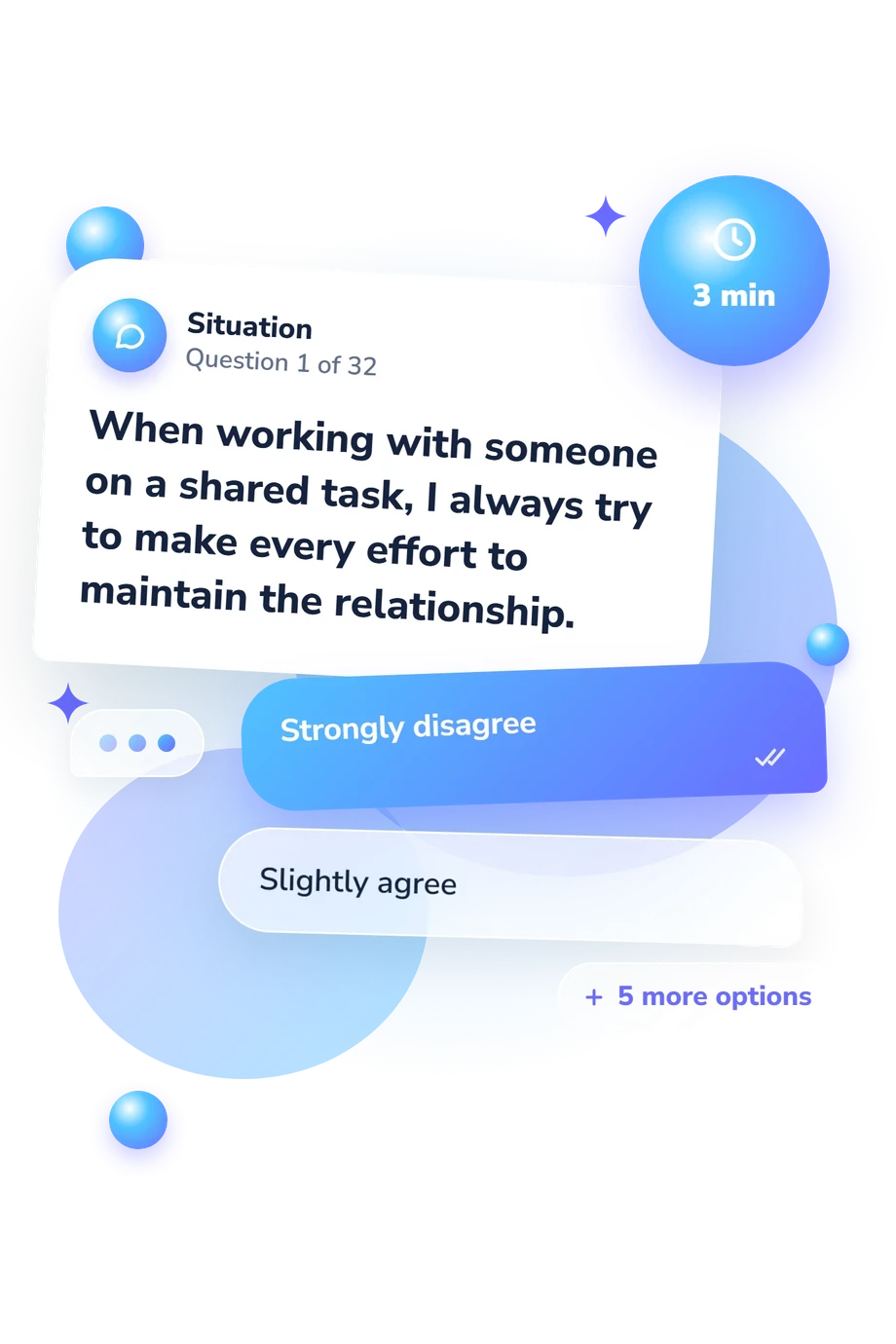
This interpersonal relationship questionnaire uses a seven-point agreement format, ranging from complete disagreement to complete agreement. Respondents rate familiar interaction patterns rather than choosing a fixed type. Items cover trust, compromise, mutual support, conflict, difficulty balancing interests, and unmet emotional needs.
The questionnaire reports a separate score for each scale and displays the assigned band for that result. No further scoring, weighting, aggregation, norming, or combined-profile rule is documented, so the output should be read as three distinct results rather than as a calculated overall score.
Methodologically, this dialogicality scale is conceptually consistent with the Dialogicity of Interpersonal Relationships Scale (Dukhnovsky, 2009). That conceptual relationship does not establish that this questionnaire uses the published instrument’s scoring, norms, or item set.
Kuksa’s 2024 study of dialogic interaction provides context for openness, partner consideration, and communicative response; it does not validate this online questionnaire.
Self-report results can shift with mood, relationship circumstances, social desirability, and self-awareness. The displayed bands are the labels shown for each questionnaire result; read them as descriptions of the score rather than fixed descriptions of a person.
- Dukhnovsky, S. V. (2009). Diagnosis of Interpersonal Relationships. Saint Petersburg: Rech.
- Kuksa, Yurii. (2024). Peculiarities of dialogic interaction of technical profile students with different types of communicative response. Psychology and Personality, 14(2), 22-29. 10.33989/2226-4078.2024.2.22
Updated: