
Asthenic State Scale Test
How the Scales are Structured
Who Usually Takes This Test?
See How You Compare
Below is a preview of how scores are typically distributed across each scale.
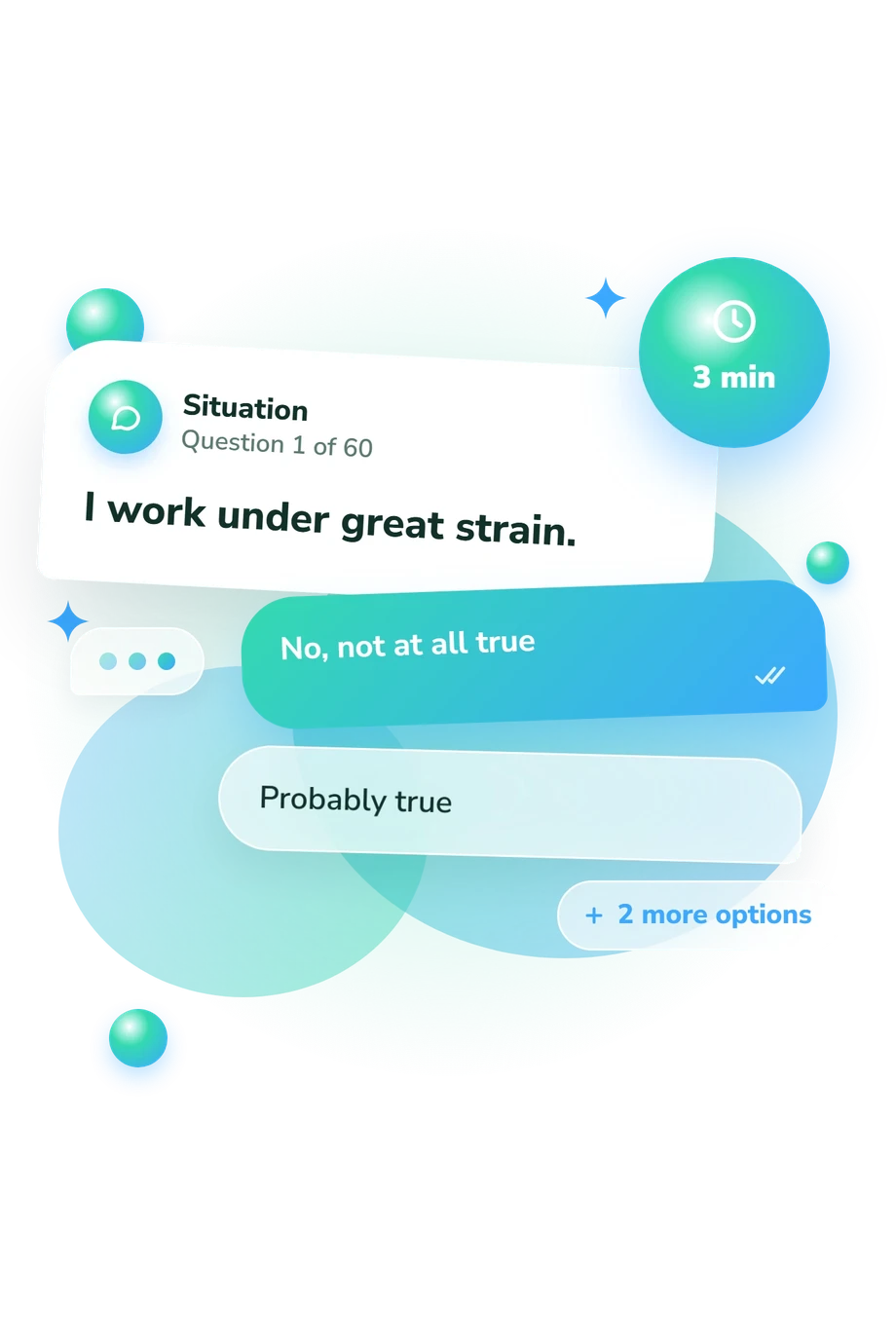
Example Questions From the Test
- Not at all true
- Somewhat true
- True
- Completely true
- Not true at all
- Probably true
- True
- Completely true
- Not at all true
- Probably true
- True
- Completely true
Asthenic State Scale Test - Description and methodology of the test
For readers trying to understand persistent tiredness, low stamina, or heightened tension, the Asthenic State Scale Test offers a structured self-report snapshot. It can function as a fatigue and weakness assessment when everyday effort, concentration, sleep, or social tolerance feels harder than usual. The result organizes these experiences into an indication of apparent asthenic symptom severity for personal reflection.
What This Assessment Explores
Asthenia covers fatigue, weakness, reduced work capacity, emotional instability, cognitive difficulty, physical discomfort, and sensory sensitivity. Items address concentration, memory, reading, headaches, dizziness, sleep, appetite, noise, worry, and social tolerance. The result describes symptoms that may make ordinary functioning harder.
The item content forms four themes:
- Fatigue and endurance show how effort becomes exhausting and recovery feels limited.
- Cognitive efficiency reflects difficulty concentrating, remembering, reading, or processing information.
- Physical symptoms and discomfort cover weakness, tremor, dizziness, headaches, sweating, and related sensations.
- Emotional instability and sensory reactivity indicate how tension, noise, worry, or other people affect tolerance.
Across the items, this asthenic state questionnaire produces one severity indication rather than separate subscale scores. The Asthenic State Scale ranges from 30-120: Low 30-50, Moderate 51-75, and High 76-120. Higher scores indicate greater severity of asthenia.
Methodology and Scientific Basis
Each item uses four response levels, from not at all true or an equivalent to completely true. The respondent judges how closely each statement fits current experience. Responses form the displayed overall score; because exact weighting is not specified, no extra point rule should be inferred. This captures perceived experience, not objective performance.
The online result functions as an asthenia assessment through self-report rather than a performance task, examination, or interview. Its closest named reference is the Malkova-Chertova Asthenic State Scale, a conceptual reference rather than evidence validating this online scoring or result bands. This version is not a documented standardized adaptation. Payenok and Bakun (2024) and Zavaliy (2022) provide clinical context for related complaints, but neither validates this online version or its bands.
Interpret the score as the apparent severity represented in the responses. No norms or validation are reported for this online questionnaire, so it cannot establish a diagnosis or explain symptoms’ cause; stress, illness, sleep, self-awareness, and response bias may affect self-report. Consider it alongside broader history and present functioning.
- Malkova, L. D., and T. G. Chertova. "Asthenic State Scale." In Workshop on General, Experimental and Applied Psychology, edited by A. A. Krylov and S. A. Manichev. Saint Petersburg: Piter, 2000, pp. 262-263, 267-268.
- Payenok, A. V., and O.-N. A. Bakun. "Comparative Characteristics of Asthenia and Quality of Life in Patients with Post-COVID Syndrome." Psychiatry, Neurology and Medical Psychology, 2024, 11(4(26)), 411-419. 10.26565/2312-5675-2024-26-06
- Zavaliy, Yurii V. "Neurological and Neuropsychological Characteristics of Postconcussion Syndrome Following Blast Mild Traumatic Brain Injury." Ukrainian Neurosurgical Journal, 2022, 28(1), 39-46. 10.25305/unj.250714
Updated: