
Perceived Stress Scale for Children Test
How the Scales are Structured
Who Usually Takes This Test?
See How You Compare
Below is a preview of how scores are typically distributed across each scale.
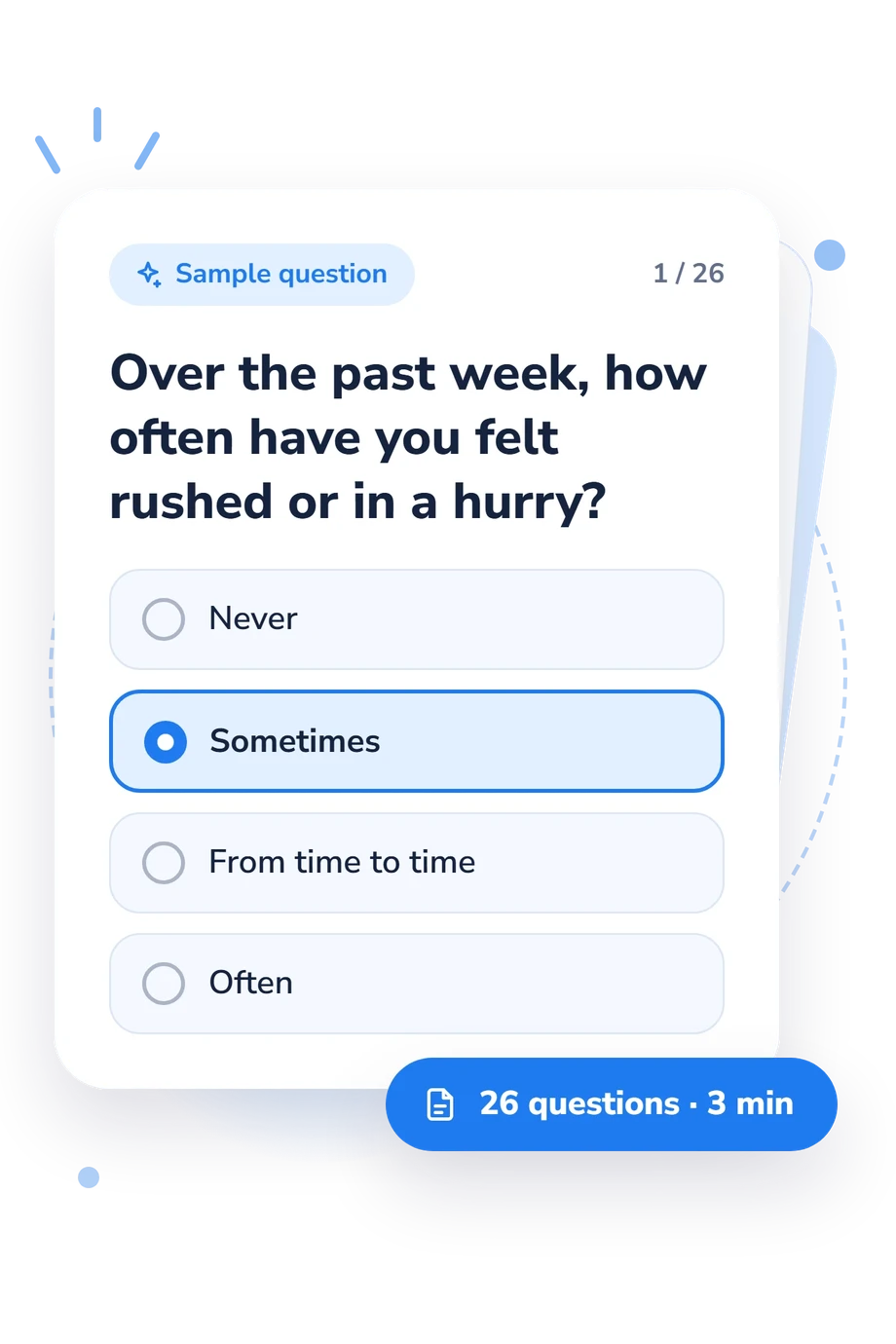
Example Questions From the Test
- Never
- Sometimes
- From time to time
- Often
- Never
- Sometimes
- From time to time
- Often
- Never
- Sometimes
- From time to time
- Often
Perceived Stress Scale for Children Test - Description and methodology of the test
Children who are dealing with school demands, family pressures, or changing friendships may benefit from a clear way to describe how stress feels in daily life. The Perceived Stress Scale for Children Test gives a structured snapshot for a child, parent, or professional. The questionnaire provides a child stress assessment by combining perceived stress, internal tension, and coping resources, helping readers understand a child's current stress and possible support needs.
What This Assessment Explores
Questions cover rushing, school worries, limited time or sleep, difficult emotions, and relationships with parents and friends. This makes it a useful stress questionnaire for children when adults need a clearer picture of current pressure and support needs.
The result reports three scores: two components and one overall perceived-stress score:
- Resources (0-21) assesses personal and external coping resources; higher scores indicate greater ability to manage difficulties: Low resources (0-7), Moderate resources (8-14), and High resources (15-21).
- Tension (0-18) assesses internal tension and anxiety; higher scores indicate greater perceived stress and emotional discomfort, with bands Low tension (0-6), Moderate tension (7-12), and High tension (13-18).
- Perceived Stress Scale (0-39) assesses overall perceived stress in daily life; higher scores indicate greater perceived stress; lower scores indicate relatively little perceived stress, with bands Low stress (0-11), Moderate stress (12-20), and High stress (21-39).
Methodology and Scientific Basis
Each item uses four frequency choices-Never, Sometimes, From time to time, or Often-and asks about everyday experiences. Themes include time pressure, school concerns, parental reassurance, emotions, sleep, conflict, and friendship, allowing the respondent to describe frequency rather than give a yes-or-no answer.
The child stress scale produces three displayed scores, each assigned by the form to the supplied low, moderate, or high bands. The questionnaire does not state an item-by-item scoring formula, so points per answer cannot be inferred from the score ranges. These bands describe this online profile, not universal clinical cutoffs.
Its closest published match is Perceived Stress Scale for Children (White, 2014), while the broader perceived-stress framework comes from Cohen, Kamarck, and Mermelstein's 1983 study. The questionnaire is conceptually consistent with these sources, but the sources do not establish that this online form is identical to either published instrument or has the same norms and standardization.
Scores are best read as a current self-report profile: recent events, interpretation of the questions, self-awareness, and willingness to disclose can affect them, so context and observations from trusted adults remain important.
- White, Barbara Prudhomme. (2014). The Perceived Stress Scale for Children: A Pilot Study in a Sample of 153 Children. International Journal of Pediatrics and Child Health, 2(2), 45-52. 10.12974/2311-8687.2014.02.02.4
- Cohen, Sheldon, Tom Kamarck, and Robin Mermelstein. (1983). A Global Measure of Perceived Stress. Journal of Health and Social Behavior, 24(4), 385-396. 10.2307/2136404
Updated: