
Freudly+971 508685814hello@freudly.ai
Freudly
social attitudes

Authoritarianism Scale (F-Scale) Test
Take the online Authoritarianism Scale (F-Scale) Test - AI psychologist FreudlyYou can take Authoritarianism Scale (F-Scale) Testhere. Online version of a simple and accurate psychological test with interpretation.en
Understand your attitudes toward authority, hierarchy, and strict social norms in about 6 minutes. Get fast, research-based insight for education or discussion with 28 focused items.
Start Online Test
Questions: 286 minutes
08:30
October 2, 2025
October 2, 2025
Material has been updated
October 2, 2025
Material has been published
24,181 view
2,195 completions
1,491 likes
Verified by Daniel Hall
Psychologist with 25 years of experience
Share
Scale Explorer

How the Scales are Structured

example score
5/7
Sexual Preoccupation (SP)
This scale measures how strongly a person is preoccupied with sexual topics in their own life and in others'.
Low focus
Moderate focus
High focus
12: Low focus | 35: Moderate focus | 67: High focus
A score of 5 suggests a moderate preoccupation with sexual topics, indicating this area is a noticeable but not dominant focus.
example score
3/7
Projectivity (P)
Projectivity measures the tendency to attribute one’s own unacceptable impulses to others and to interpret people or situations as threatening.
Low
Moderate
High
12: Low | 35: Moderate | 67: High
A score of 3 falls in the Moderate range, suggesting occasional suspicious interpretations of others without a consistently threatening view of the social environment.
example score
3/7
Destructiveness And Cynicism (DAC)
Measures the degree of hostile, cynical attitudes toward others and a tendency toward destructive or mistrustful interpretations of human nature.
Low
Moderate
High
12: Low | 35: Moderate | 67: High
A score of 3 falls in the Moderate range, suggesting some skeptical or negative views of human nature but not a strongly cynical or destructive stance overall.
example score
5/7
Superstition and Stereotypy (SaS)
Measures tendency toward superstitious or mystical beliefs, cognitive rigidity, and reliance on stereotypes.
Low
Moderate
High
12: Low | 35: Moderate | 67: High
A score of 5 falls in the Moderate range, suggesting a noticeable but not extreme tendency toward rigid thinking and some reliance on superstitious or stereotyped beliefs.
example score
2/7
Anti-Intraception (AI)
Measures the extent to which a person rejects subjective experience, imagination, and individuality in favor of strict rationalism and conformity.
Low
Moderate
High
13: Low | 45: Moderate | 67: High
A score of 2 falls in the Low range, suggesting relatively little tendency to dismiss subjective or imaginative perspectives and less devaluation of individuality.
example score
2/7
Authoritarian Aggression (AA)
Measures the tendency to endorse punitive, hostile responses toward people who violate conventional norms or hold dissenting views.
Low
Moderate
High
12: Low | 35: Moderate | 67: High
A score of 2 falls in the Low range, suggesting relatively little inclination toward punishing or rejecting people with differing opinions.
example score
5/7
Authoritarian Submission (AS)
Measures the tendency to obey authorities uncritically and prefer strong leadership and rigid hierarchy.
Low
Moderate
High
13: Low | 45: Moderate | 67: High
A score of 5 falls in the Moderate range, suggesting a noticeable but not extreme inclination toward deferring to authority and favoring clear hierarchical order.
example score
3/7
Conventionalism (C)
Conventionalism measures adherence to traditional social norms and values, reflecting preference for established rules and customs.
Low conventionalism
Moderate conventionalism
High conventionalism
12: Low conventionalism | 35: Moderate conventionalism | 67: High conventionalism
A score of 3 suggests a moderate, situational preference for traditional norms rather than a strongly conservative orientation.
example score
166/196
Overall Index (OI)
This scale measures the overall intensity of authoritarian attitudes, including preference for strict hierarchy, conformity, and suppression of dissent.
Low
High
28154: Low | 155196: High
A score of 166 falls in the High range, indicating a pronounced tendency toward authoritarian attitudes compared with the scale’s lower range.
example score
5/7
Power Complex (PC)
Measures the extent to which a person tends to think in terms of dominance and submission and identify with strong leaders.
Low
Moderate
High
13: Low | 45: Moderate | 67: High
A score of 5 falls in the Moderate range, suggesting a noticeable but not extreme tendency toward power-oriented, dominance-focused attitudes and alignment with strong leadership.
Start Online Test
just completed the test
DATA-BASED USER COHORTS

Who Usually Takes This Test?

Politics and society learners
41%OF USERS
People curious about ideology and democracy take it to see how strongly they lean toward strict authority, hierarchy, and conformity.
Psychology students and researchers
34%OF USERS
Students and researchers use it as a historical benchmark to compare classic measures of authoritarian attitudes with modern frameworks.
Self-reflection and values seekers
25%OF USERS
People exploring their own beliefs take it to understand how they react to rules, tradition, dissent, and social norms.
BASED ON AGGREGATED, ANONYMIZED DATA FROM TENS OF THOUSANDS OF FREUDLY USERS.
Benchmarking

See How You Compare

Once you complete the test, your results are compared with real-world data from people in your country.
Below is a preview of how scores are typically distributed across each scale.
Concern about sex (Cas)
Average
4.1
Normal range
3.25
min.
1
max.
7
This curve shows how scores are typically distributed.
Once you complete the test, your result will appear on the scale so you can see how you compare.
Projectivity (P)
Projectivity (P)
Average
3.6
Normal range
2.84.4
min.
1
max.
7
This curve shows how scores are typically distributed.
Once you complete the test, your result will appear on the scale so you can see how you compare.
Destructiveness and Cynicism (DaC)
Average
2.9
Normal range
1.84
min.
1
max.
7
This curve shows how scores are typically distributed.
Once you complete the test, your result will appear on the scale so you can see how you compare.
Superstition and Stereotypy (SaS)
Average
2.7
Normal range
1.93.5
min.
1
max.
7
This curve shows how scores are typically distributed.
Once you complete the test, your result will appear on the scale so you can see how you compare.
Anti-introspection (A)
Average
4.8
Normal range
3.75.9
min.
1
max.
7
This curve shows how scores are typically distributed.
Once you complete the test, your result will appear on the scale so you can see how you compare.
Authoritarian Aggression (AA)
Average
4.1
Normal range
3.44.9
min.
1
max.
7
This curve shows how scores are typically distributed.
Once you complete the test, your result will appear on the scale so you can see how you compare.
Authoritarian Submission (AS)
Average
4.7
Normal range
3.65.7
min.
1
max.
7
This curve shows how scores are typically distributed.
Once you complete the test, your result will appear on the scale so you can see how you compare.
Conventionalism (C)
Conventionalism (C)
Average
4.4
Normal range
3.35.5
min.
1
max.
7
This curve shows how scores are typically distributed.
Once you complete the test, your result will appear on the scale so you can see how you compare.
Integral Indicator (II)
Average
134
Normal range
109.9158.2
min.
28
max.
196
This curve shows how scores are typically distributed.
Once you complete the test, your result will appear on the scale so you can see how you compare.
"Power Complex" ("C)
Average
2.5
Normal range
1.53.6
min.
1
max.
7
This curve shows how scores are typically distributed.
Once you complete the test, your result will appear on the scale so you can see how you compare.
Featured On
SAMPLE QUESTIONS

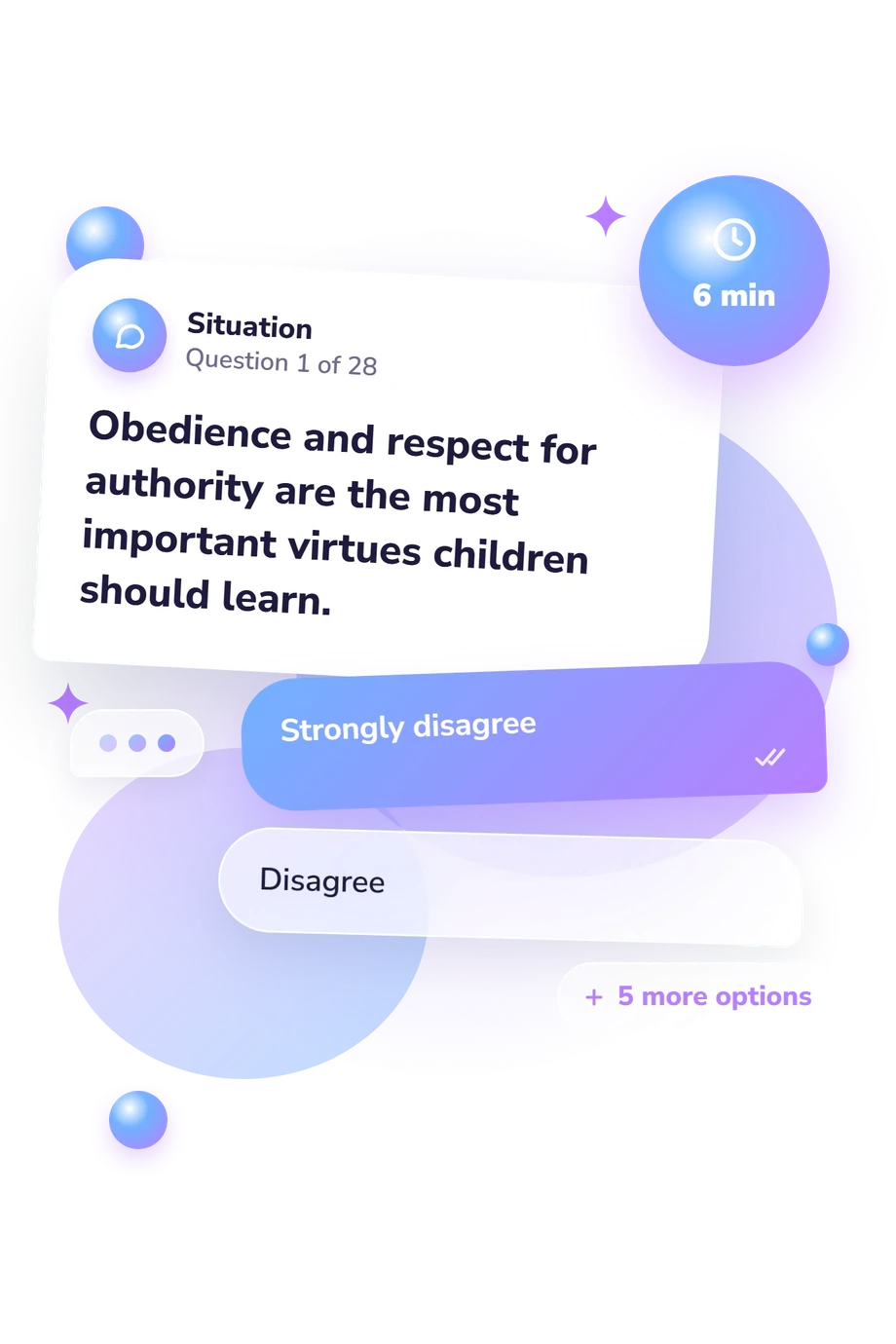
Example Questions From the Test

We are seeking to determine what the public thinks and feels about a range of social issues. We believe that the questionnaire presented here will be of interest to you. It includes many social questions and problems that you may have already considered, read about in newspapers and magazines, or heard about in the media. This is not an intelligence test and not a test of factual knowledge. Responses are not classified as “right” or “wrong.” The best response is your personal opinion. Please read each statement carefully and select the response option that best reflects your reaction. There is no need to spend a long time on any one item. Answer each item accurately and carefully. Express your personal point of view. Do not discuss the items with others until you have finished.
    • Strongly disagree
    • Disagree
    • Somewhat disagree
    • Not sure
    • Somewhat agree
    • Agree
    • Strongly agree
    • Completely disagree
    • Disagree
    • Somewhat disagree
    • Not sure
    • Somewhat agree
    • Agree
    • Completely agree
    • Strongly disagree
    • Disagree
    • Somewhat disagree
    • Not sure
    • Somewhat agree
    • Agree
    • Strongly agree
WHAT THE TEST MEASURES
About This Assessment

Authoritarianism Scale (F-Scale) Test - Symptoms and Signs

social attitudes

Developed in the mid-20th century, the Authoritarianism Scale (F-Scale) is a self-report questionnaire designed to assess attitudes and response patterns associated with authoritarian-oriented thinking and preferences for social conformity and hierarchy. It is most commonly used in educational and research contexts to characterize individual differences in ideological and personality-related attitudes (R. Nevitt Sanford; Else Frenkel-Brunswik; Daniel J. Levinson; Theodor W. Adorno). The measure includes 28 items and typically requires about 6 minutes to complete.

Items are presented as statements endorsed to varying degrees, yielding a summary of the respondent’s level of agreement with themes often linked to authoritarian dispositions. The Authoritarianism Scale (F-Scale) has also been discussed in the literature with respect to historical context, conceptual specificity, and potential response-style or content-related limitations; interpretation is therefore generally framed cautiously and in conjunction with other data sources when used for psychological assessment.

Author: Daniel J. Levinson, Else Frenkel-Brunswik, R. Nevitt Sanford, Theodor W. Adorno
Literature: John F. Dovidio, Peter Glick, and Laurie A. Rudman (Eds.). On the nature of prejudice: fifty years after Allport. Blackwell. 2005.; T. W. Adorno, E. Frenkel-Brunswik, D. J. Levinson, and R. N. Sanford. The authoritarian personality. Harper. 1950.
Popular tests
Comments
Leave a Comment