
Level of Fixed Emotional Set Test
How the Scales are Structured
Who Usually Takes This Test?
See How You Compare
Below is a preview of how scores are typically distributed across each scale.
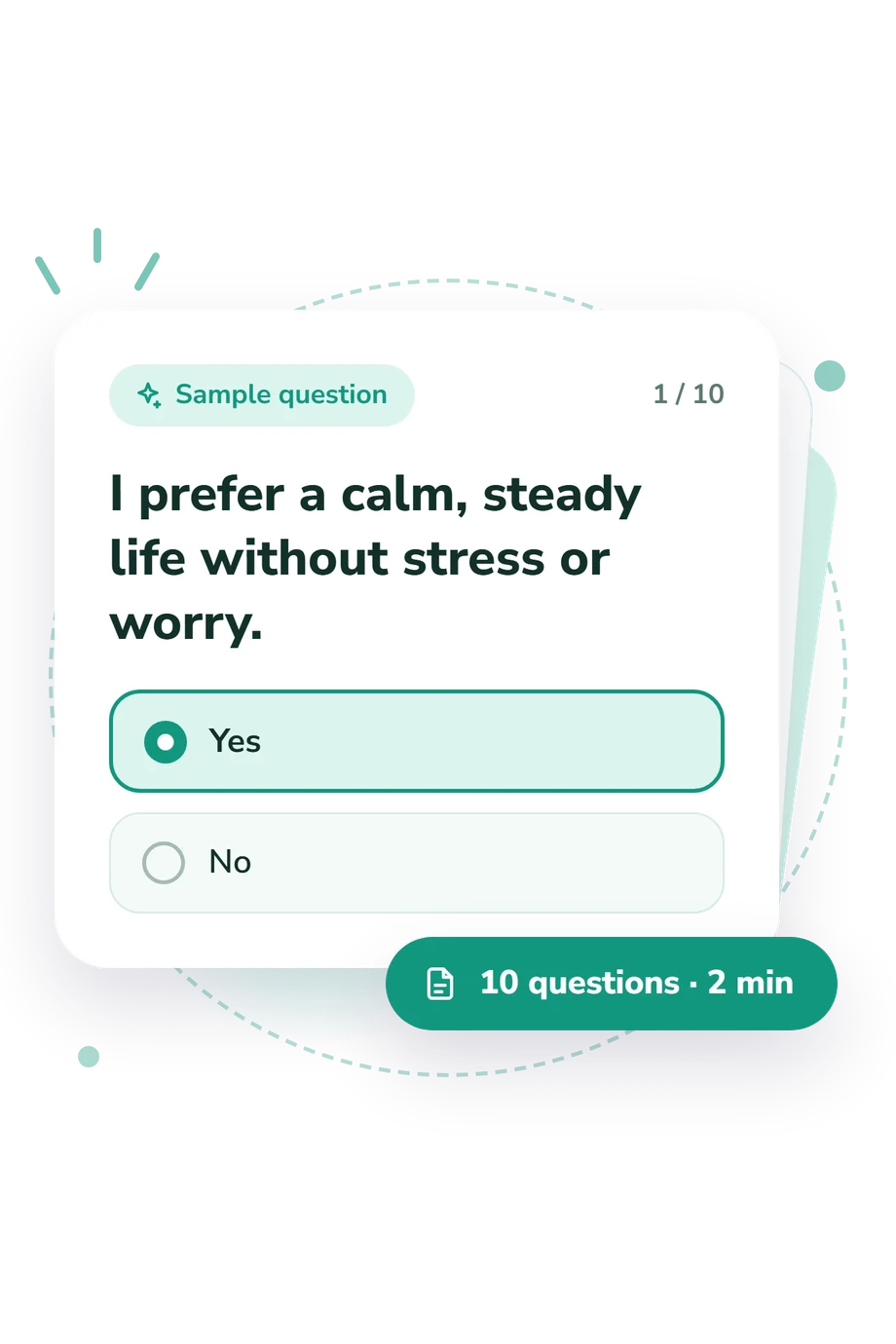
Example Questions From the Test
- Yes
- No
- Yes
- No
- Yes
- No
Level of Fixed Emotional Set Test - Description and methodology of the test
For readers considering whether a brief self-reflection could clarify their general emotional stance, this questionnaire offers a focused way to examine how they place themselves between extremes. The Level of Fixed Emotional Set Test is intended for people who want to consider their habitual outlook without reducing it to a broad personality label. This emotional set assessment describes a tendency in responses, not a complete personality profile.
What This Assessment Explores
The statements focus on steadiness, compromise, and how a person positions themselves in ordinary life. They address preferring calm over stress, avoiding major risks, comparing oneself with others, expecting outcomes to work out, and considering consequences before acting.
The middle-position result offers a narrow indication of how flexibly a person responds to emotional situations, rather than a judgment of character. In this fixed emotional set test, that indication supports self-reflection about recurring attitudes and everyday choices.
The item themes can be grouped as follows:
- Calm and stability indicate a preference for a steady life with less worry.
- Risk moderation reflects caution about actions that could cause serious loss.
- Social comparison shows whether someone places themselves near the ordinary middle.
- Compromise orientation describes avoiding both exceptional highs and pronounced lows.
Methodology and Scientific Basis
This dichotomous self-report gives each statement a Yes or No response. Respondents judge whether descriptions fit their usual outlook, so the score reflects personal interpretation rather than clinical observation; all answers form one displayed result, with no separate weighting rule stated.
Together, the responses place the outlook between ordinary middle positions and more pronounced alternatives.
The wording is conceptually consistent with the Fixed Emotional Set questionnaire associated with Makarov and Makarova (2002), a named source for this construct. Makarov’s 2001 work and 2023 historical account connect related ideas with transactional analysis and recurring emotional positions. This online version is not a standardized reproduction, so those sources do not establish its scoring validity.
The Test Result spans 0-10. Higher scores indicate a stronger tendency toward an intermediate, compromise position in emotional situations. Bands are More extreme stance (0-4), Balanced / flexible (5-6), and Strongly middle-positioned (7-10); average scores suggest balance between extremes and flexibility.
Interpret the outcome as a tendency rather than a permanent identity: the bands are descriptive, not population norms, and self-report can shift with mood, circumstances, self-awareness, or self-presentation.
- Makarov, Viktor V., and Galina A. Makarova. Transactional Analysis: Eastern Version. Moscow: Academic Project and Professional Psychotherapeutic League, 2002.
- Makarov, Viktor V. Psychotherapy of Every Day and Whole Life. Moscow: Professional Psychotherapeutic League, 2001. ISBN 5-9292-0045-9.
- Makarov, Viktor V. “This Night Turned My Ideas About My Profession and Life Upside Down”: The Origins of Transactional Analysis in the Soviet Union. Transactional Analysis in Russia, 2023, vol. 3, no. 1, pp. 80-85. 10.56478/taruj20233180-85
Updated: