
Goal Disengagement and Reengagement Scale Test
How the Scales are Structured
Who Usually Takes This Test?
See How You Compare
Below is a preview of how scores are typically distributed across each scale.
Example Questions From the Test
- Disagree
- Somewhat disagree
- Neither agree nor disagree
- Somewhat agree
- Agree
- Disagree
- Somewhat disagree
- Neither agree nor disagree
- Somewhat agree
- Agree
- Disagree
- Somewhat disagree
- Neither agree nor disagree
- Somewhat agree
- Agree
Goal Disengagement and Reengagement Scale Test - Description and methodology of the test
People facing a blocked, delayed, or no-longer-meaningful aim can use this goal adjustment test to examine the balance between persistence and adaptability. The Goal Disengagement and Reengagement Scale Test is intended for self-reflection when circumstances make an original plan difficult to attain, giving the reader a two-dimensional profile of goal regulation. Its result describes how persistence and flexibility work together without reducing either response to a simple strength or weakness.
What This Assessment Explores
When goals become unrealistic, the questionnaire examines two responses: stepping back from the original aim and identifying meaningful alternatives. Its items address stopping effort, loosening attachment, considering new goals, and investing energy in them. These themes fit setbacks, changing priorities, and situations where persistence may no longer serve the person.
The result shows how readily alternative pathways are identified, while the companion dimension reflects release from the original pursuit; this goal flexibility assessment captures both dimensions. Together, the scores describe a tendency toward persistence, redirection, or rapid loss of motivation.
The result contains two scales:
- Goal Reengagement (6-30) measures alternative-goal flexibility: Low goal shift 6-16; Moderate goal shift 17-26; High goal shift 27-30.
- Goal Disengagement (4-20) measures stopping pursuit during difficulty: Persistent 4-11; Flexible 12-12; Quick to Disengage 13-20.
Methodology and Scientific Basis
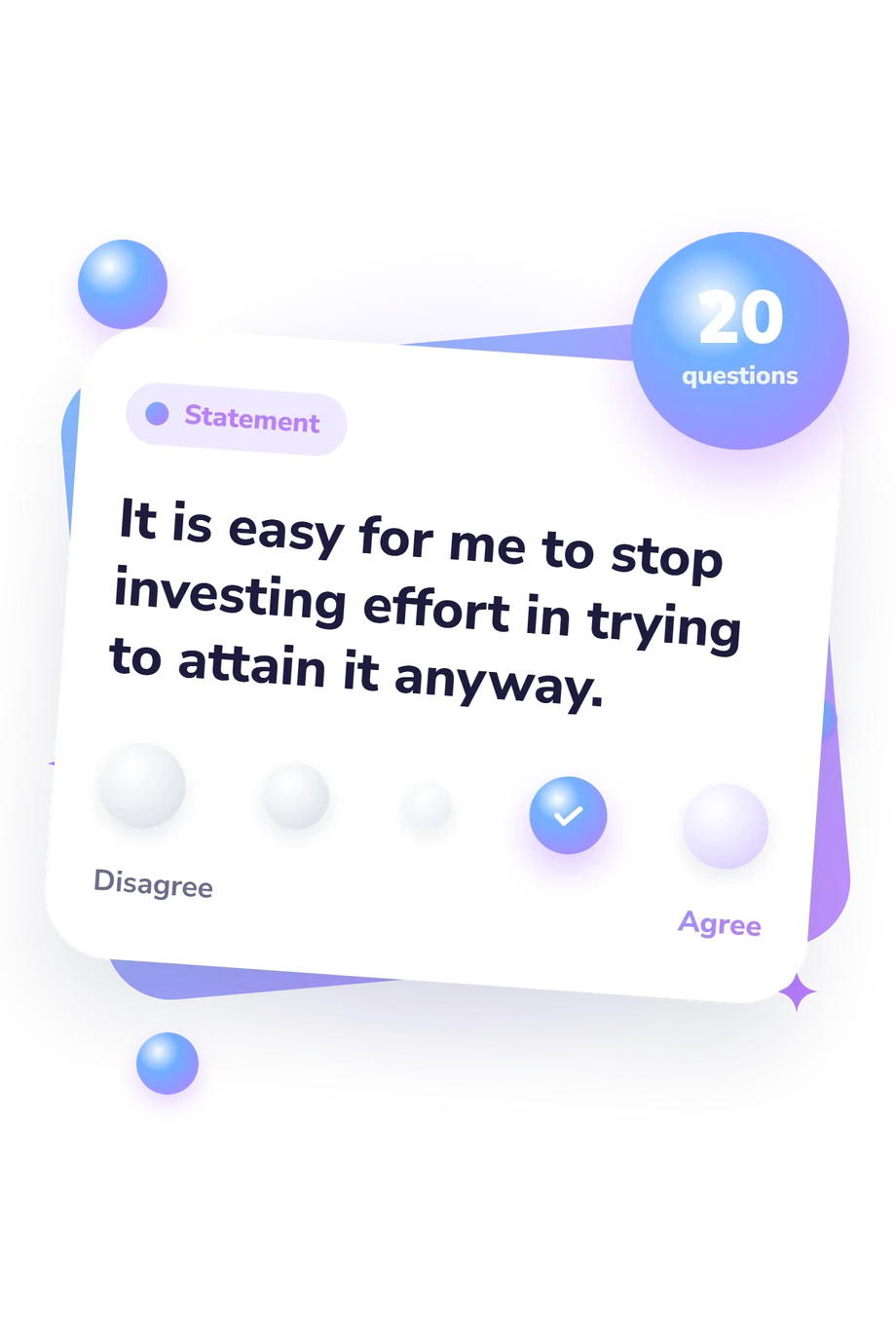
Each statement uses a five-point agreement format, from Disagree to Agree, with three intermediate positions. Responses are combined into two scores; agreement is not uniformly positive because some items concern releasing effort and attachment, while others concern finding and pursuing replacement goals.
Conceptually, this questionnaire is consistent with the Goal Adjustment Scale developed by Wrosch and colleagues, which separates disengagement from unattainable goals and reengagement with new ones. The 2013 review connects these capacities with self-regulation, well-being, and health, but that evidence does not validate this online version. By separating these capacities, this questionnaire serves as a goal adjustment questionnaire for structured self-reflection rather than a standardized clinical assessment.
The online format provides score bands, not population norms or diagnostic thresholds. Results can shift with current circumstances, honest responding, and self-awareness. A score describes a tendency in the situations covered by the items; it does not predict every decision or make persistence or disengagement universally beneficial. Read both dimensions together and consider the goal that prompted the answers.
- Wrosch, Carsten, Michael F. Scheier, Gregory E. Miller, Richard Schulz, and Charles S. Carver. “Adaptive Self-Regulation of Unattainable Goals: Goal Disengagement, Goal Reengagement, and Subjective Well-Being.” Personality and Social Psychology Bulletin, 2003, 29(12), 1494-1508. 10.1177/0146167203256921
- Wrosch, Carsten, Michael F. Scheier, and Gregory E. Miller. “Goal Adjustment Capacities, Subjective Well-Being, and Physical Health.” Social and Personality Psychology Compass, 2013, 7(12), 847-860. 10.1111/spc3.12074
Updated: