
Perceived Stress Scale (PSS-14) Test
How the Scales are Structured
Who Usually Takes This Test?
See How You Compare
Below is a preview of how scores are typically distributed across each scale.
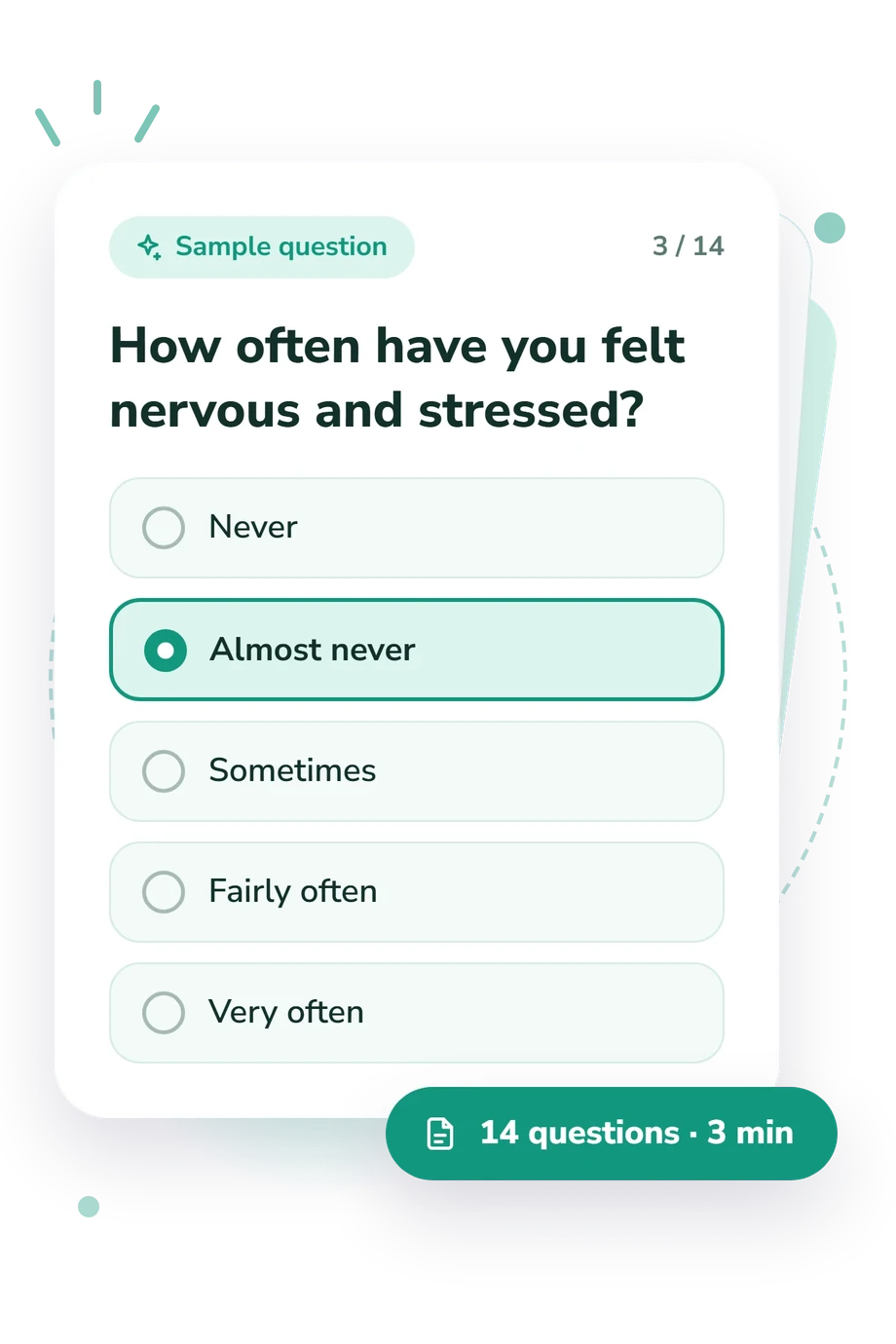
Example Questions From the Test
- Never
- Almost never
- Sometimes
- Fairly often
- Very often
- Never
- Almost never
- Sometimes
- Fairly often
- Very often
- Never
- Almost never
- Sometimes
- Fairly often
- Very often
Perceived Stress Scale (PSS-14) Test - Description and methodology of the test
People who want to understand how stress feels amid everyday demands may use the Perceived Stress Scale (PSS-14) Test to reflect on their appraisals of stress and perceived control. This perceived stress questionnaire organizes self-reported experiences into an overall reading that combines negative perceptions with perceived ability to cope, rather than identifying what caused the strain.
What This Assessment Explores
The items cover everyday pressure, unexpected events, overload, nervousness, irritability, time management, and confidence in handling problems. This PSS-14 questionnaire therefore gives a profile of perceived demands alongside the respondent’s sense of control.
The result is divided into three related readings:
- Coping Factor (0-28) shows management of stress and adaptive coping; Low coping (0-11), Moderate coping (12-21), and High coping (22-28) are the displayed bands, with higher scores indicating stronger coping and resilience.
- Distress Factor (0-32) shows psychological discomfort and negative responses; Low distress (0-7), Moderate distress (8-17), and High distress (18-32) indicate increasing difficulty adapting.
- Perceived Stress Scale (0-56) measures subjective daily stress, combining negative perceptions and perceived ability to cope; Low stress (0-15), Moderate stress (16-31), and High stress (32-56) are displayed bands, while higher scores may indicate substantial stress and potential mental and physical health risks.
Methodology and Scientific Basis
Responses use ordered frequency choices from Never to Very often. Prompts cover overload, nervousness, loss of control, coping, confidence, and time management; this captures subjective appraisal rather than an objective event count.
Responses become displayed totals. With no stated per-answer allocation or reverse-keying rule, the ranges cannot reveal one; interpretation follows the supplied bands and score pattern.
The principal conceptual reference is the published PSS-14 described by Cohen et al. (1983) as a measure of subjective stress. Hewitt, Flett, and Mosher (1992) examined its factor structure and relation to depressive symptoms; Cohen and Williamson (1988) supplied U.S. population context. For this PSS-14 assessment, the three-scale online arrangement is conceptually consistent with that evidence base, but it is not independently standardized or validated by Cohen et al. (1983). The questionnaire has no documented norms or reliability estimates, and its results can shift with memory, current circumstances, and honest self-report; read them as a reflective profile rather than a diagnosis or complete assessment.
- Cohen, S., Kamarck, T., & Mermelstein, R. (1983). A Global Measure of Perceived Stress. Journal of Health and Social Behavior, 24(4), 385-396. 10.2307/2136404
- Hewitt, P. L., Flett, G. L., & Mosher, S. W. (1992). The Perceived Stress Scale: Factor Structure and Relation to Depression Symptoms in a Psychiatric Sample. Journal of Psychopathology and Behavioral Assessment, 14(3), 247-257. 10.1007/BF00962631
- Cohen, S., & Williamson, G. M. (1988). Perceived Stress in a Probability Sample of the United States. In S. Spacapan & S. Oskamp (Eds.), The Social Psychology of Health (pp. 31-67). Sage Publications.
Updated: