
Personal Risk Factors Assessment Test
How the Scales are Structured
Who Usually Takes This Test?
See How You Compare
Below is a preview of how scores are typically distributed across each scale.
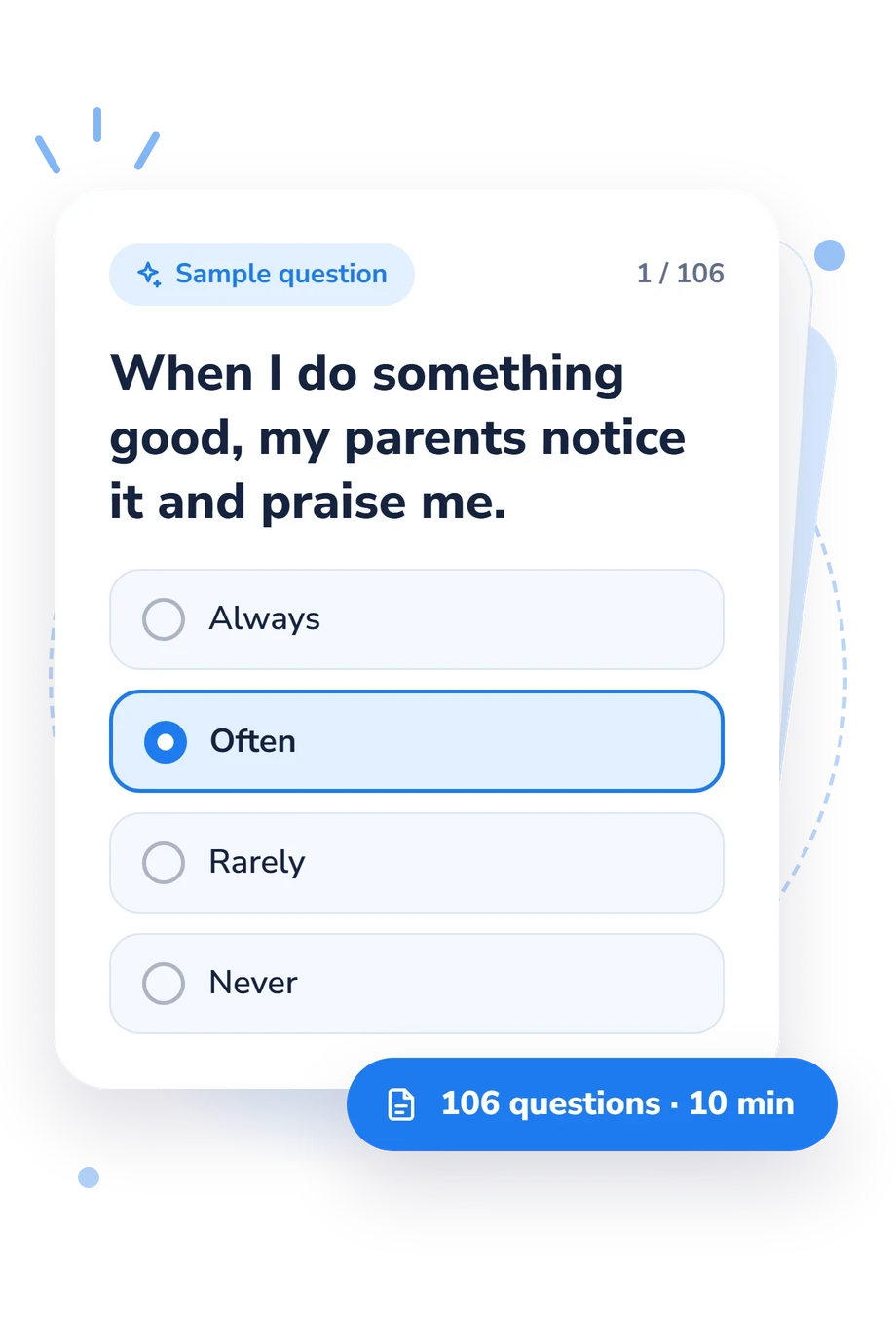
Example Questions From the Test
- Always
- Often
- Rarely
- Never
- Always
- Often
- Rarely
- Never
- Always
- Often
- Rarely
- Never
Personal Risk Factors Assessment Test - Description and methodology of the test
People seeking a structured way to examine circumstances linked with addictive-behavior vulnerability may use the Personal Risk Factors Assessment Test to consider school, family, peer, and personal contexts. It is intended as an assessment of risk factors in an adolescent’s everyday experiences, relationships, attitudes, and habits. The profile reports separate domain results alongside an overall risk estimate.
What This Assessment Explores
Questions cover school, family, peer exposure, substance attitudes, emotional states, and habits. Readers can examine how an adolescent’s context and reactions may increase vulnerability. As a substance use risk assessment, it highlights areas for reflection.
The five dimensions are:
- School (0-19) covers underachievement, conflict, absenteeism, and school changes; Low 0-9, Moderate 10-14, High 15-19.
- Immediate Social Environment (0-58) reflects deviant or substance-using peers and approval of such behavior; Low influence 0-24, Moderate influence 25-41, High influence 42-58.
- Psychological (0-57) covers free time, impulsivity, loneliness, hardship, and sensation seeking; Low 0-20, Moderate 21-37, High 38-57.
- Family (0-37) reflects weak shared values and goals, unclear norms, parental conflict, and insufficient expectations; higher scores may indicate an unfavorable environment linked to addictive-behavior risk; Low 0-15, Moderate 16-26, High 27-37.
- Overall Risk (0-171) estimates adverse conditions across domains; Low 0-68, Moderate 69-118, High 119-171.
Methodology and Evidence Base
Items use formats suited to content: frequency choices, yes-or-no answers, perceived harm, past-use categories, and estimates of peers’ behavior or access. This self-report design covers personal experiences and surrounding conditions. The questionnaire reports domain scores and an overall estimate, but it does not state a standardized answer-to-point conversion, so displayed ranges should not be reverse-engineered into a scoring rule.
Conceptually, it is consistent with Shipitsyna (2004) on risk and protective conditions affecting minors, but is not presented as an adaptation or validation of it. Bulycheva (2023) emphasizes social surroundings and relationships in risky behavior, while Wills et al. (2013) links impulsivity and self-regulation with social and emotional influences on substance use.
Taken as an addiction risk assessment, the result is best read as a pattern across domains. Higher domain scores identify areas for reflection, while a high overall band indicates multiple adverse conditions. Interpretation remains limited by self-report, current circumstances, insight, and possible under- or over-reporting; the bands are descriptive, not universal clinical cutoffs or a diagnosis.
- Shipitsyna, L. M. (Ed.). (2004). Risk and Protective Factors in the Prevention of Psychoactive Substance Abuse among Minors. Moscow: Moscow City Foundation for Support of School Book Publishing. 111 pp.
- Bulycheva, Ekaterina V. (2023). Adolescents’ relationships with the social environment as a factor of protection against risky behaviours. National Psychological Journal, 1(49), 88-101. 10.11621/npj.2023.0108
- Wills, Thomas A., Bantum, Erin O’Carroll, Pokhrel, Pallav, Maddock, Jay E., Ainette, Michael G., Morehouse, Ellen, and Fenster, Bonnie. (2013). A dual-process model of early substance use: tests in two diverse populations of adolescents. Health Psychology, 32(5), 533-542. 10.1037/a0027634
Updated: