
Inventory of the Dimensions of Emerging Adulthood (IDEA) Test
How the Scales are Structured
Who Usually Takes This Test?
See How You Compare
Below is a preview of how scores are typically distributed across each scale.
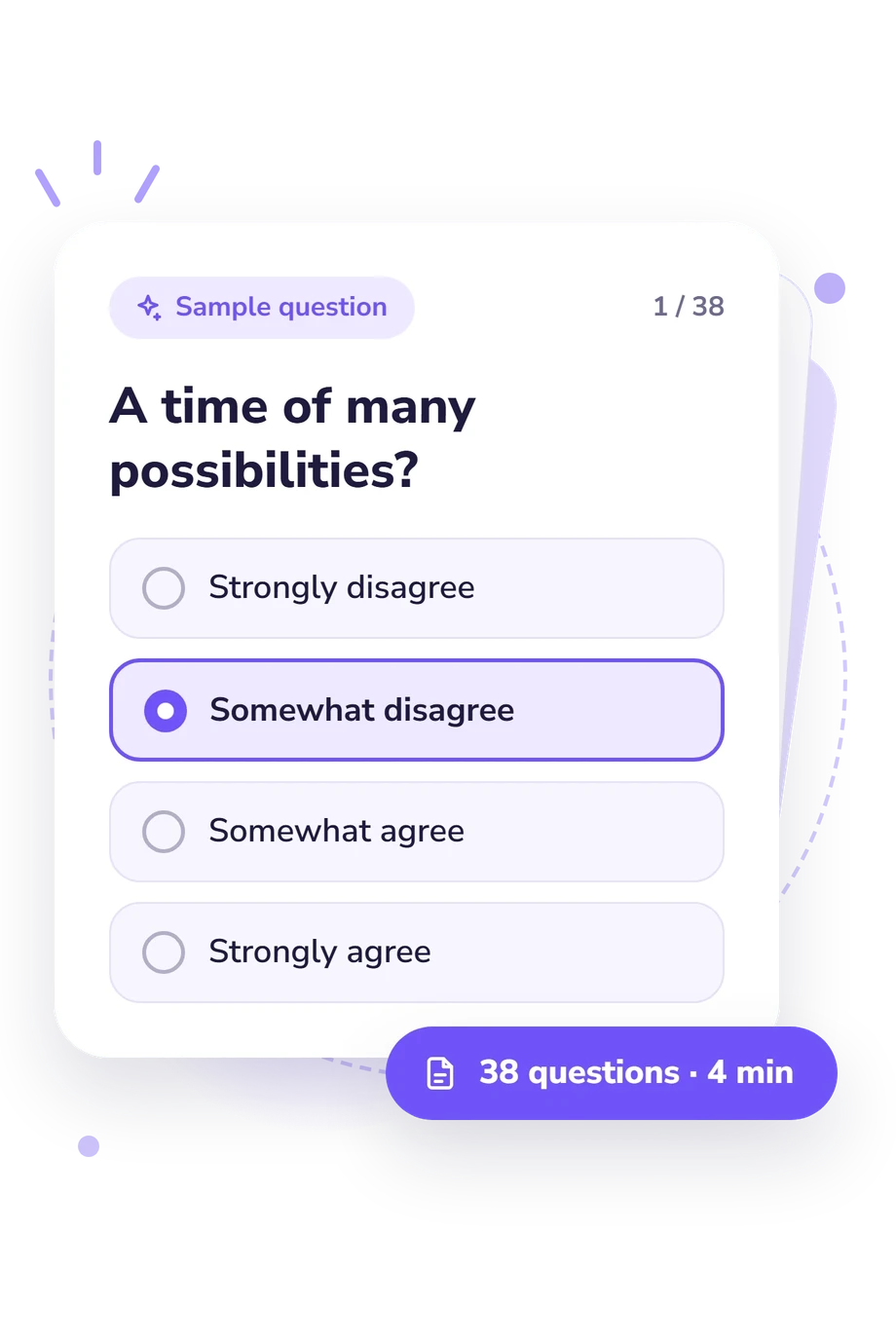
Example Questions From the Test
- Strongly disagree
- Somewhat disagree
- Somewhat agree
- Strongly agree
- Strongly disagree
- Disagree somewhat
- Agree somewhat
- Strongly agree
- Strongly disagree
- Somewhat disagree
- Somewhat agree
- Strongly agree
Inventory of the Dimensions of Emerging Adulthood (IDEA) Test - Description and methodology of the test
For readers trying to understand how they are navigating the transition toward adult roles, the Inventory of the Dimensions of Emerging Adulthood (IDEA) Test offers a structured way to reflect on this life stage. Its structure organizes experiences of freedom, uncertainty, pressure, and self-definition as dimensions of emerging adulthood without reducing them to one overall judgment. The profile is most useful for noticing which themes feel especially prominent in your current circumstances.
What This Assessment Explores
The items ask you to rate statements about possibilities, confusion, experimentation, stress, independence, pressure, values, and becoming an adult. They capture how this period feels rather than judging it as good or bad. Together, the dimensions form an emerging adulthood profile that shows how strongly each theme appears in your responses.
The five displayed dimensions are:
- Instability (4-16) shows change and uncertainty: More stable (4-8), Moderately changeable (9-12), Highly changeable (13-16).
- In-Between (3-12) shows feeling between roles: Clear adult role (3-5), Mixed/transitioning (6-9), Strong in-between feeling (10-12).
- Self-Focus (3-12) shows priority given to autonomy and personal development: Low self-focus (3-6), High self-focus (7-12).
- Experimentation (4-16) shows willingness to try new possibilities: Low exploration (4-8), Moderate exploration (9-12), High exploration (13-16).
- Identity Exploration (5-20) shows active work on identity, values, and direction: Low (5-9), Moderate (10-14), High (15-20).
Methodology and Scientific Basis
Each statement uses a four-point agreement format, moving from Strongly disagree to Strongly agree, with wording that asks how much a description fits the respondent's experience. Responses are grouped into five dimension totals and read through the displayed bands; the questionnaire does not present one single developmental score.
The structure is conceptually consistent with the IDEA 19-item five-factor adaptation (Yerofeyeva, 2023). It is also situated within Arnett's theory of emerging adulthood, which emphasizes exploration, instability, self-focus, and gradual movement toward adult roles. Reifman, Arnett, and Colwell (2007) connect that framework with assessment and practical application. These sources explain the model's logic, but they do not establish identical norms for every online version.
The IDEA inventory is a self-report reflection tool, so answers may shift with current circumstances, self-awareness, social expectations, and response style. No population norms or diagnostic thresholds are supplied; scores are therefore best treated as a structured snapshot for reflection, not a clinical conclusion. Comparing the profile with your lived context can make the result more useful than reading any band in isolation.
- Yerofeyeva, V. G. (2023). Characteristics of Emerging Adulthood: Adaptation of the Questionnaire in Russian Culture. Social Psychology and Society, 14(3), 187-204. 10.17759/sps.2023140312
- Reifman, A., Arnett, J. J., & Colwell, M. J. (2007). Emerging Adulthood: Theory, Assessment and Application. Journal of Youth Development, 2(1), 37-48. 10.5195/JYD.2007.359
- Arnett, J. J. (2000). Emerging Adulthood: A Theory of Development from the Late Teens through the Twenties. American Psychologist, 55(5), 469-480. 10.1037/0003-066X.55.5.469
Updated: