
Motivational State Scale Test
How the Scales are Structured
Who Usually Takes This Test?
See How You Compare
Below is a preview of how scores are typically distributed across each scale.
Example Questions From the Test
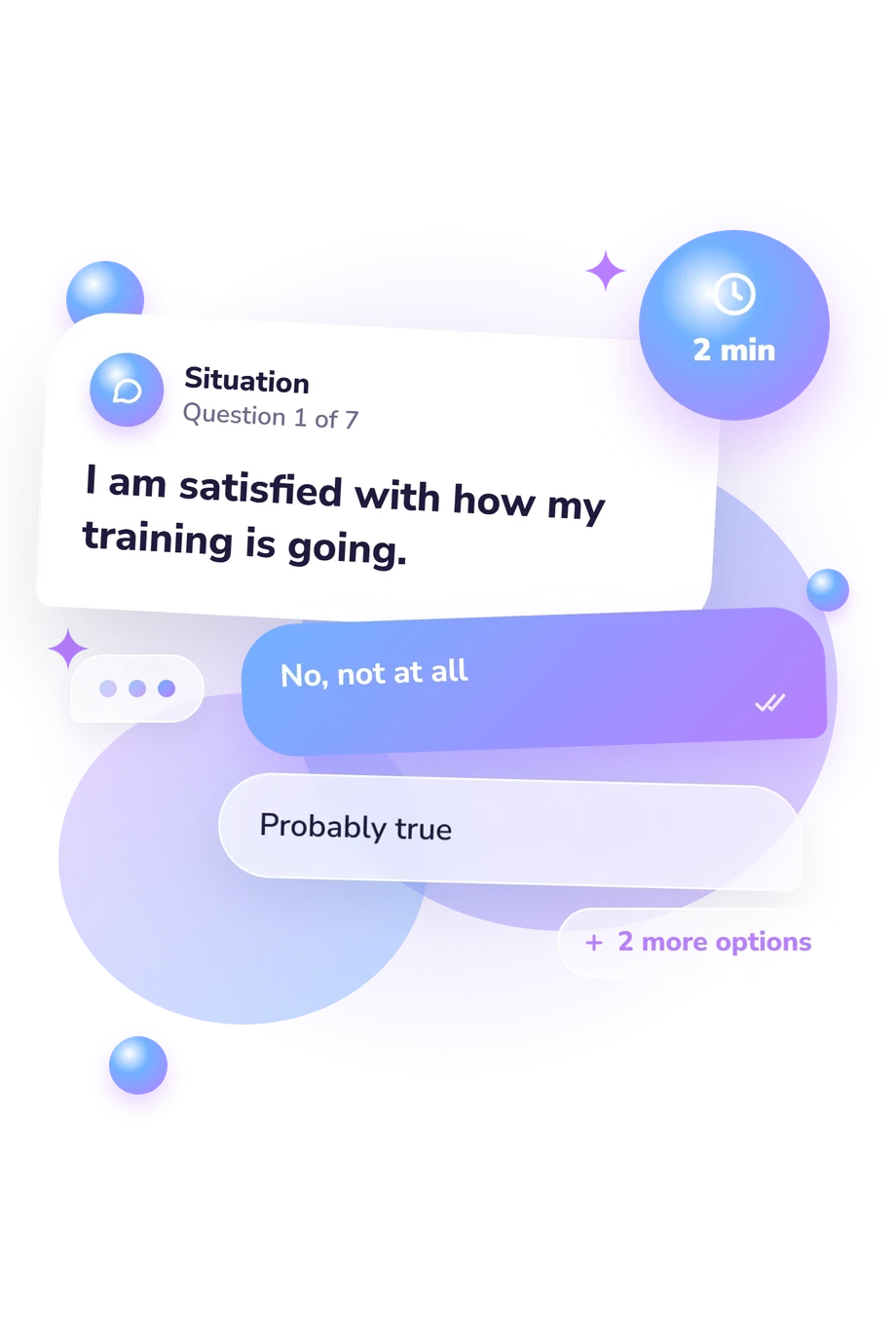
- No, not at all
- Probably true
- True
- Completely true
- No, not at all
- Probably true
- True
- Completely true
- Not at all true
- Probably true
- True
- Completely true
Motivational State Scale Test - Description and methodology of the test
Athletes who want to understand a current shift in training engagement can use the Motivational State Scale Test as a focused self-report. It is suited to athletes reflecting on practice, preparation, and season goals, and can also give coaches a concise starting point for discussion. Its value as a training motivation test lies in showing present engagement, confidence in the programme, and detachment rather than a stable personality characteristic.
What This Assessment Explores
The questionnaire examines present engagement in training. Its statements address satisfaction, willingness to change the method, seasonal goals, active participation, feedback, confidence in the programme, and personal concern about practice. Together, they describe a current state rather than a fixed trait.
An athlete can notice whether drive is supported by goals and confidence or weakened by doubt, conflict, detachment, or dissatisfaction. The result offers an athlete motivation assessment by linking these reactions with recent training experience and prompting discussion of conditions and goals.
These are the result details shown by the questionnaire:
- Motivational State (7-28) reports training drive: Low drive (7-18), Optimal (19-22), and Very high (23-28). Lower results are associated with absent drive, conflict, or doubts; higher results indicate very strong motivation and may coincide with anxiety or inexperience.
Methodology and Evidence Base
Each statement uses a four-point agreement format, ranging from "No, not at all" to "Completely true." The respondent reports directly on training rather than completing an interview or performance task. The questionnaire reports a single displayed result, but it does not state a standardized item-scoring rule; weighting, reversal, or aggregation should not be inferred from the seven-item range.
The closest named source is Sopov’s Motivational State Scale, as described in his 2005 book. This questionnaire is conceptually consistent with that instrument, not presented as a standardized adaptation. Deci and Ryan’s self-determination framework offers a broader lens for interest, agency, and goal-directed engagement, without making the result a direct measure of every construct in that theory.
The questionnaire is presented without stated norms, reliability estimates, or validation data for this online version. As a motivational state assessment, it offers a snapshot shaped by training conditions, expectations, recent experience, and candour. A low or high result can guide conversation about goals and engagement.
- Sopov, V. F. (2005). Mental States in Intense Professional Activity: Study Guide. Moscow: Academic Project; Triksta. 128 pp. ISBN 5-8291-0589-6; 5-902358-55-8.
- Nakhodkin, V., Khvatskaya, E., Ilina, N., Andreev, V., & Andreev, V. (2021). Research on the state of young hockey players’ pre-competitive psychological fitness. Laplage em Revista, 7(3), 283-291. 10.24115/S2446-62202021731296p.283-291
- Shevchenko, E. I., Martynenko, I. V., Oreshkina, I. N., & Solodukhin, I. A. (2022). Priority directions of speed endurance development in higher sports skill athletes in short track. Journal of Physical Education and Sport, 22(1), Article 29, 225-229. 10.7752/jpes.2022.01029
- Deci, E. L., & Ryan, R. M. (1985). Intrinsic Motivation and Self-Determination in Human Behavior. New York: Plenum Press.
Updated: