
Intolerance of Uncertainty Scale Test
How the Scales are Structured
Who Usually Takes This Test?
See How You Compare
Below is a preview of how scores are typically distributed across each scale.
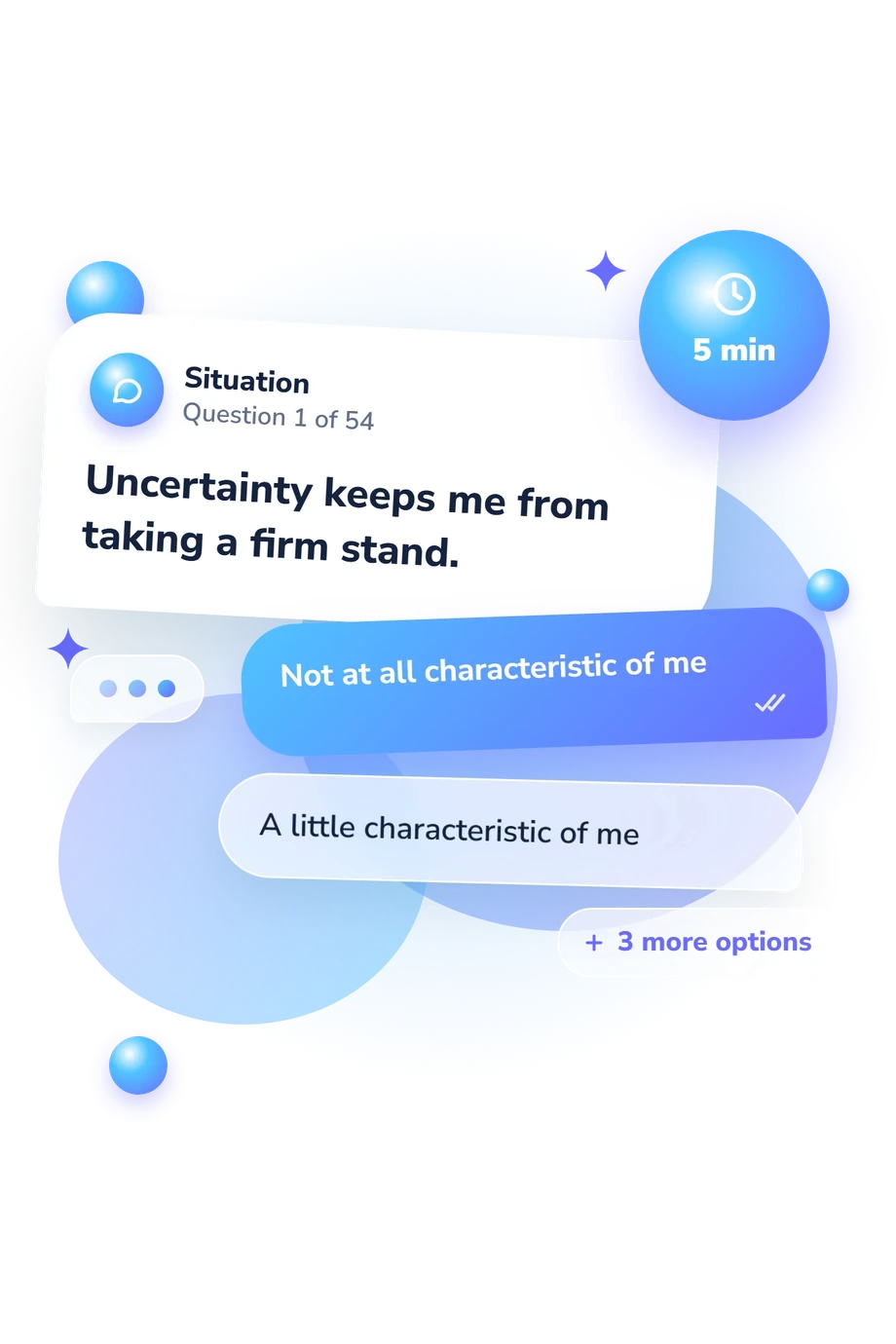
Example Questions From the Test
- Not at all like me
- Somewhat like me
- Yes, like me
- Very much like me
- Exactly like me
- Not at all characteristic of me
- A little characteristic of me
- Somewhat characteristic of me
- Mostly characteristic of me
- Very characteristic of me
- Not at all like me
- A little like me
- Somewhat like me
- Very much like me
- Exactly like me
Intolerance of Uncertainty Scale Test - Description and methodology of the test
People who feel blocked by incomplete information, unexpected changes, or an unknowable future may use this assessment to examine their reactions more systematically. The Intolerance of Uncertainty Scale Test is intended for people who want to understand how uncertainty affects emotions, decisions, planning, and everyday functioning. The result summarizes overall difficulty tolerating uncertainty, while the item themes show the kinds of reactions the questionnaire considers. As an intolerance of uncertainty questionnaire, it offers a structured starting point for self-reflection.
What This Assessment Explores
Uncertainty is treated here as more than not knowing an answer. The items examine how unpredictable situations affect emotional comfort, confidence, preparation, action, and sleep. They suit people who notice distress or hesitation when outcomes cannot be guaranteed.
The Intolerance of Uncertainty Scale ranges from 27-135: More tolerant is 27-40, Elevated difficulty is 41-70, and Very high difficulty is 71-135. An uncertainty tolerance assessment shows whether the pattern reflects ease with the unknown, growing strain, or pronounced difficulty.
The items cover these recurring situations:
- Emotional discomfort shows how ambiguity is linked with unease, anxiety, stress, or vulnerability.
- Need for certainty shows how strongly incomplete information creates pressure for definite answers.
- Anticipatory control shows how planning and preventing surprises become coping responses.
- Action and functioning show whether doubt affects decisions, performance, sleep, or avoidance.
Methodology and Scientific Basis
Each statement uses a five-point response scale, moving from not describing the person to describing them very strongly. Wording varies slightly, but each item asks how characteristic the reaction is. The questionnaire reports one overall result, and the bands function as descriptive levels of difficulty.
Its evidence base is tied to the published Intolerance of Uncertainty Scale developed by Freeston and colleagues. Conceptually, this intolerance of uncertainty measure is consistent with that instrument, not a reproduction of its research protocol. Buhr and Dugas's 2002 study examined the English version's psychometric properties, while Sexton and Dugas's 2009 study examined negative beliefs about uncertainty and factor structure. Those studies clarify the construct and measurement history but do not establish identical reliability, norms, or validity for this online version.
Read the result alongside the item themes and your current context: self-report is shaped by response style, mood, recent events, and self-awareness. Those studies do not establish identical reliability, norms, or validity for this online version, so the score cannot by itself establish a disorder.
- Freeston, Mark H., Josée Rhéaume, Hélène Letarte, Michel J. Dugas, and Robert Ladouceur. “Why Do People Worry?” Personality and Individual Differences 17, no. 6 (1994): 791-802. 10.1016/0191-8869(94)90048-5
- Buhr, Kristin, and Michel J. Dugas. “The Intolerance of Uncertainty Scale: Psychometric Properties of the English Version.” Behaviour Research and Therapy 40, no. 8 (2002): 931-945. 10.1016/S0005-7967(01)00092-4
- Sexton, Kathryn A., and Michel J. Dugas. “Defining Distinct Negative Beliefs About Uncertainty: Validating the Factor Structure of the Intolerance of Uncertainty Scale.” Psychological Assessment 21, no. 2 (2009): 176-186. 10.1037/a0015827
Updated: