
Freudly+971 508685814hello@freudly.ai
Freudly
existential psychology

Existential Motivations Test
Take the online Existential Motivations Test - AI psychologist FreudlyYou can take Existential Motivations Testhere. Online version of a simple and accurate psychological test with interpretation.en
In 7 minutes, understand how fulfilled your core existential motivations are and how aligned you feel with your life. Get clear, actionable insight to strengthen inner balance for therapy, coaching, or research.
Start Online Test
Questions: 367 minutes
08:30
October 2, 2025
October 2, 2025
Material has been updated
October 2, 2025
Material has been published
19,715 views
1,857 completions
1,521 likes
Verified by Daniel Hall
Psychologist with 25 years of experience
Share
Scale Explorer

How the Scales are Structured

example score
5/12
Time (T)
Time reflects how consistently you attend to meaningful relationships and significant events, supporting a sense of richness and value in life.
Limited focus
Developing focus
Strong focus
36: Limited focus | 79: Developing focus | 1012: Strong focus
A score of 5 falls in the Limited focus range, suggesting you may often have difficulty sustaining attention to important relationships and events that contribute to existential fulfillment.
example score
9/12
Relatedness (R)
Coherence measures how well you create meaningful connections with other people and values that support belonging and purpose.
Low coherence
Moderate coherence
High coherence
36: Low coherence | 79: Moderate coherence | 1012: High coherence
A score of 9 suggests moderately strong coherence, with generally meaningful relationships and values that support a sense of belonging and purpose.
example score
5/12
Value in the Future (VitF)
Measures how well a person perceives their actions and goals as meaningful and valuable in the long term, supporting purpose and life direction.
Low future value
Moderate future value
High future value
36: Low future value | 79: Moderate future value | 1012: High future value
A score of 5 indicates low future value, suggesting long-term meaning and direction are currently less salient and may be harder to connect to everyday actions.
example score
8/12
Involvement in Relationships (IiR)
This scale measures how actively a person engages in social and personal relationships that support belonging and meaning.
Low involvement
Moderate involvement
High involvement
36: Low involvement | 79: Moderate involvement | 1012: High involvement
A score of 8 indicates moderate involvement in relationships, suggesting generally consistent participation with some room to deepen connection or engagement when needed.
example score
10/12
Opportunities for Action (OfA)
Measures the perceived availability of space and possibilities for self-realization and active participation in life that support a sense of meaning and significance.
Limited opportunities
Adequate opportunities
Abundant opportunities
36: Limited opportunities | 79: Adequate opportunities | 1012: Abundant opportunities
A score of 10 indicates you generally perceive abundant opportunities to act and realize yourself, supporting engagement and a stronger sense of meaning in daily life.
example score
17/36
Fundamental Motivation 4: Meaning in Life (FM4MiL)
Measures how strongly a person experiences and pursues life purpose through future-oriented values, relationships, and activities.
Lower meaning
Moderate meaning
Higher meaning
919: Lower meaning | 2031: Moderate meaning | 3236: Higher meaning
A score of 17 falls in the Lower meaning range, suggesting purpose and future-oriented engagement may feel less defined or less consistently accessible right now.
example score
9/12
Recognition of Value (RoV)
Measures the extent to which you accept your own uniqueness and significance, supporting authenticity and inner resilience.
Lower acknowledgment
Moderate acknowledgment
Stronger acknowledgment
36: Lower acknowledgment | 79: Moderate acknowledgment | 1012: Stronger acknowledgment
A score of 9 indicates a generally solid acceptance of your own value, with some room to further strengthen stable self-recognition across situations.
example score
9/12
Fair Attitude (FA)
Measures how strongly a person experiences fairness and justice in relation to themselves and others as part of maintaining dignity and inner honesty.
Low
Moderate
High
36: Low | 79: Moderate | 1012: High
A score of 9 indicates a moderate sense of fair treatment, suggesting you generally perceive justice and reciprocity but may notice inconsistencies in some situations.
example score
9/12
Interested Attention (IA)
Focused Attention measures how well you notice and care for your own feelings and needs in a way that supports self-respect.
Low
Moderate
High
36: Low | 79: Moderate | 1012: High
A score of 9 indicates a moderate level of focused attention, suggesting you often tune into your feelings and needs and usually respond to them in supportive ways.
example score
23/36
Fundamental Motivation 3: Self-Worth (FM3SW)
FM-3 Self-Worth measures the extent to which a person feels self-acceptance, authenticity, and deserving of fair treatment as a basis for self-respect and inner harmony.
Low
Moderate
High
923: Low | 2432: Moderate | 3336: High
A score of 23 falls in the Low range, suggesting self-worth is less consistently supported and may be more sensitive to external evaluation or unfair treatment.
example score
7/12
Intimacy (I)
Closeness measures emotional involvement and the capacity to form deep interpersonal connections that support joy and existential fulfillment.
Low closeness
Moderate closeness
High closeness
36: Low closeness | 79: Moderate closeness | 1012: High closeness
A score of 7 indicates moderate closeness, suggesting a generally present ability for emotional involvement and deeper connection that may still fluctuate by context.
example score
32/36
Fundamental Value (FV)
FM-2 assesses the extent to which a person experiences joy of life and satisfaction with existence through perceived quality of life, meaning, time, and closeness.
Low
Moderate
High
919: Low | 2029: Moderate | 3036: High
A score of 32 falls in the High range, suggesting a strong sense of fundamental value expressed as generally satisfying, meaningful living and a felt closeness to life here and now.
example score
7/12
Space (S)
Space reflects how much physical and psychological room you experience for autonomy, freedom, and choice in life.
Restricted space
Adequate space
Expansive space
36: Restricted space | 79: Adequate space | 1012: Expansive space
A score of 7 suggests a generally adequate sense of room and freedom, with some situations still feeling limiting for autonomous choice.
example score
7/12
Sense of Security (SoS)
Measures the extent to which you feel safe and accepted in society and close relationships, supporting trust in the world and self-confidence.
Low security
Moderate security
High security
36: Low security | 79: Moderate security | 1012: High security
A score of 7 indicates a moderate sense of safety and acceptance, with some areas where security may feel less stable or consistent.
example score
7/12
Support (S)
Support measures how stable and dependable your inner beliefs and external structures feel as foundations you can rely on in life.
Limited support
Moderate support
Strong support
36: Limited support | 79: Moderate support | 1012: Strong support
A score of 7 suggests a moderate sense of stable foundations, with some reliable supports present but also room to strengthen consistency and security.
example score
21/36
Fundamental Trust (FT)
Measures the extent to which you feel basic safety, support, and freedom of choice in the world (a sense of “I can”).
Low
Moderate
High
919: Low | 2029: Moderate | 3036: High
A score of 21 falls in the Moderate range, suggesting a generally present sense of safety and support with some situations where confidence and perceived room for choice may fluctuate.
example score
111/144
Existential Fulfillment (EF)
Measures how fully your core existential motivations—freedom of choice, valuing life, self-worth, and meaning—are realized as an overall sense of harmony with life.
Low fulfillment
Moderate fulfillment
High fulfillment
3685: Low fulfillment | 86119: Moderate fulfillment | 120144: High fulfillment
A score of 111 falls in the Moderate fulfillment range, suggesting a generally supportive sense of connection and authenticity with some areas where existential balance could be strengthened.
Start Online Test
just completed the test
DATA-BASED USER COHORTS

Who Usually Takes This Test?

People seeking life meaning
41%OF USERS
They feel stuck or empty and want a clearer picture of what gives their life depth, direction, and inner balance.
Therapy and coaching clients
34%OF USERS
They use the results with a therapist or coach to pinpoint which core motivations are underfulfilled and set concrete growth goals.
Couples and close partners
25%OF USERS
They take the relationship-focused version to see how their connection supports or blocks safety, value, and shared meaning.
BASED ON AGGREGATED, ANONYMIZED DATA FROM TENS OF THOUSANDS OF FREUDLY USERS.
Benchmarking

See How You Compare

Once you complete the test, your results are compared with real-world data from people in your country.
Below is a preview of how scores are typically distributed across each scale.
Time (T)
Time (T)
Average
8
Normal range
6.69.4
min.
3
max.
12
This curve shows how scores are typically distributed.
Once you complete the test, your result will appear on the scale so you can see how you compare.
Correlation (C)
Correlation (C)
Average
5.8
Normal range
4.47.1
min.
3
max.
12
This curve shows how scores are typically distributed.
Once you complete the test, your result will appear on the scale so you can see how you compare.
Value in the Future (VitF)
Average
9.7
Normal range
8.211.3
min.
3
max.
12
This curve shows how scores are typically distributed.
Once you complete the test, your result will appear on the scale so you can see how you compare.
Engagement in Relationships (EiR)
Average
9.2
Normal range
7.910.4
min.
3
max.
12
This curve shows how scores are typically distributed.
Once you complete the test, your result will appear on the scale so you can see how you compare.
Opportunities for Activity (OfA)
Average
6.9
Normal range
5.38.6
min.
3
max.
12
This curve shows how scores are typically distributed.
Once you complete the test, your result will appear on the scale so you can see how you compare.
FM-4: The Meaning of Life (FTMoL)
Average
26.5
Normal range
22.830.2
min.
9
max.
36
This curve shows how scores are typically distributed.
Once you complete the test, your result will appear on the scale so you can see how you compare.
Acknowledging Value (AV)
Average
6.1
Normal range
4.97.4
min.
3
max.
12
This curve shows how scores are typically distributed.
Once you complete the test, your result will appear on the scale so you can see how you compare.
Fair Treatment (FT)
Fair Treatment (FT)
Average
9.3
Normal range
7.910.8
min.
3
max.
12
This curve shows how scores are typically distributed.
Once you complete the test, your result will appear on the scale so you can see how you compare.
Focused Attention (FA)
Average
9.1
Normal range
7.710.5
min.
3
max.
12
This curve shows how scores are typically distributed.
Once you complete the test, your result will appear on the scale so you can see how you compare.
FM-3: Self-Worth (FS)
Average
24.3
Normal range
20.628
min.
9
max.
36
This curve shows how scores are typically distributed.
Once you complete the test, your result will appear on the scale so you can see how you compare.
Closeness (C)
Closeness (C)
Average
7.7
Normal range
6.39.1
min.
3
max.
12
This curve shows how scores are typically distributed.
Once you complete the test, your result will appear on the scale so you can see how you compare.
FM-2: Fundamental Value (FFV)
Average
24.9
Normal range
2128.7
min.
9
max.
36
This curve shows how scores are typically distributed.
Once you complete the test, your result will appear on the scale so you can see how you compare.
Space (S)
Space (S)
Average
5.3
Normal range
3.86.8
min.
3
max.
12
This curve shows how scores are typically distributed.
Once you complete the test, your result will appear on the scale so you can see how you compare.
Security (S)
Security (S)
Average
7.2
Normal range
5.78.6
min.
3
max.
12
This curve shows how scores are typically distributed.
Once you complete the test, your result will appear on the scale so you can see how you compare.
Support (S)
Support (S)
Average
9
Normal range
7.710.4
min.
3
max.
12
This curve shows how scores are typically distributed.
Once you complete the test, your result will appear on the scale so you can see how you compare.
FM-1: Fundamental Trust (FFT)
Average
23.3
Normal range
19.926.8
min.
9
max.
36
This curve shows how scores are typically distributed.
Once you complete the test, your result will appear on the scale so you can see how you compare.
Existential Fulfillment (EF)
Average
101.8
Normal range
87.2116.4
min.
36
max.
144
This curve shows how scores are typically distributed.
Once you complete the test, your result will appear on the scale so you can see how you compare.
Featured On
SAMPLE QUESTIONS

Example Questions From the Test

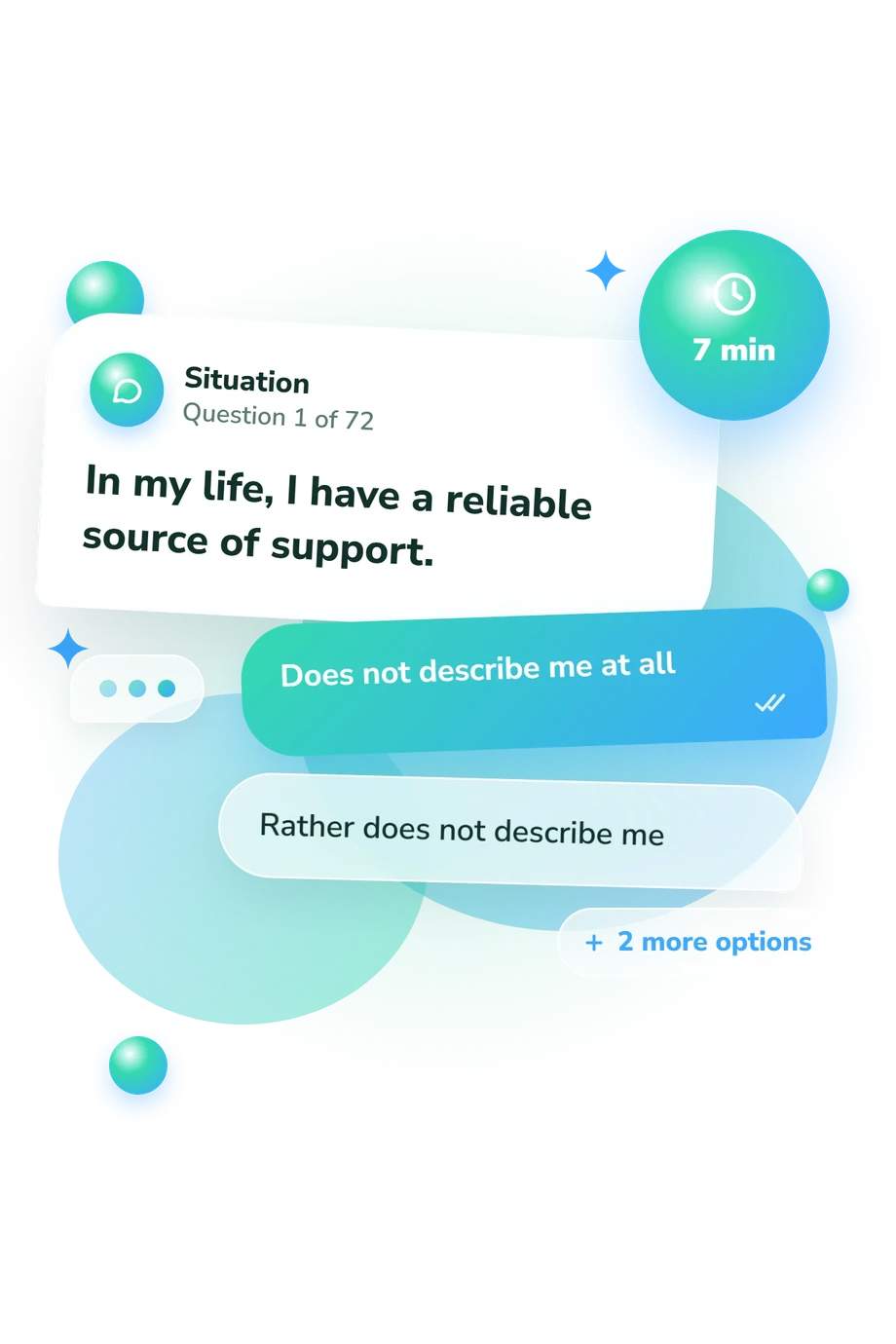
    • Does not apply at all
    • Mostly does not apply
    • Mostly applies
    • Completely applies
    • Does not describe me at all
    • Mostly does not describe me
    • Mostly describes me
    • Describes me completely
    • Not true at all
    • Rather not true
    • Rather true
    • Completely true
WHAT THE TEST MEASURES
About This Assessment
Test of Existential Motivations, TEM

Existential Motivations Test - Symptoms and Signs

existential psychology
fulfillment
meaningfulness

This measure is designed to support structured self-report assessment of meaning-related and existential themes in a person’s current experience. The Existential Motivations Test provides a brief snapshot of perceived alignment with core motivations and sense of engagement with life, and may be used as an adjunct to clinical formulation and reflective discussion.

The instrument consists of 36 items and typically requires about 7 minutes to complete. Items query subjective perceptions of fulfillment, inner coherence, and lived connection to personal values and circumstances; results are generally interpreted descriptively and in context rather than as a standalone diagnostic indicator. The Existential Motivations Test is attributed in part to Viktor E. Frankl, Rollo May, and James C. Crumbaugh.

Author: James C. Crumbaugh, Rollo May, Viktor E. Frankl
Literature: Ryan, R. M., & Deci, E. L. Self-determination theory and the facilitation of intrinsic motivation, social development, and well-being. American Psychologist. 2000.; Steger, M. F., Frazier, P., Oishi, S., & Kaler, M. The meaning in life questionnaire: Assessing the presence of and search for meaning in life. Journal of Counseling Psychology. 2006.
Popular tests
Comments
Leave a Comment