
Procrastination Tendency Scale Test
How the Scales are Structured
Who Usually Takes This Test?
See How You Compare
Below is a preview of how scores are typically distributed across each scale.
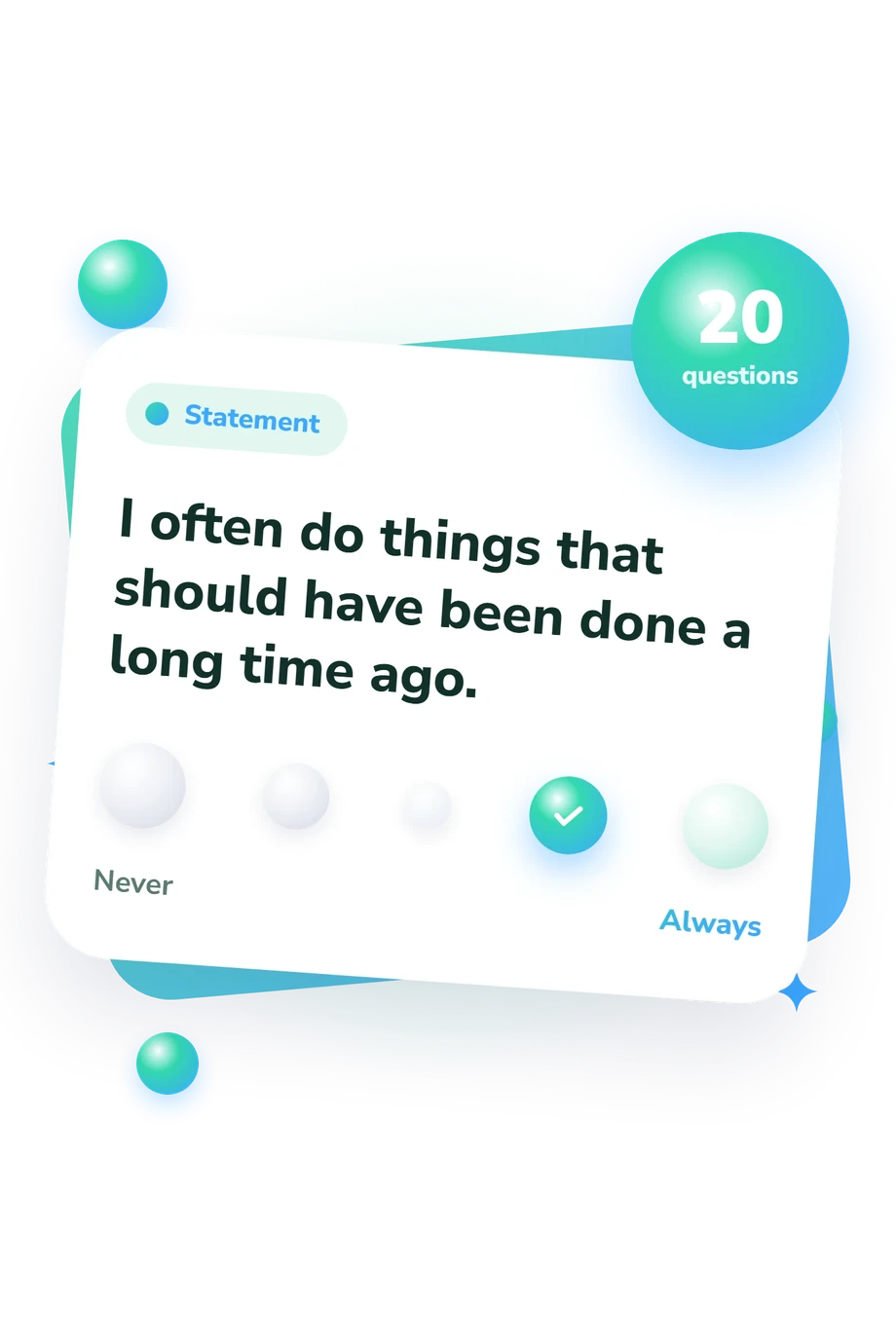
Example Questions From the Test
- Never
- Rarely
- Sometimes
- Usually
- Always
- Never
- Rarely
- Sometimes
- Usually
- Always
- Never
- Rarely
- Sometimes
- Usually
- Always
Procrastination Tendency Scale Test - Description and methodology of the test
People who want to understand why routine responsibilities drift, cluster near deadlines, or remain unfinished may find the Procrastination Tendency Scale Test useful for structured self-reflection. As a procrastination self-assessment, it focuses on everyday behavior rather than isolated missed tasks, helping a respondent consider whether delay is occasional, habitual, or linked to difficulties with self-organization. The result offers a practical starting point for noticing patterns and planning change.
What This Assessment Explores
Instead of treating procrastination as one missed deadline, the questionnaire looks at recurring timing choices around obligations, decisions, errands, purchases, correspondence, appointments, and rest. It is intended for people who want to examine delay patterns in ordinary life. Its focus resembles a task delay questionnaire because the result summarizes a tendency, not an isolated lapse. Higher results suggest more frequent postponement and weaker self-organization; lower results suggest more consistent prompt action and self-discipline.
These themes appear in four result dimensions:
- The Procrastination Scale (20-100) summarizes delay; Low is 20-52, Average 53-66, and High 67-100.
- Task postponement shows how often obligations and small activities are left until later.
- Last-minute behavior captures rushing, delayed purchases, and work started near deadlines.
- Prompt self-organization reflects quick action, completed plans, early arrival, and evening rest.
Methodology and Scientific Basis
Each item uses five ordered choices-Never, Rarely, Sometimes, Usually, and Always-so the respondent reports behavioral frequency. Statements cover both delay and timely action, and answers combine into one total. Because the questionnaire does not state a more detailed point-contribution rule, the displayed bands should not be reverse-engineered into an invented formula.
This procrastination behavior test is best understood as a frequency-based self-report measure. Its content is conceptually consistent with the General Procrastination Scale (Lay, 1986), a published framework for habitual delay, but the online questionnaire is not that instrument or a validated adaptation of it. Svartdal and Steel (2017) show why procrastination scales require care: they can emphasize different facets, so their scores are not automatically interchangeable.
The result bands are interpretive categories, not clinical cutoffs or population norms. Scores may shift with workload, fatigue, deadlines, mood, and self-perception, while self-report can understate or overstate behavior. Read the result alongside recent examples and repeated observations, using it to identify patterns rather than as a fixed label.
- Lay, Clarry H. (1986). At last, my research article on procrastination. Journal of Research in Personality, 20(4), 474-495. 10.1016/0092-6566(86)90127-3
- Svartdal, Frode, and Piers Steel. (2017). Irrational Delay Revisited: Examining Five Procrastination Scales in a Global Sample. Frontiers in Psychology, 8, Article 1927. 10.3389/fpsyg.2017.01927
Updated: