
Procrastination Scale (PSI) Test
How the Scales are Structured
Who Usually Takes This Test?
See How You Compare
Below is a preview of how scores are typically distributed across each scale.
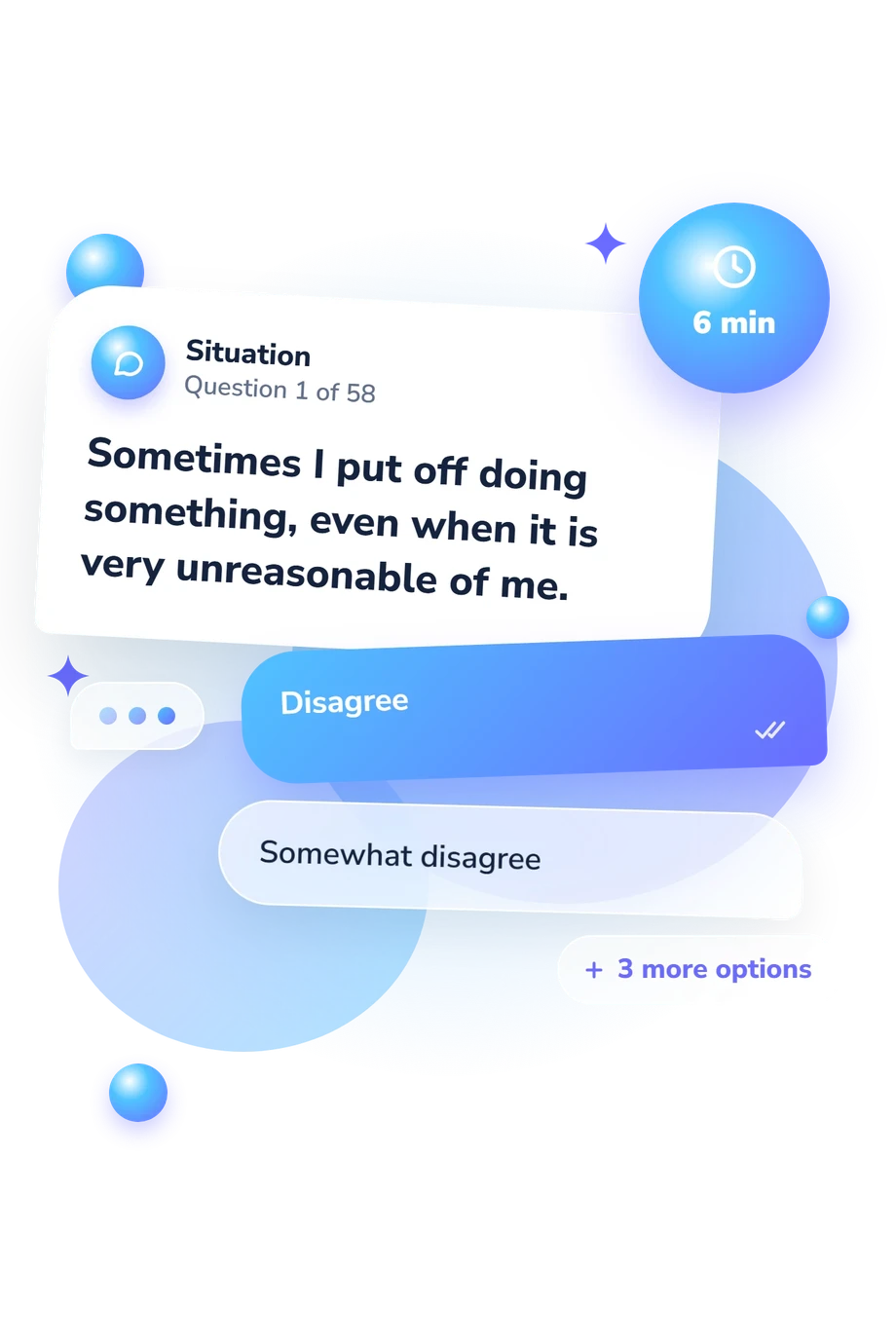
Example Questions From the Test
- Disagree
- Somewhat disagree
- Sometimes
- Somewhat agree
- Agree
- Disagree
- Mostly no
- Sometimes
- Mostly yes
- Agree
- Disagree
- Rather no
- Sometimes
- Rather yes
- Agree
Procrastination Scale (PSI) Test - Description and methodology of the test
People who notice missed deadlines, delayed starts, or unfinished intentions can use this questionnaire to examine the pattern without reducing it to a single lapse. The Procrastination Scale (PSI) Test is suited to anyone seeking a clearer picture of task initiation, prioritization, and follow-through. Used as a procrastination self-assessment, this questionnaire helps connect everyday choices with the situations in which delay becomes most persistent and difficult to interrupt.
What This Assessment Explores
This questionnaire focuses on recurring delay rather than occasional rescheduling. It asks about postponed responsibilities, late starts, missed deadlines, regret after delaying, and distraction by less important activities. That makes the procrastination questionnaire relevant to people examining study, work, or everyday planning habits.
The result summarizes how strongly delay characterizes the reported behavior. Lower levels suggest timely completion, middle levels allow flexibility in time use, and higher levels point to repeated postponement.
The displayed Procrastination scale runs from 29 to 145 and is interpreted through these result bands:
- Low (29-73) indicates timely task completion with little evidence of persistent postponement.
- Moderate (74-117) reflects flexible time allocation, with delay that may be situational rather than pervasive.
- High (118-145) indicates pronounced procrastination and frequent postponement for an indefinite period.
Methodology and Scientific Basis
Methodologically, the items use a five-point agreement format, moving from disagreement through an intermediate response to agreement. They cover delayed action and timely behavior, including starting important work, organizing priorities, meeting deadlines, and resisting distraction.
The questionnaire displays one overall Procrastination result; its item weighting and reverse-scoring procedure are not documented, while the items ask about starting important work, organizing priorities, meeting deadlines, and resisting distraction.
The relevant source work is Piers Steel’s 2002 dissertation, which provides a conceptual reference for the Procrastination Scale (PSI) without establishing an exact 29-item correspondence. Klepikova and Kormacheva's 2019 study addresses its adaptation, while Steel's 2010 work discusses arousal, avoidant, and decisional patterns. This questionnaire is conceptually consistent with those sources, not presented as a validated adaptation.
No standardized norms, reliability estimates, or clinical cutoffs are stated for this online version, so the result bands are descriptive rather than universal thresholds. Self-report can shift with workload, stress, memory, motivation, and candor. The result supports reflection on procrastination habits but cannot by itself explain why delay occurs.
- Steel, Piers. The Measurement and Nature of Procrastination. Doctoral dissertation, University of Minnesota, 2002.
- Klepikova, N. M., and Kormacheva, I. N. "Adaptation of the Procrastination Scale and the Irrational Procrastination Scale in P. Steel’s Technique." Systems Psychology and Sociology, no. 3 (31), 2019, pp. 26-37. 10.25688/2223-6872.2019.31.3.03
- Steel, Piers. "Arousal, Avoidant and Decisional Procrastinators: Do They Exist?" Personality and Individual Differences, vol. 48, no. 8, 2010, pp. 926-934. 10.1016/j.paid.2010.02.025
Updated: