
Hardiness Scale Test
How the Scales are Structured
Who Usually Takes This Test?
See How You Compare
Below is a preview of how scores are typically distributed across each scale.
Example Questions From the Test
- No
- Probably not
- Probably yes
- Yes
- No
- Probably not
- Probably yes
- Yes
- No
- Probably no
- Probably yes
- Yes
Hardiness Scale Test - Description and methodology of the test
People weighing whether to persist with a demanding course, revise their approach, or seek a different way of handling strain may use this Hardiness Scale Test to organize that reflection. A hardiness questionnaire can help a reader consider which beliefs support active participation, perceived agency, and learning from difficulty. The result offers language for deciding what to examine more closely in daily life.
What This Assessment Explores
Attention falls on the person's stance toward ordinary demands: whether activity feels worth entering, influence seems possible, and novelty can be approached as useful experience. This hardiness assessment describes beliefs that shape persistence, initiative, and openness when circumstances do not proceed as expected.
The four result dimensions are:
- Challenge (0-30) shows willingness to meet uncertainty as a route to learning; Low 0-8, Moderate 9-18, High 19-30.
- Control (0-51) reflects perceived influence and personal choice; Low control 0-20, Moderate control 21-38, High control 39-51.
- Commitment (0-54) measures active engagement and the ability to find value in activities; Low engagement 0-29, Moderate engagement 30-46, High engagement 47-54.
- Hardiness (0-135) summarizes the combined pattern associated with coping under stress; Low hardiness 0-61, Moderate hardiness 62-99, High hardiness 100-135.
Methodology and Scientific Basis
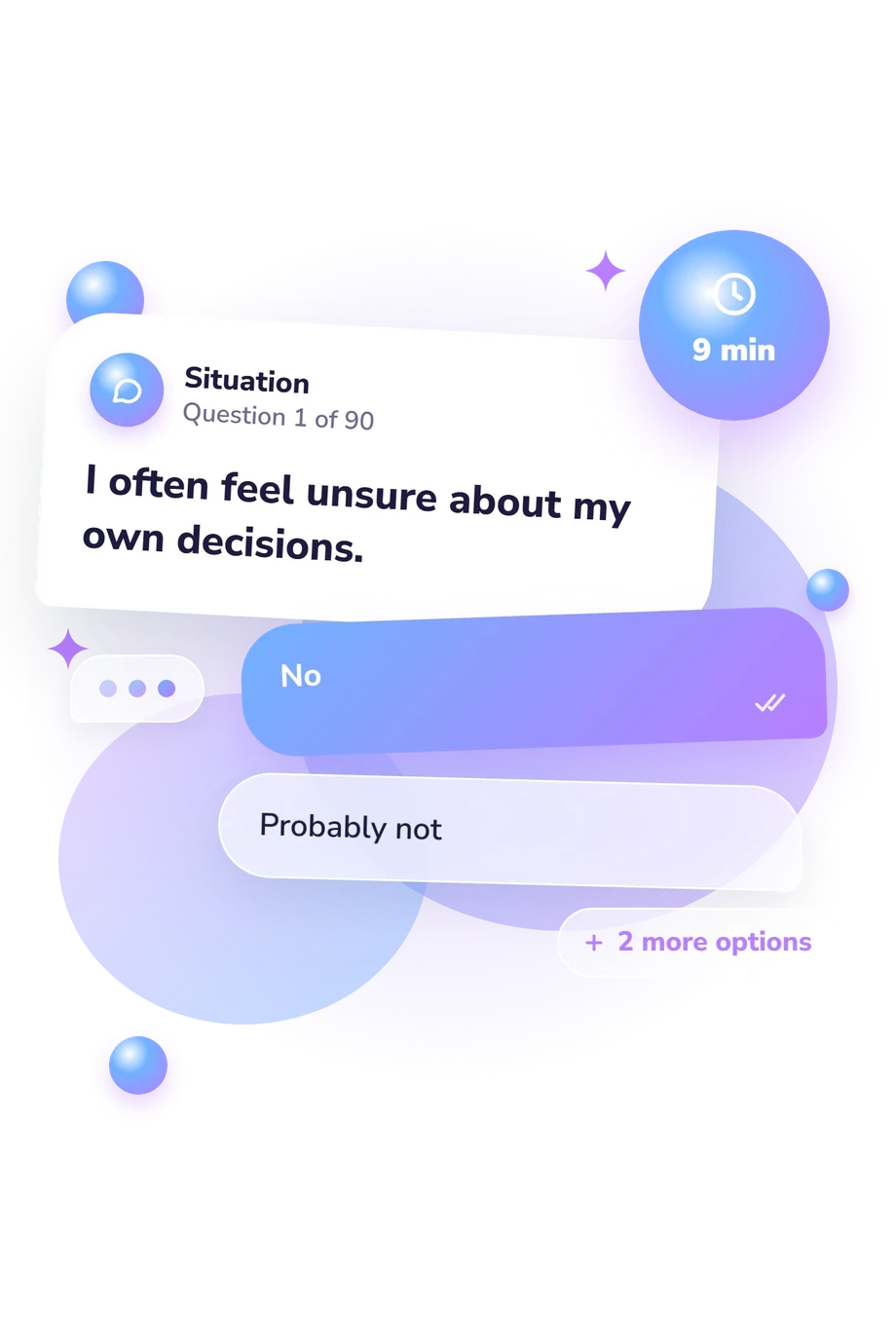
The sampled questions present an attitude or situation with four graded responses, usually No, Probably not, Probably yes, and Yes. They touch decisions, persistence, routine, relationships, future concerns, setbacks, and reactions to unexpected events, without asking the respondent to recount a particular event. This format samples the component beliefs and the overall profile rather than a single isolated behavior.
The questionnaire is conceptually consistent with the Hardiness Test and the commitment-control-challenge model, but is not an adaptation of that published instrument. This framework treats hardiness as distinct from optimism, self-efficacy, and resilience.
Responses are combined into displayed totals, while the item key and calculation formula are not stated. Thus, the four labels should not be read as a simple point-by-point scoring rule. No standardization or clinical norms are provided for this online scoring of the psychological hardiness test; current stress, mood, context, and self-awareness can influence the self-report profile, and the displayed bands are the catalogue's result bands rather than clinical cutoffs.
- Leontiev, Dmitry A., and Elena I. Rasskazova. Hardiness Test. Moscow: Smysl, 2006, 64 pp. ISBN 5-89357-228-9.
- Maddi, Salvatore R., and Suzanne C. Kobasa. The Hardy Executive: Health Under Stress. Homewood, IL: Dow Jones-Irwin, 1984, 131 pp. ISBN 0-87094-381-2.
- Kobasa, Suzanne C. Stressful Life Events, Personality, and Health: An Inquiry into Hardiness. Journal of Personality and Social Psychology, 37(1), 1-11, 1979. DOI 10.1037/0022-3514.37.1.1.
Updated: