
LGBT Quiz
How the Scales are Structured
Who Usually Takes This Test?
See How You Compare
Below is a preview of how scores are typically distributed across each scale.
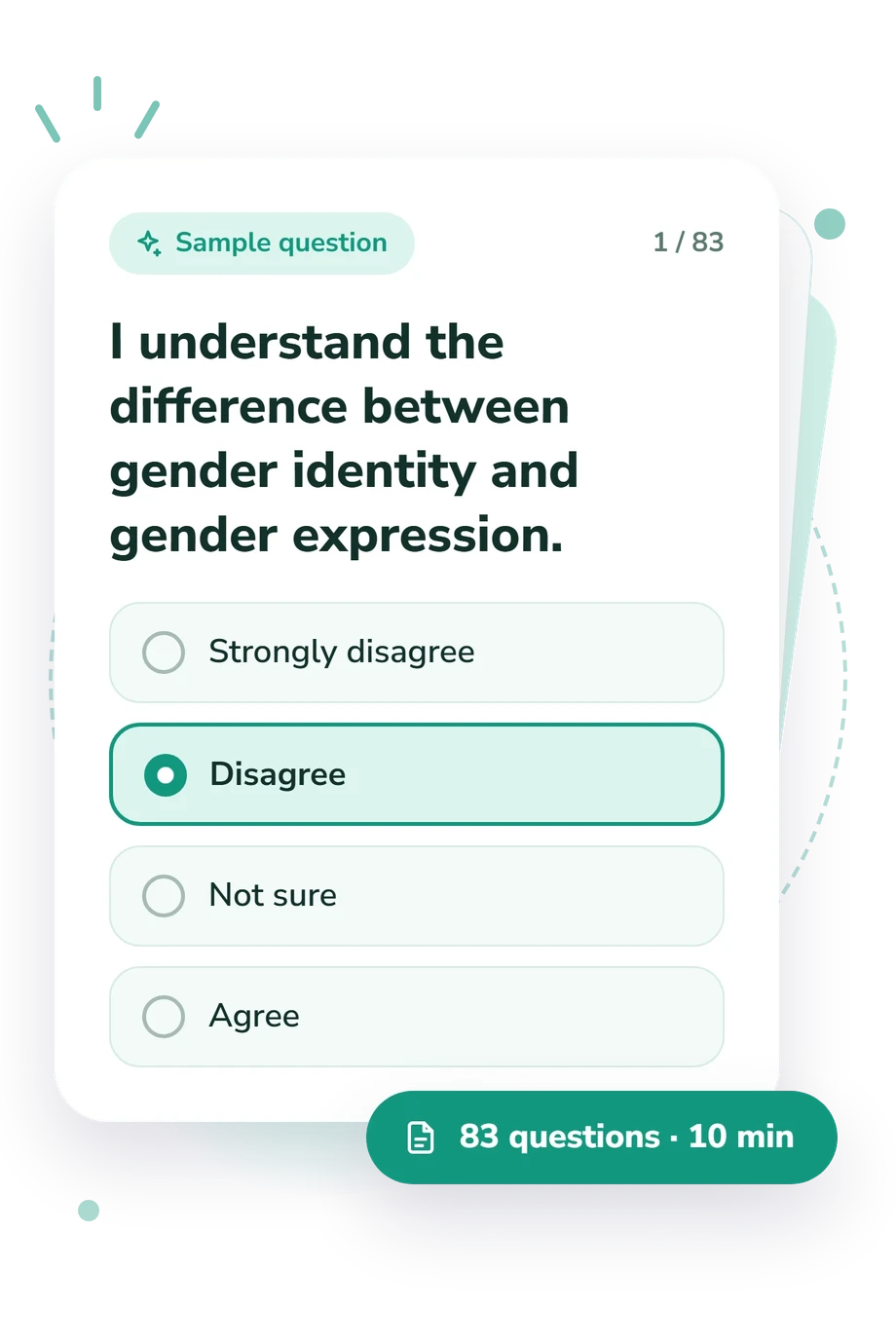
Example Questions From the Test
- Strongly disagree
- Disagree
- Not sure
- Agree
- Strongly disagree
- Disagree
- Not sure
- Agree
- Strongly disagree
- Disagree
- Not sure
- Agree
LGBT Quiz - Description and methodology of the test
People who want a structured way to reflect on identity, safety, language, and support can turn to this lgbt quiz when they are not seeking an immediate label. This questionnaire is intended for people examining personal experiences, questions, or allyship knowledge and inclusive behavior. Readers asking which LGBTQ identity fits them can use this assessment for a broader LGBTQ identity profile rather than a forced label.
What This Assessment Explores
Rather than assigning an identity label, the assessment examines comfort, safety, identity questions, inclusive language, allyship, and responses to mistakes or negative reactions. It combines queer identity exploration with comfort and allyship themes, showing whether exploration feels open, whether privacy or environment affects disclosure, and where further learning may help.
The result is organized into three dimensions:
- Comfort & Safety (0-30) measures comfort discussing topics, sharing feelings, setting boundaries, and feeling safe: Lower comfort/safety 0-10; Mixed comfort/safety 11-20; Higher comfort/safety 21-30.
- Identity Exploration (0-30) measures active reflection on attractions, romantic feelings, gender identity or expression, and possible labels: More settled 0-10; Some exploration 11-20; Active exploration 21-30.
- Knowledge & Allyship Basics (0-30) measures understanding of terms, pronouns, respectful language, and inclusive behaviors: Developing 0-12; Moderate 13-22; Strong 23-30.
Methodology and Scientific Basis
Each statement offers four agreement choices; the strongly worded option varies, with some presenting strongly disagree and others strongly agree. Items cover comfort, skills, and concerns such as hiding questions, fearing judgment, or protecting privacy. Responses are grouped thematically, but point contributions are unspecified; displayed bands are descriptive categories, not a scoring rule deduced from ranges.
Conceptually, this lgbt identity quiz overlaps with published measures only by dimension. The Ally Identity Measure (Jones et al., 2014) addresses ally identity and behavior; the Transgender Inclusive Behavior Scale offers a narrower comparison for inclusive behavior. Identity exploration has conceptual overlap with Toomey, Anhalt, and Shramko (2016), while Testa et al. (2015) is only a contextual comparison for gender-minority stress and resilience, not general comfort or safety. None establishes this questionnaire’s validity, and it is not an adaptation of them.
Results can highlight patterns and suggest subjects for reflection or learning. Current circumstances, privacy concerns, self-awareness, and candor can shape self-report, so the result is a snapshot of the questionnaire’s themes rather than a complete account of identity, safety, or allyship.
- Jones, K. Nicole, Melanie Elyse Brewster, and Jacob A. Jones. "The creation and validation of the LGBT Ally Identity Measure." Psychology of Sexual Orientation and Gender Diversity 1, no. 2 (2014): 181-195. 10.1037/sgd0000033
- Russell B. Toomey, Karla Anhalt, and Maura Shramko. "An examination of the validity and reliability of a measure of sexual orientation identity exploration, resolution, and affirmation." Self and Identity 15, no. 4 (2016): 488-504. 10.1080/15298868.2016.1157516
- Shanna K. Kattari, Ashley A. O'Connor, and Leonardo Kattari. "Development and validation of the Transgender Inclusive Behavior Scale (TIBS)." Journal of Homosexuality 65, no. 2 (2018): 181-196. 10.1080/00918369.2017.1314160
- Rylan J. Testa, Janice Habarth, Jayme Peta, Kimberly F. Balsam, and Walter Bockting. "Development of the Gender Minority Stress and Resilience Measure." Psychology of Sexual Orientation and Gender Diversity 2, no. 1 (2015): 65-77. 10.1037/sgd0000081
Updated: