
Self–Other, Career–Work Test
How the Scales are Structured
Who Usually Takes This Test?
See How You Compare
Below is a preview of how scores are typically distributed across each scale.
Example Questions From the Test
- having a lot of free time
- being successful in everything I do
- giving gifts to my friends
- finding an elegant solution to a difficult problem
- "Work is not a wolf; it will not run off into the woods."
- "If you want to live, you have to know how to get by."
- "What you give is yours."
- "A good salesperson and a good repairman will never go hungry."
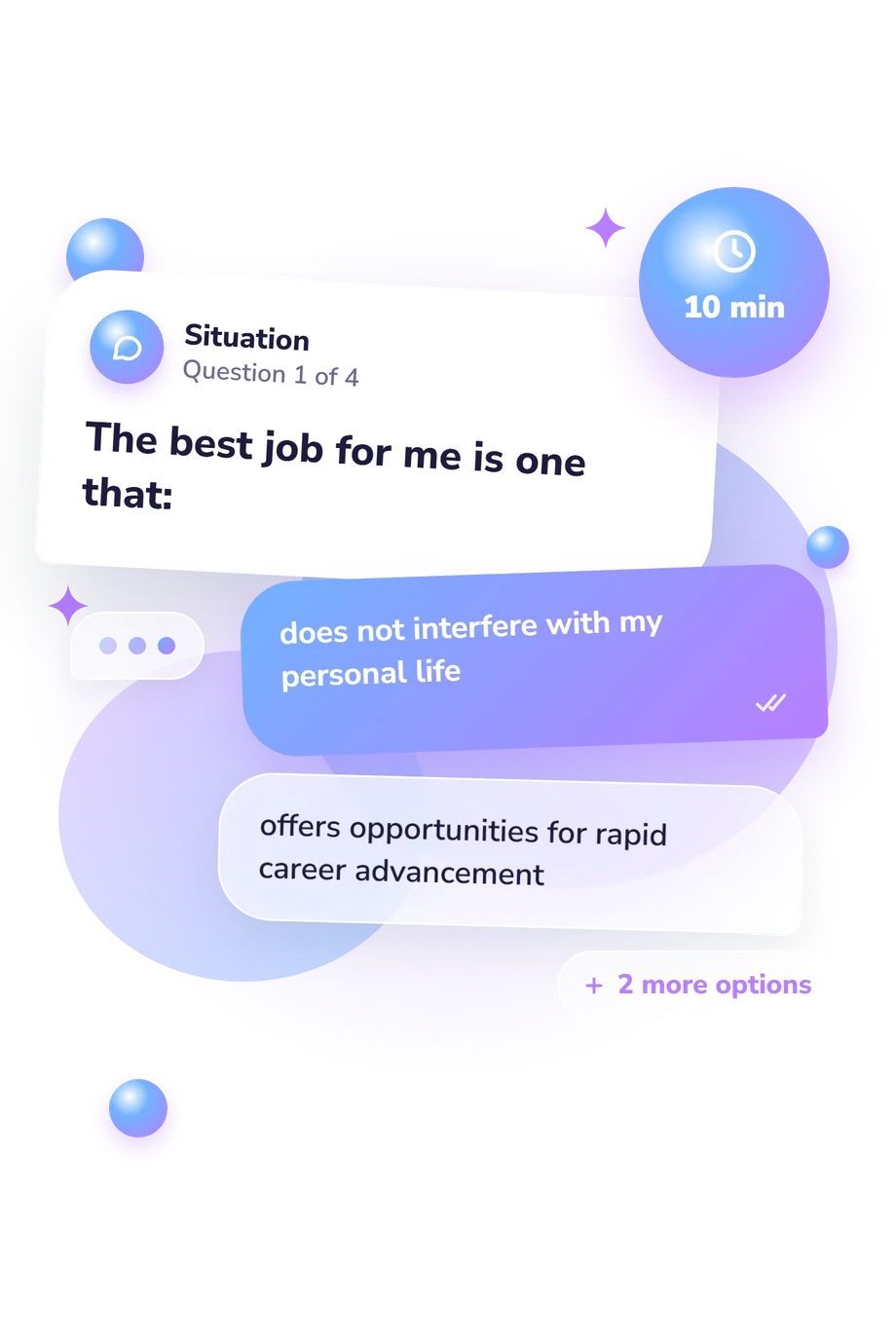
- does not interfere with my personal life
- offers opportunities for rapid career advancement
- is useful to other people
- is interesting
Self–Other, Career–Work Test - Description and methodology of the test
People reviewing a career decision, a current work situation, or competing personal demands may use the Self-Other, Career-Work Test to examine what guides their choices. It suits anyone seeking structured reflection on motivation, relationships, achievement, and well-being. As a career orientation assessment, it returns a four-part profile rather than a single label or verdict.
What This Assessment Explores
The items contrast free time, success, generosity, usefulness, interesting work, status, relationships, and meaningful activity. The profile compares priorities with work motivation, concern for others, career ambition, and interest in work, showing how work priorities interact when values compete. The scales are:
- Work (0-12) measures professional orientation, success striving, and self-realization; Low 0-4, Moderate 5-8, High 9-12.
- Other (0-12) measures concern for others’ interests and well-being, empathy, and willingness to help; Low focus on others 0-4, Balanced focus 5-8, High focus on others 9-12.
- Career (0-12) measures advancement, success, and material well-being; Low career focus 0-4, Moderate career focus 5-8, High career focus 9-12.
- Self (0-12) measures personal interests, calmness, and well-being; Low self-focus 0-4 may indicate fatigue or lack of motivation for activity; Moderate self-focus 5-8; High self-focus 9-12 may be within normal limits or may reflect temporary difficulties.
Methodology and Evidence Base
Each item offers four competing options; across the sample, these include personal time, advancement, helping others, interesting work, and usefulness to other people. Scores remain separate rather than forming one total. Equal option weights, reverse scoring, and conversion rules are not documented, so they should not be inferred from the bands.
Conceptually, the questionnaire is consistent with Self-Other, Career-Work, the closest source for its subject matter, but is not presented as an adaptation of that publication. Rezapkina's work on professional self-awareness and career choice relates to its motives and vocational direction. Holland's vocational-choice framework provides context for work interests, but this profile does not use Holland's typology.
Interpret the orientations together: work motivation may coexist with concern for others, career ambition, or recovery needs. Scores can reflect present circumstances as well as settled preferences. Their bands are descriptive guideposts, not established norms or a calculated balance score. No standardization sample, reliability estimates, or validity coefficients are stated; self-report may shift with fatigue, pressure, self-awareness, or the wish to appear favorable.
- Rezapkina, G. V. (2014). Self-Other, Career-Work. Career Guidance Methodological Cabinet.
- Rezapkina, G. V. (2011). Development of Teachers' Professional Self-Awareness (Continuation). Bulletin of Practical Psychology of Education, 8(2), 92-102.
- Rezapkina, G. V. (2008). Psychology and Career Choice: A Pre-Profile Training Program. 2nd ed. Moscow: Genesis. ISBN 978-5-98563-144-9.
- Holland, J. L. (1959). A theory of vocational choice. Journal of Counseling Psychology, 6(1), 35-45. 10.1037/h0040767
Updated: