
Manipulation Vulnerability Assessment Test
How the Scales are Structured
Who Usually Takes This Test?
See How You Compare
Below is a preview of how scores are typically distributed across each scale.
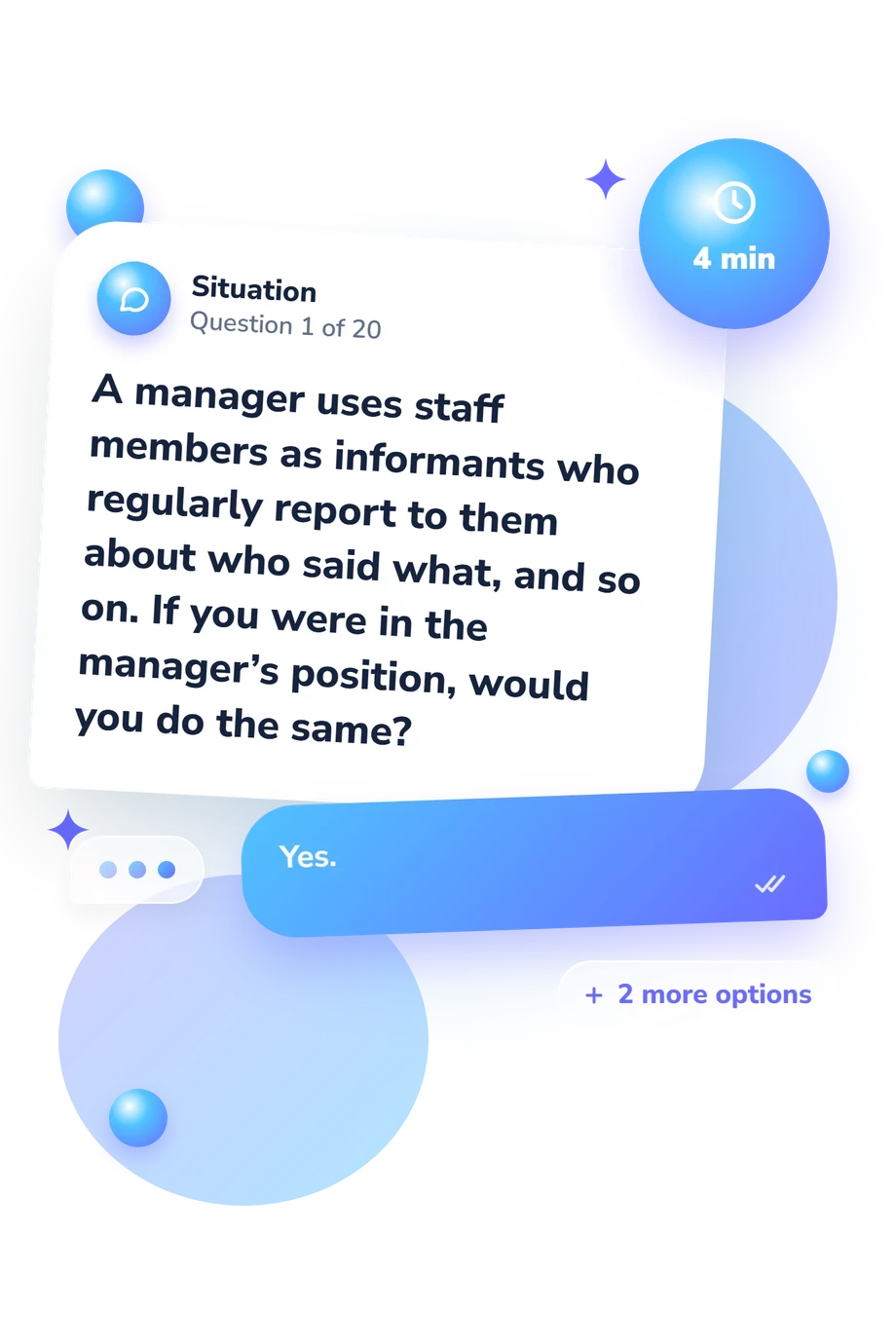
Example Questions From the Test
- a) Spare her nerves and do everything herself.
- b) Keep assigning tasks to him.
- c) It depends on the details.
- It is clear that she is in love; she will be a wonderful wife.
- I doubt it.
- I find it difficult to answer.
- Give advice.
- Avoid giving advice.
- Decide depending on the circumstances.
Manipulation Vulnerability Assessment Test - Description and methodology of the test
People who want to examine how they respond to pressure, guilt, flattery, or social expectations can use this assessment for structured self-reflection. The Manipulation Vulnerability Assessment Test is intended for readers who want to understand how influence may affect everyday choices. It can clarify where personal boundaries feel firm and where reflection may be useful. As a manipulation vulnerability assessment, it offers a focused snapshot rather than a fixed description of character.
What This Assessment Explores
The assessment focuses on susceptibility to manipulative influence in everyday situations. Its scenarios ask respondents to judge interpersonal influence and its effects; recognition and judgment are features of these situations, while the scale reflects susceptibility. They cover advice, loyalty, pressure, threats, emotional leverage, status displays, and attempts to shift responsibility.
Scenarios fall into three areas:
- Advice and responsibility situations show how you evaluate requests, dependence, and decisions affecting others.
- Emotional and relational situations reveal how you interpret guilt, approval, threats, and compliance.
- Workplace, education, and consumer encounters show how you respond to authority, status, group pressure, and unfair demands.
Results use a scale, Vulnerability to Manipulation (0-43): Low vulnerability (0-20) indicates high resistance, Moderate vulnerability (21-30) indicates partial vulnerability, and High vulnerability (31-43) indicates substantial susceptibility. A higher result suggests that influence may affect judgment more easily in these situations but does not predict behavior everywhere.
Methodology and Scientific Basis
Short interpersonal vignettes form the item set. Response options include yes/no choices, alternative actions, evaluations of consequences, and an “it depends” answer. Situations cover family, school, management, romance, and consumer encounters, asking the respondent to interpret influence rather than recall facts.
The questionnaire produces a combined score. That score gives a view of resistance to manipulation in the situations represented by the items, while the ranges organize the result for interpretation. Because the online format does not specify how many points each answer contributes, read the result through the stated ranges rather than an invented item-by-item rule.
Conceptually, the questionnaire is consistent with the Vulnerability to Manipulation Questionnaire (Sheinov, 2012), the closest source for its focus on recognizing and resisting manipulation. Sheinov and Devitsyn’s 2022 publication describes a related short version examining manipulation susceptibility, but it does not establish that this online version shares its items or psychometric properties.
Interpret the score as a snapshot of self-reported judgment. Stress, personal experience, social desirability, and confidence in recognizing influence can shape answers, so examples from daily life provide context.
- Sheinov, V. P. (2012). Development of a questionnaire for assessing an individual’s vulnerability to manipulative influences. Voprosy Psikhologii, (4), 147-154.
- Sheinov, V. P., & Devitsyn, A. S. (2022). A short version of the questionnaire of vulnerability to manipulation. Systems Psychology and Sociology, 1(41), 70-80. 10.25688/2223-6872.2022.41.1.6
Updated: