
Psychological Safety–Insecurity Questionnaire (S-I) Test
How the Scales are Structured
Who Usually Takes This Test?
See How You Compare
Below is a preview of how scores are typically distributed across each scale.
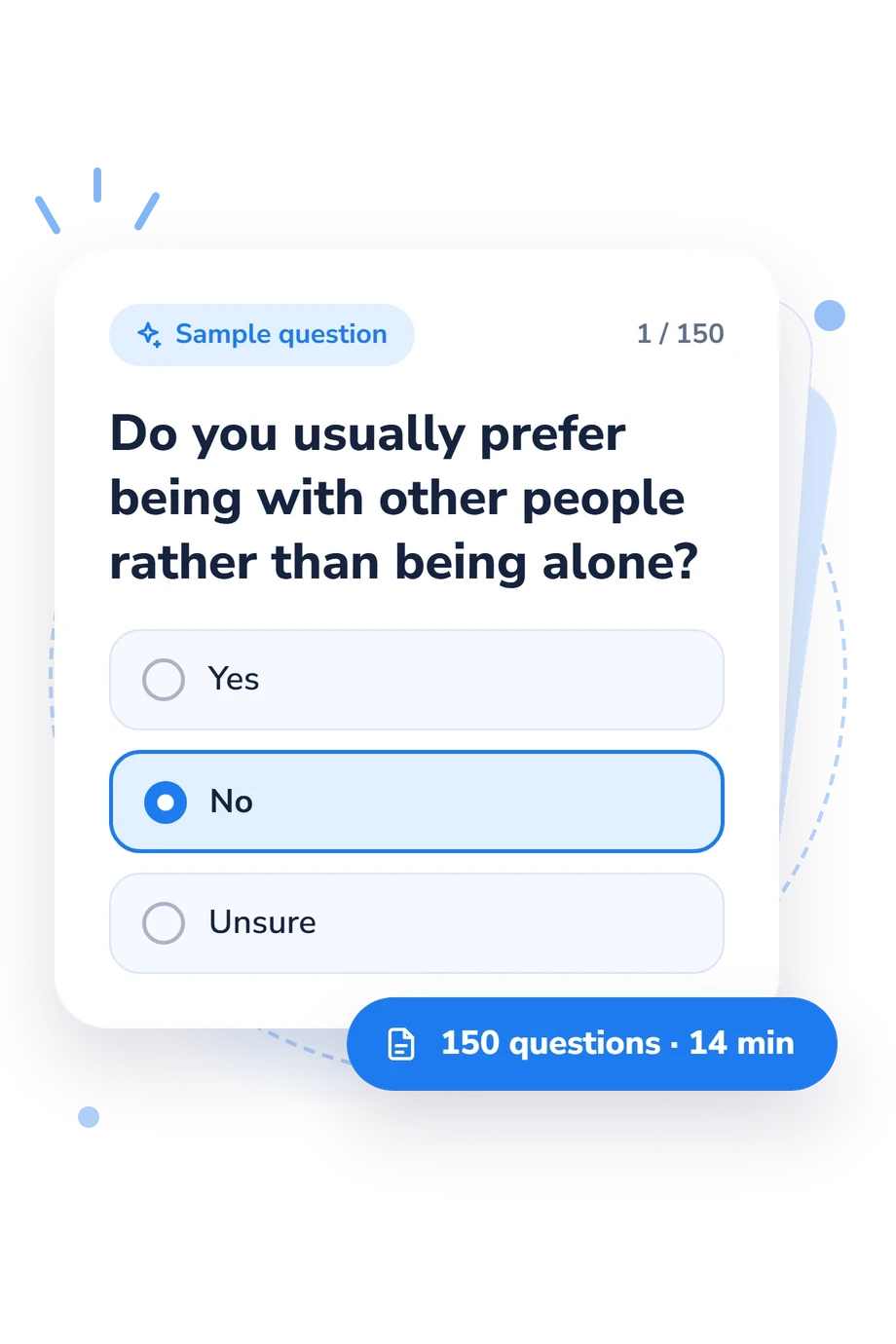
Example Questions From the Test
- Yes
- No
- Unsure
- Yes
- No
- Unsure
- Yes
- No
- Unsure
Psychological Safety–Insecurity Questionnaire (S-I) Test - Description and methodology of the test
People deciding whether to explore their current emotional outlook may use the Psychological Safety-Insecurity Questionnaire (S-I) Test to pause and organize personal impressions. As a psychological safety questionnaire, this assessment turns responses about everyday social and emotional experiences into a pattern that can support more focused self-reflection. The result can help a reader decide which feelings or situations deserve closer attention.
What This Assessment Explores
Questions focus on how a person experiences connection with others and their place in the world. They cover loneliness, acceptance, respect, usefulness, self-worth, inferiority, anxiety, happiness, fairness, confidence, and expectations about the future. This makes the questionnaire useful for examining recurring perceptions in relationships and daily life.
The displayed dimensions are:
- Psychological Safety-Insecurity (Flat Scale), -75-75, reflects the unweighted balance between safety and insecurity; Vulnerability is -75--1, and Psychological safety is 0-75.
- Psychological Safety-Insecurity (Weighted Scale), -200-200, gives selected responses more influence when estimating perceived psychological protection; Vulnerability / low safety is -200--1, and Psychological safety is 0-200.
Within this psychological insecurity assessment, higher scores indicate greater felt security, while lower scores indicate more vulnerability. The profile describes reported experience rather than fixed character.
Methodology and Scientific Basis
Items are brief self-report prompts answered with Yes, No, and Unsure, with a few using Not sure. They concern ordinary experiences, so the respondent selects the option matching their usual or current impression. The scoring key determines each response's contribution; counting yes answers alone cannot reproduce the result.
The two presentations use an unweighted and a weighted form. Selected responses receive different influence in the weighted version, while the flat version applies no differential weights. Both summarize the direction of the response pattern rather than a simple total of favorable answers.
The closest published basis is Maslow's Security-Insecurity Inventory, alongside Maslow's manual. This questionnaire is conceptually consistent with that work while remaining a separate online self-reflection format rather than the original inventory. Edmondson's work on psychological safety in teams contributes a related organizational perspective on learning.
Because this is a security-insecurity test, its results are best read with the item themes in mind. The bands are descriptive categories for this questionnaire rather than population comparisons, and a score is a snapshot shaped by current context, memory, self-awareness, and response candor rather than a clinical diagnosis.
- Maslow, A. H., Hirsh, E., Stein, M., & Honigmann, I. (1945). A clinically derived test for measuring psychological security-insecurity. The Journal of General Psychology, 33(1), 21-41. 10.1080/00221309.1945.10544493
- Maslow, A. H. (1952). Manual for the Security-Insecurity Inventory. Palo Alto, CA: Consulting Psychologists Press.
- Edmondson, A. C. (1999). Psychological safety and learning behavior in work teams. Administrative Science Quarterly, 44(2), 350-383. 10.2307/2666999
Updated: